Damp Rated Wine Cellar Light Fixtures: Which Zones Need Them
Choosing Between Them for a Specific Run
Sixty to seventy percent relative humidity, held without interruption for a decade, is an unusual thing to ask of a room. Most interior spaces in a house swing. A bathroom reaches saturation for twenty minutes after a shower and then dries out. A kitchen climbs while a pot boils and settles back by evening. A garage runs damp through one season and clears in another.
A wine cellar does none of that. It is commissioned to a setpoint and then held there indefinitely, for as long as the collection lives in it. Very few enclosed spaces in a house operate that way. A humidor is one. A walk-in cold room behind a restaurant kitchen is another. Past those, the list runs short.
That difference lands harder on the light fixtures than on almost anything else in the room. The overwhelming majority of residential luminaires are listed for dry locations, and that listing carries an assumption inside it: any moisture that arrives is temporary, and the space ventilates enough to clear it before it accumulates anywhere. A cellar's construction works against that assumption: vapor barrier on the warm side, sealed threshold, a gasketed door, and no ventilation path to the rest of the house.
What follows is what the three location listings actually say, what the two digits in an IP code encode and what they leave out, and which parts of a cellar warrant which specification.
What Dry, Damp, and Wet Listings Actually Say
These three are defined categories, and a fixture carries one of them as a mark applied by the testing laboratory that listed it. They are not manufacturer tiers.
Dry location: a place not normally subject to dampness or wetness. The definition allows for temporary dampness, a building under construction being the standard example, provided ventilation is adequate to keep moisture from accumulating. Bedrooms, hallways, dining rooms, and offices sit here. A fixture with no location mark at all is almost always dry-location only.
Damp location: a place normally or periodically subject to condensation of moisture in, on, or adjacent to the electrical equipment, including partially protected locations. The code-side language covers interior spaces subject to moderate degrees of moisture, and the examples given are some basements, some barns, and some cold-storage warehouses. Of those three, cold storage describes conditions closest to a cellar's.
Wet location: a place where water or another liquid can drip, splash, or flow on or against the equipment. Enclosed showers, open decks, exposed exterior mounting. A wet listing is the higher bar on water exposure, subject to the mounting sub-markings covered below.

The distinction that matters here is the one between dry and damp, and it is narrower than the words suggest. A damp listing addresses moisture and condensation on and around the fixture. It does not address direct water contact, and nothing in a properly built cellar should be producing direct water contact anyway. What the damp listing buys in a cellar is tolerance for a room that is permanently moist and never dries out.
What an IP Number Encodes, and What It Leaves Out
IP codes come from a different standard than the location listings, and the two are routinely quoted together despite measuring different things. An IP number is two digits, and each digit is its own scale.
First digit, solids: it runs 0 through 6 and describes protection against solid objects entering the enclosure. Zero is no protection. The middle of the range steps down through objects larger than 50 millimeters, 12.5, 2.5, and 1 millimeter. Five is dust-protected, meaning dust may enter but not in quantities that interfere with operation, and six is dust-tight. In a sealed cellar this digit does very little work.
Second digit, liquids: it runs 0 through 8 and describes protection against water arriving from outside the enclosure. One is vertically dripping water. Two is dripping water with the enclosure tilted up to 15 degrees. Three is spray up to 60 degrees off vertical. Four is splashing from any direction. Five and six are water projected from a nozzle, low pressure and high. Seven and eight are immersion, temporary and continuous.
Read that second scale again and notice what is absent from it. Every step describes liquid water arriving from somewhere, in a defined quantity, at a defined angle or pressure. None of it describes air held at high relative humidity for years. None of it describes vapor condensing onto a surface. The IP scale was written to grade ingress, and sustained humidity is not an ingress event.
That is why an IP number by itself is a weak answer to the cellar question, and why the location listing is the mark to look for first. A fixture can carry a respectable second digit and still be listed dry-location only, because the two systems are answering different questions. Ask for the listing. Treat any IP number on the sheet as supplementary detail.
Condensation Is a Surface Temperature Question
Condensation forms on a surface when that surface sits at or below the dew point of the air touching it. The dew point is not a property of the fixture. It is a property of the air in the room, set by temperature and relative humidity together.
Run the number for cellar air. At 55 degrees and 65 percent relative humidity, the dew point works out to roughly 43 degrees. That figure is a calculation from those two inputs and nothing else, and it is the most useful number in this entire subject, because it tells you how cold a surface has to get before water appears on it.
Now put a fixture in that air. A luminaire mounted inside the cellar sits at room temperature or slightly above it, since even an efficient LED puts some heat into its own housing. Room temperature here is 55 degrees, twelve degrees clear of the dew point. A fixture living entirely inside the cellar envelope is not going to sweat, and a damp listing is not there to solve condensation on the lens.
TIP: Dew point tracks temperature as much as humidity, so relative humidity alone cannot compare two rooms' condensation margins. A 55 degree cellar and a 68 degree tasting room, both at 65 percent, sit roughly 12 degrees apart in dew point.
The case that changes is a fixture whose body does not stay inside the cellar. A recessed housing extends through the ceiling plane into whatever sits on the other side. A wall-mounted fixture back-boxed into an exterior wall takes on part of that wall's temperature. Where the space beyond is warmer than the cellar, which is the usual arrangement in Southern California where cellars are built inside the conditioned envelope, the housing runs warm and stays clear. Where that space runs colder than the cellar, the housing becomes the coldest thing in the room and the margin to 43 degrees narrows quickly.
How Continuous Humidity Works on Fixture Materials
Setting condensation aside, moist air on its own is a load on materials, and it is the load a damp listing is largely built for.
Gasketing and sealing: a damp-listed luminaire is assembled with sealing at joints where a dry-listed one has none. A gasket at the lens, a sealed cable entry, a wiring compartment closed against room air rather than open to it. That construction is the working difference between the two listings, and it is what a specifier is actually buying.
Housing material and finish: aluminum housings develop surface oxidation in continuously moist air, which is invisible on a concealed fixture and obvious on an exposed one. Powder coat performs well as long as the film stays unbroken, since a chip at an edge gives moisture a start on the substrate underneath. Stainless hardware is the durable specification for anything mounted where it stays in view for the life of the room.
Fastener and hardware pairing: dissimilar metals in contact in permanently moist air corrode faster than either metal does alone. A plain steel screw driven into an aluminum housing is a common enough pairing to be worth naming on a schedule rather than leaving to whatever ships in the box.
Along the Orange County coast the air adds salt to that same chemistry, which is why brushed stainless and powder-coated components get specified on projects near the water where a painted steel equivalent would hold up fine inland.
Which Zones of a Cellar Warrant Which Listing
A cellar is not uniform, and writing one blanket note across the whole schedule either specifies past what several zones need or leaves a gap in the one that mattered.
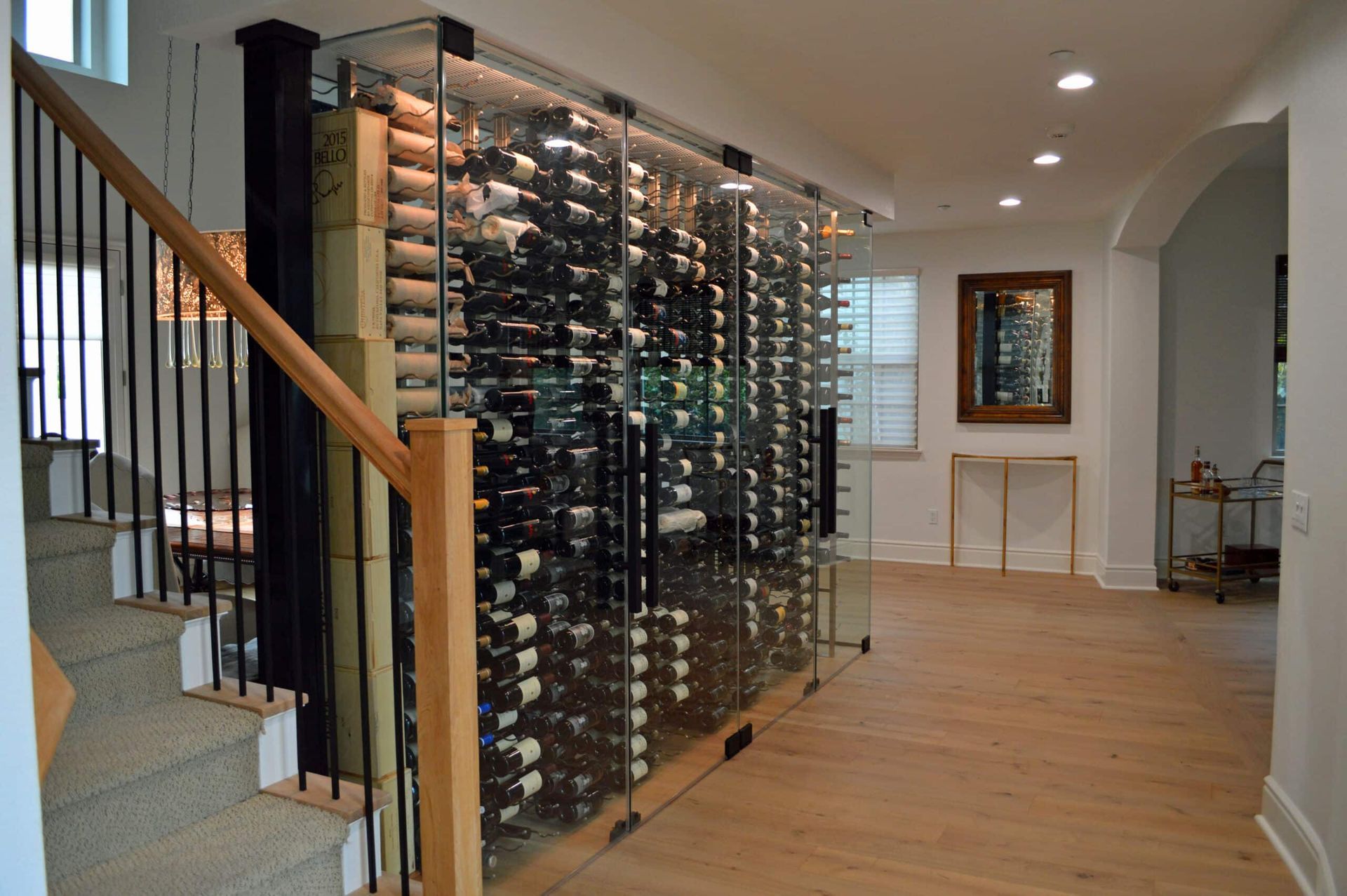
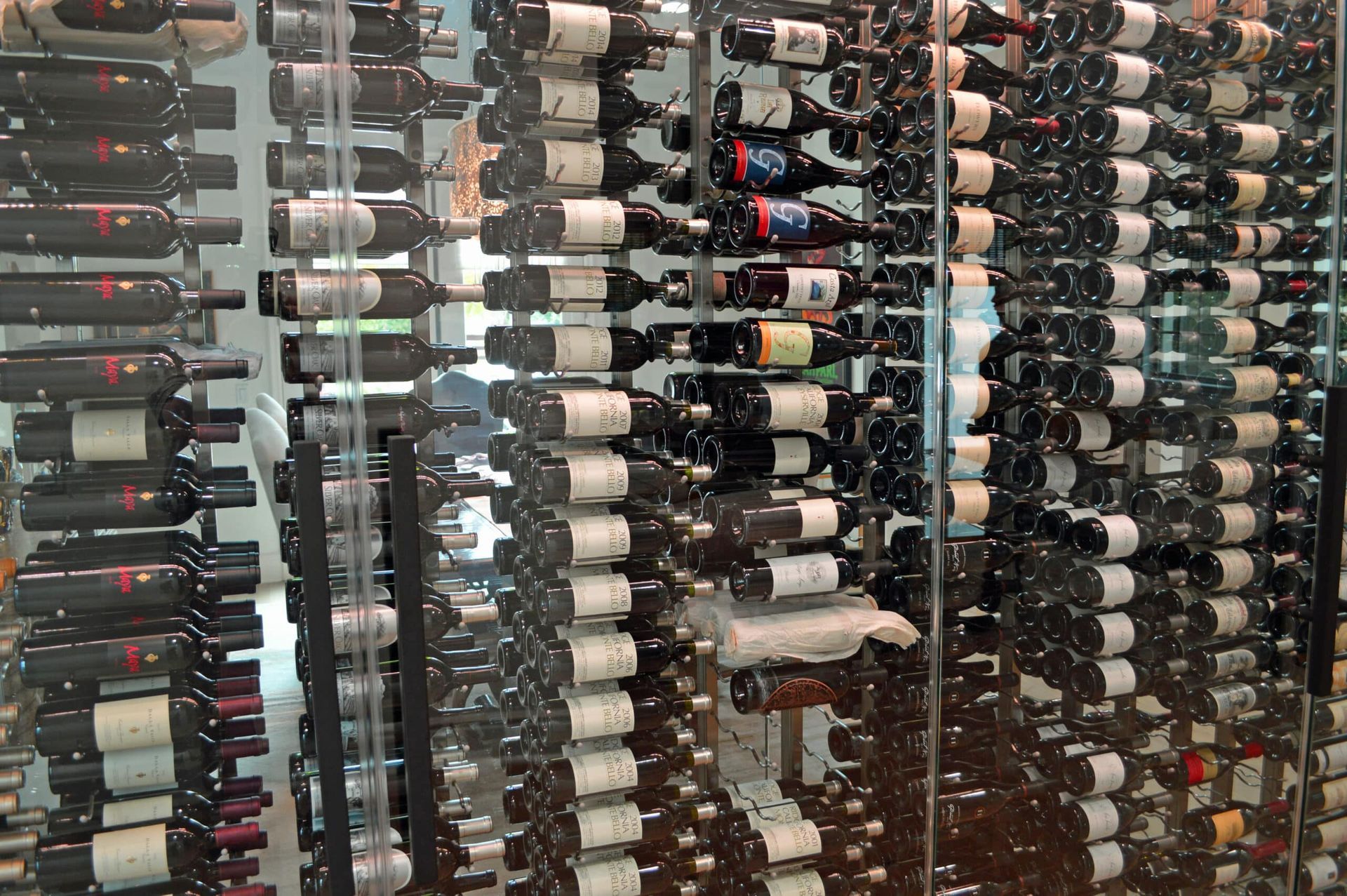
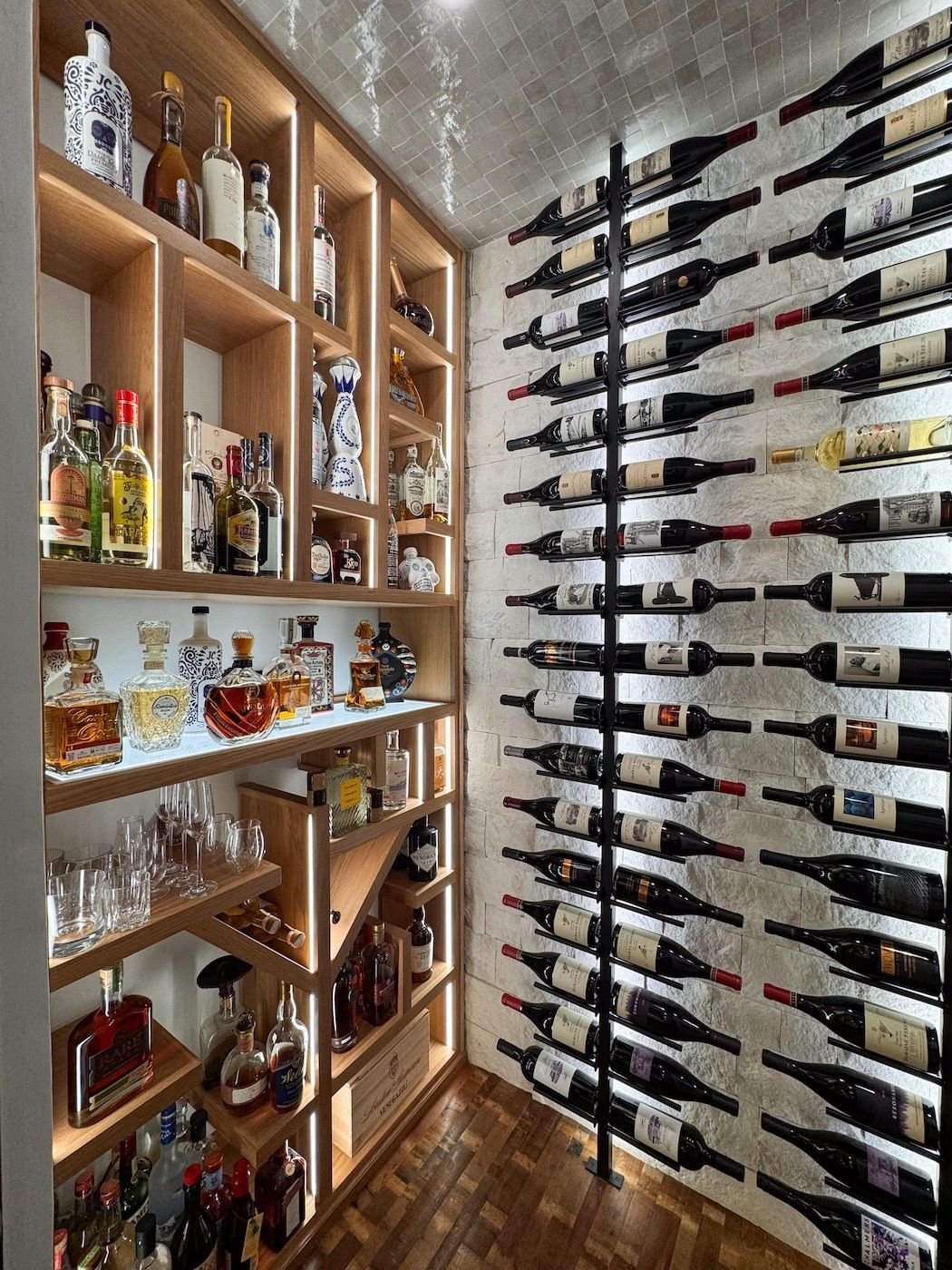
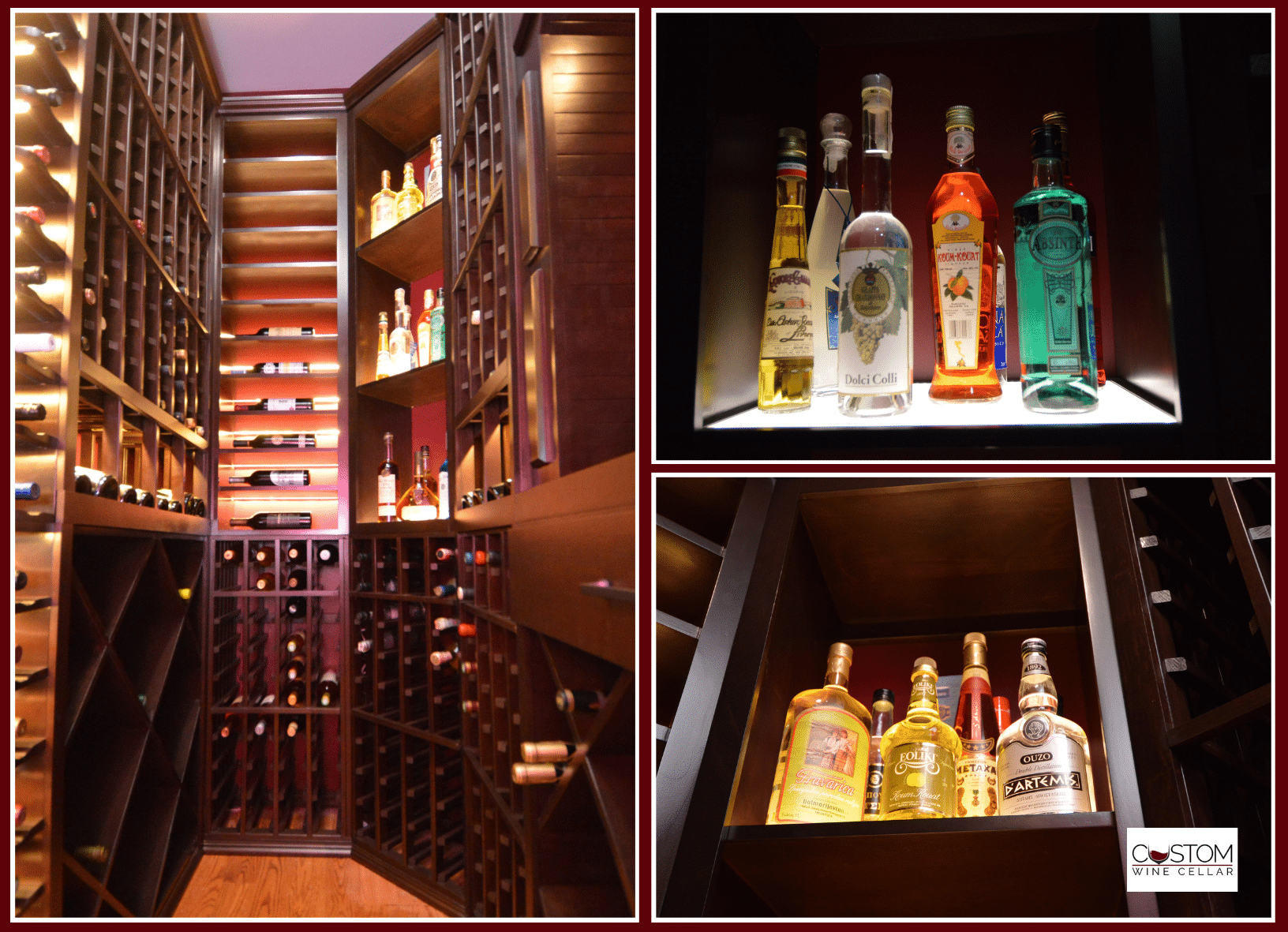
Inside the sealed envelope, exposed: rack-integrated runs, display niches, toe-kick fixtures, anything mounted on or into the racking. These sit in cellar air permanently and have no relief. Damp listing is the right call, and it is the right call on any fixture that becomes hard to reach once the racks are loaded.
Inside the envelope, recessed through a plane: ceiling cans and any fixture recessed through a wall or ceiling plane. Damp listing, plus two additional markings on the housing that the next section covers.
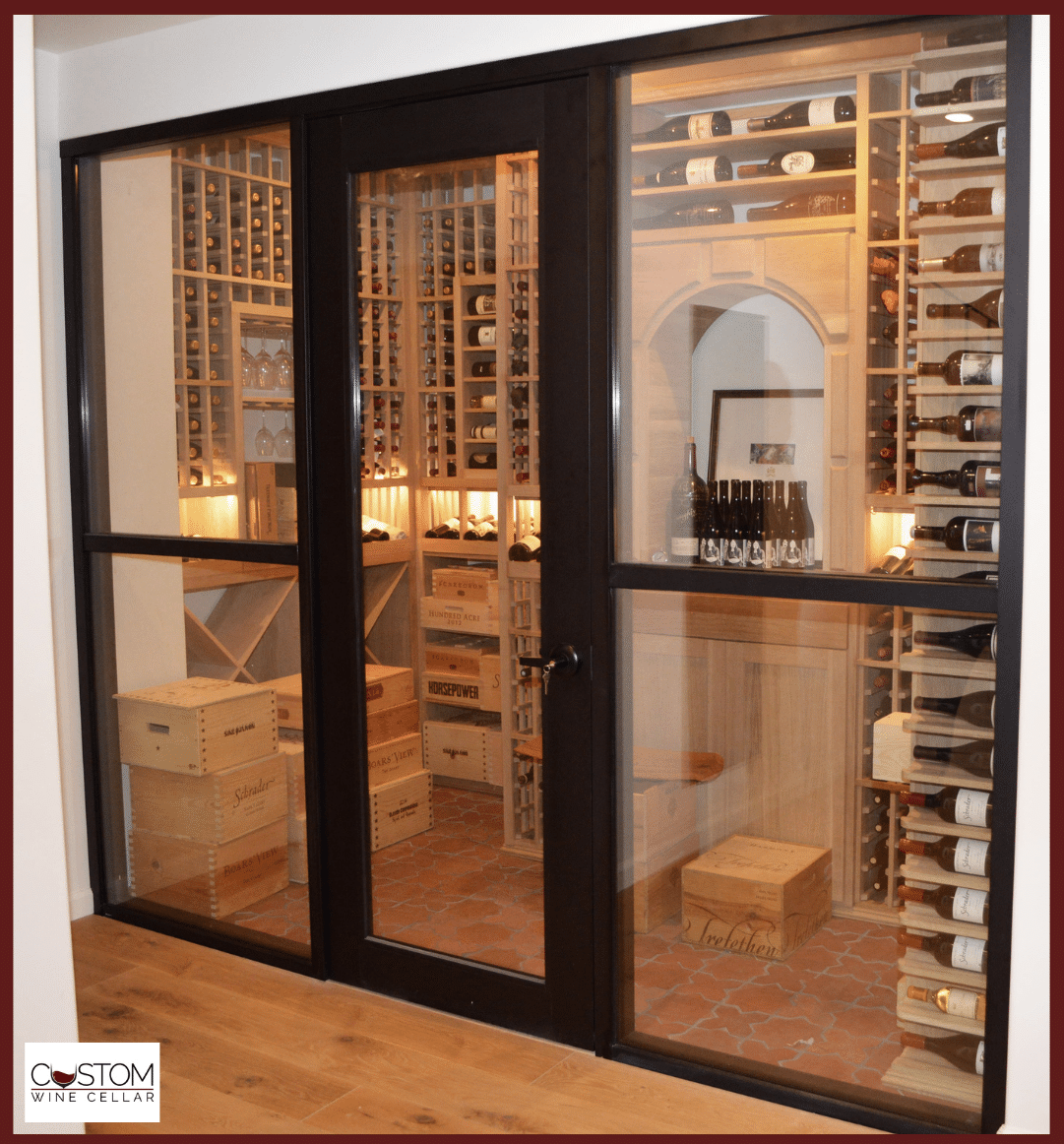
The door reveal and the glass: a glass cellar door is the coldest large surface in the assembly, and it is the surface that shows condensation first on its outer face when the marine layer sits over the coast in the morning. Fixtures mounted in or immediately beside a door jamb occupy the wettest microclimate the room produces. Damp listing there without argument.
Outside the envelope: the tasting area, the approach, anything on the warm side of the vapor barrier. Standard dry-location product is correct in those positions and there is no return in specifying beyond it.
One more component deserves a line: an LED strip run inside an unsealed channel extrusion is a separate case from a luminaire, since the extrusion is not a listed enclosure and behaves on its own terms.

The Recessed Housing Carries Two More Markings
A recessed fixture is the only category in a cellar where the listing on the trim is an incomplete specification. The housing behind it carries two additional markings, and they are unrelated to each other.
IC rating governs whether the housing may sit in direct contact with insulation. A non-IC housing requires a clearance from insulation on all sides, which means a deliberate void in the thermal layer at every fixture location. On a cellar ceiling built to the insulation values these rooms need, those voids add up across a fixture count.
Airtight is a separate, measured designation. A housing labeled airtight has been tested for air leakage by a standardized method, ASTM E283, at a set pressure difference across the assembly, and the threshold commonly written into energy standards is no more than 2.0 cubic feet per minute at 75 pascals. The same language calls for the housing to be sealed to the finished ceiling with a gasket or caulk, since a tight can set into a loose hole leaks regardless of its own rating.
For a cellar with a ceiling cavity above it, specify both. Air on the cellar side is being held at a humidity the surrounding assembly was never designed to carry, and any of it migrating upward reaches surfaces at temperatures nobody is controlling. Airtight IC housings are ordinary catalog items across the specification-grade downlight lines.
What Belongs on the Fixture Schedule
Specification language is where all of this either holds or quietly does not.
Name the listing, not a description: "Suitable for Damp Locations" is a mark a laboratory applies to a tested product. "Moisture resistant," "humidity rated," and "sealed construction" are manufacturer copy with no defined meaning behind them. If a cut sheet states no location listing, treat the fixture as dry-location only.
Call out housing material and finish separately: The listing says nothing about what the fixture is made of. Two damp-listed downlights, one in painted steel and one in powder-coated aluminum with stainless trim hardware, will look very different at year ten in the same room.
Schedule the recessed housing as its own line item: IC rating and airtight designation belong on the drawing alongside the trim and the lamp; neither should be assumed to arrive with them.
Assign the listing zone by zone: A single note reading "all fixtures damp rated" is faster to write and buries the reasoning. A schedule that assigns the listing by position tells a bidder what the room is doing and why, and it survives a value-engineering pass far better than a blanket instruction does.
One boundary worth stating plainly: choosing fixtures is a design and specification exercise, and the installation itself belongs to a licensed electrician working to the requirements that apply to the job.
Frequently Asked Questions
Can a dry rated fixture be made damp rated after it is installed?
No. A location listing applies to the fixture as the manufacturer assembled and marked it, and it covers that exact configuration. Adding a gasket, substituting a trim ring from a different product line, or sealing around a lens in the field puts the assembly outside what the laboratory tested, and the mark stops describing what is actually on the wall. The remedy for a wrong listing is a different fixture.
Does an ETL or CSA mark count the same as a UL mark?
Yes, for this purpose. UL, ETL, which belongs to Intertek, and CSA are all Nationally Recognized Testing Laboratories, and a damp-location listing from any of them carries equivalent weight. ETL and CSA marks turn up frequently on architectural and specification-grade lighting, so a fixture without a UL mark is not automatically unlisted. What matters is that some recognized laboratory has listed the fixture for damp locations and that the mark, with its control number, appears on the product itself.
What does the X mean in a rating written as IPX4?
It means that digit was never certified. An IP code has a fixed two-digit structure, so when a manufacturer tests only one of the two properties, an X holds the untested position. IPX4 tells you the enclosure passed splashing water from any direction and says nothing whatsoever about solid or dust ingress. Read an X as missing information rather than as a score of zero.
Is a wet rated fixture automatically the safer choice for a cellar?
Not automatically. Wet listings carry sub-markings that restrict orientation and mounting position. "Covered Ceiling Mount Only" approves water contact on the front face and not the back. "Suitable for Mounting within 1.2 m (4 Feet) of Ground" covers intermittent splashing at low level. "Suitable for Ground-Mounted Recessed" covers below-grade positions. A wet-listed fixture chosen without reading its sub-marking can be less appropriate to a rack position than a plain damp-listed one, and it often arrives in a heavier form factor with a deeper housing than the millwork was drawn around.
Is there anywhere in a cellar where condensation is supposed to form?
Yes, at the cooling system's evaporator coil. That coil is held deliberately below the room's dew point, which is the mechanism by which the system pulls moisture out of the air and holds relative humidity at a target instead of letting it drift. Water forming there is the equipment doing its job, and it leaves through a drain by design. The coil is the one surface in the room engineered to sit in the condensing range, which is precisely the reason nothing else should be anywhere near it.
Does a cellar humidifier change what fixtures I should specify?
It changes where the wettest air in the room sits. In markets where summer ambient runs above 110 degrees at roughly 20 percent relative humidity, Phoenix, Scottsdale, and Las Vegas among them, the system runs active humidification to hold the target rather than only removing moisture. Fixtures sitting in the discharge path of a humidification stage see conditions wetter than the room average, so that zone earns a damp listing even where the rest of the schedule would call it optional.
Check the location listing on every fixture before the cellar schedule goes out for bid — specifying it correctly at the drawing stage costs nothing and settles the question for the life of the room. Cachet Wine Cellars designs and builds custom wine cellars from Irvine, California, with a lifetime warranty on every installation. Call (949) 569 7857.
Recent Posts