
Basement Wine Cellars: The Ultimate Wine Storage
Basements offer something most other spaces don't: dedicated square footage, natural insulation from the surrounding earth, and the ability to build wine cellars of substantial capacity. A Manhattan Beach basement became home to 2,000+ bottles. A Pleasanton basement transformed from storage space into a 1,500-bottle wine room. Basements represent the ultimate blank canvas for wine cellar design.
Why Basements Are Ideal for Wine Storage
Basements offer natural advantages for wine storage that no other space can match. The earth surrounding basement walls provides thermal mass — a form of natural insulation that keeps temperatures far more stable than anything achievable in above-ground rooms. Concrete floors and walls further buffer the space against outdoor temperature swings, which is why basements have historically been the instinctive choice for wine storage, even before modern climate control existed.
Space is another compelling advantage. Basements offer square footage that homeowners often underutilize — a finished basement might accommodate a recreation room, a home office, or a guest bedroom, while an unfinished one sits largely empty. That unused footage is an opportunity waiting to be claimed. A 1,500-bottle wine cellar can take shape in basement space while still leaving room for storage, utility systems, and future projects.
The separation from main living areas is equally valuable. A basement wine cellar operates quietly and independently — the cooling system runs downstairs while life continues upstairs, with no intrusion on sound or climate. For serious collectors who want impressive capacity without a cellar encroaching on daily life, this separation is ideal. Long-term stability, however, may be the basement's most distinctive quality.
The earth itself maintains a relatively constant temperature year-round, meaning that even a sealed, unconditioned basement outperforms any above-ground space in terms of consistency. Add precision climate control, and the basement wine room becomes a reliable storage environment anywhere in the country — desert heat, coastal fog, and mountain cold all cease to be relevant concerns.
Converting Basements to Premium Wine Rooms
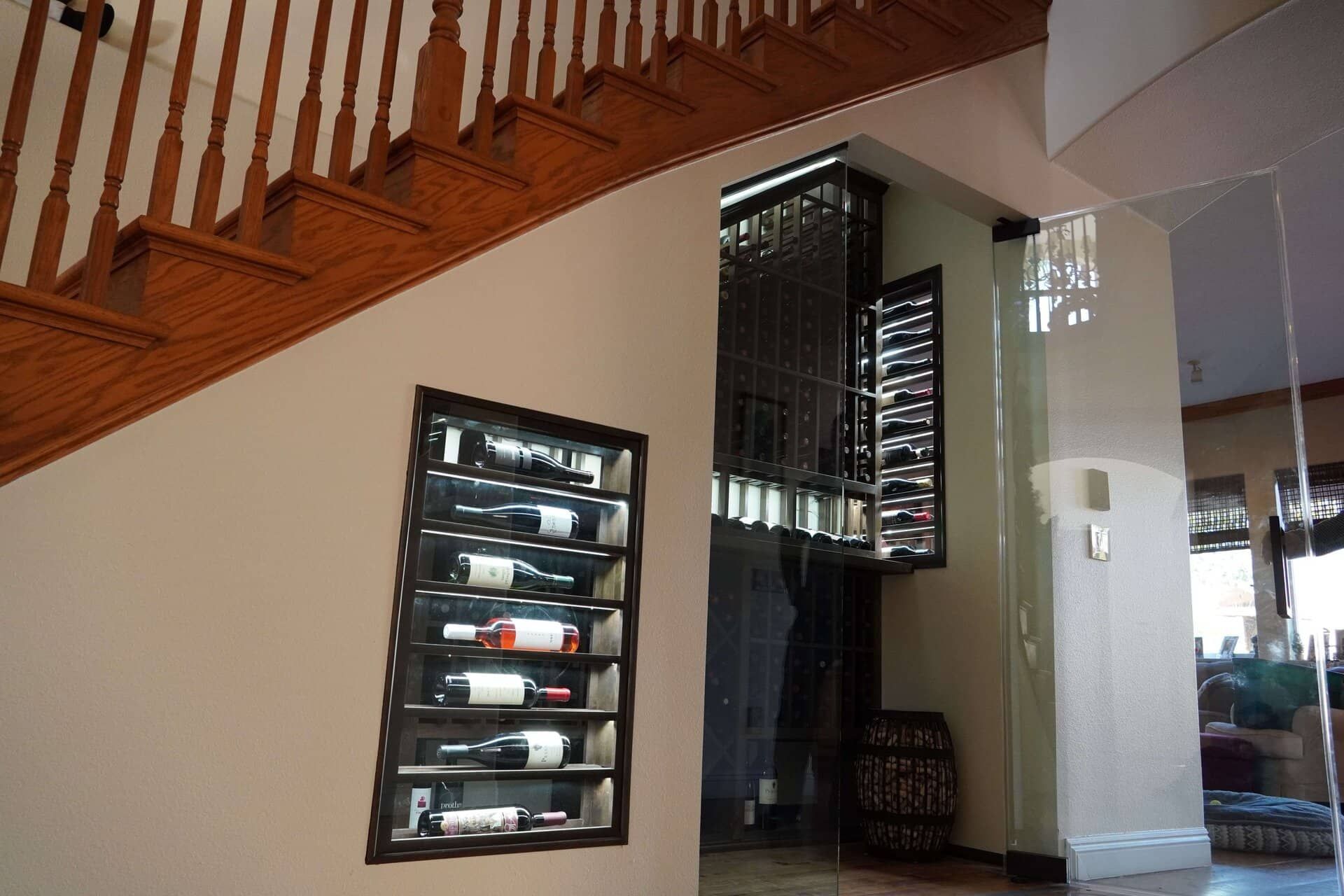
STAGE
01
Wall Preparation
We frame and insulate basement walls regardless of existing conditions. Spray foam insulation fills gaps and creates vapor barriers preventing moisture problems. Vapor barriers on concrete floors prevent ground moisture from rising and destabilizing humidity. Proper insulation means cooling system works efficiently and maintains stable conditions without overworking.
STAGE
02
Lighting in Basement Cellars
Basements lack natural light, making lighting important. We create inviting spaces using recessed ceiling lights preventing shadows, LED strips making bottles visible and attractive, and wall sconces creating ambiance. Goal is making basement wine rooms feel like intentional retreat spaces, not utilitarian storage areas.
STAGE
03
Finish Choices
Range from contemporary to traditional. Some basement cellars feature concrete floors polished to high gloss. Others use tile, stone, or hardwood. Walls can be left as finished concrete for industrial aesthetics, or finished with drywall and paint for traditional looks. Finishes should coordinate with collection's aesthetic and cellar's purpose.
STAGE
04
Structural Considerations
Basements sometimes include support columns, uneven floors, or plumbing that requires working around. These constraints force creative design that often becomes better than the original plan. Columns become architectural features. Uneven floors get leveled. Plumbing gets relocated. The result is a polished, intentional basement wine room, not a compromise.
Capacity & Organization in Large Cellars
Basement space unlocks a level of capacity that smaller installations simply cannot achieve. A 400-square-foot basement corner can hold 1,200 bottles using double- or triple-deep cable racking, while a 600-square-foot wine room can accommodate 2,000 or more. That kind of scale allows serious collectors to house their entire collection under a single climate-controlled roof, rather than splitting it between a basement corner, a cooling closet, and an off-site storage service.
Of course, large-capacity cellars only work if they are thoughtfully organized. Different sections should serve different purposes: a section for current-drinking wines positioned at a convenient height, a separate area for long-term aging bottles stored higher or deeper, and a dedicated display section for special bottles that deserve to be seen. A well-planned basement cellar becomes a curated space — not a repository, but a collection with intention and order.
Ease of access is just as important as capacity. The most frequently reached wines should sit at eye level, while display bottles earn prominent placement. In larger spaces, distinct temperature zones can be created for different wine types, tailoring conditions to each. Some clients go a step further, incorporating a small tasting area or decanting table — transforming the cellar from pure storage into a private retreat, a place not just to keep wine, but to appreciate it.
Climate Control Engineering for Basements
Basements benefit from natural temperature stability, but precision climate control remains essential. CellarPro systems by CalEng perform exceptionally well in basement environments, offering the efficiency and reliability that serious collections demand. For those seeking California-engineered solutions, the US Cellar Systems RMD series brings proper heat load calculation into the equation — accounting for the basement's inherent insulation properties to right-size the system from the outset.
Ducting strategy in a basement differs from above-ground installations. Rather than routing through attics, ductwork typically runs through rim joists or into adjacent utility areas. This keeps mechanical noise well away from the cellar itself while maintaining consistent performance throughout the space. Thoughtful ductwork design ensures even temperature distribution, even across larger installations where coverage might otherwise be uneven.
Humidity management benefits naturally from the basement's thermal mass, which resists the fluctuations that challenge above-ground spaces. That said, proper vapor barriers, careful sealing, and continuous humidity monitoring remain standard practice regardless. The result is a layered approach — the basement's inherent stability working in concert with precision climate control — that creates conditions as close to ideal as long-term wine storage can achieve.
Notable Basement Projects
Manhattan Beach 2,000-Bottle Basement
Five hundred square feet of unfinished basement space was transformed into a spectacular wine room for a homeowner with a serious collection and the capacity to match it. The space was insulated, sealed, and finished with care — white oak racking organized the bottles into distinct sections, while warm LED lighting created an atmosphere that was as inviting as it was functional. The cooling system ran silently in the background, maintaining perfect conditions without announcement. Stepping inside felt less like entering a basement and more like arriving at a wine country estate.
Pleasanton 1,500-Bottle Wine Room
A 600-square-foot basement conversion became a premium wine room for a homeowner who entertained frequently and wanted a space that could showcase a collection as beautifully as it preserved one. Cable racking, wooden racks, and display shelving were distributed across three distinct sections, creating both visual interest and functional organization. A small bar and seating area completed the space — not an afterthought, but a genuine retreat designed for appreciation as much as storage.
Together, these projects make a clear case
basements are not a compromise for wine storage — they are, when properly designed, among the finest locations available. Natural insulation, dedicated square footage, and separation from the main living areas give basements inherent advantages that above-ground spaces cannot replicate. Paired with precision climate control and thoughtful design, they become ideal homes for substantial collections — spaces where wine can be stored, preserved, and genuinely appreciated across generations.
