
Restaurant Wine Cellars: Wine Program as Revenue
For restaurants, a wine program is integral to your identity, your margins, and your guest experience. At Cachet Wine Cellars, we've built cellars for Hell's Kitchen at Harrah's San Diego (2,500+ bottles), Nicco's Steakhouse at Durango Casino Las Vegas (4,000+ bottles), and dozens of independent restaurants throughout California. We know that restaurant wine cellars must balance preservation, accessibility, and visual impact.
The Challenge: Managing Inventory & Margins
Most restaurants struggle with the same wine program basics: keeping inventory in proper conditions, making selections accessible to staff, creating visual appeal, and driving sales. Impressive wine lists are often undermined by mediocre storage — bottles cramped, disorganized, and exposed to temperature fluctuations that damage them over time. That damaged inventory is a direct loss. Guests who can't see a quality selection simply don't order, and that's lost revenue.
A proper restaurant wine cellar solves all of this. It protects inventory by maintaining perfect conditions, organizes bottles so staff can locate and retrieve them efficiently, and displays premium selections where guests can see them — creating the visual excitement that drives orders. With wine margins running 40 to 60 percent, a well-executed program is among the most profitable in the house.
Display vs. Storage: Separation of Concerns
STAGE
01
Front-of-House Display
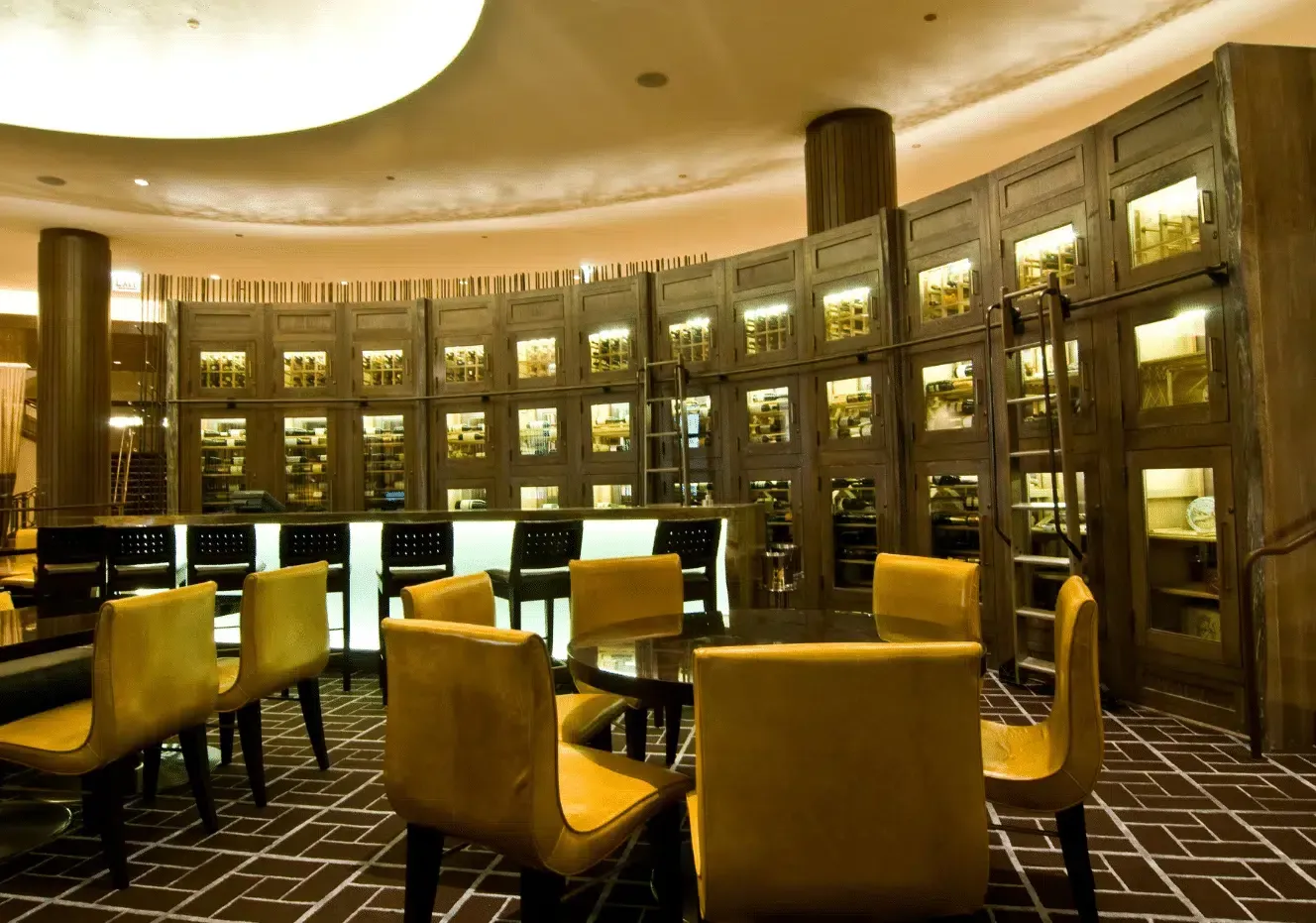
A glass cellar or wine wall visible from the dining room — showcasing 300 to 500 premium selections — turns the collection into a sales tool. Hell's Kitchen demonstrates this perfectly: dramatic acrylic racks displaying 2,500 bottles from the bar area, where the visual impact alone drives wine orders. Lighting makes bottles glow, labels stay readable, and guests order what they can see.
STAGE
02
Back-of-House Storage
A separate climate-controlled storage cellar keeps remaining inventory in perfect condition until it's needed for service. Organization is the priority here — staff should be able to locate and pull any bottle quickly and efficiently. Unlike the display cellar, this space can be entirely utilitarian: dark, cool, and orderly. Perfect preservation and easy accessibility are the only goals.
STAGE
03
Optimal Workflow
The display cellar shows guests what's available; the storage cellar maintains the full inventory behind the scenes. Staff who know where every wine lives can serve efficiently and confidently. Guests who can see the collection — and trust it has been properly cared for — order more frequently and spend more. That confidence translates directly into higher check averages.
Notable Restaurant Projects
STAGE 1
Distribution Model
Back-of-house storage handles bulk inventory — working stock, backup bottles, and high-volume SKUs — while the front-of-house display features 100 to 200 carefully chosen showpiece bottles visible to diners. Display selections are curated for visual impact: beautiful labels, premium positioning, sommelier recommendations. Diners order from the full wine list but are influenced by what they see. Staff bridge the gap when needed, guiding guests from display wines to suitable list alternatives. The result is maximum visibility with no sacrifice to inventory efficiency.
STAGE 2
Temperature Zones
A service zone maintained at optimal tasting temperature allows wines to express their full flavor profile, while a separate aging zone held at 50°F accommodates long-term storage — some premium bottles resting five to ten years before service. White wines require their own service thermostat, typically around 45°F. Multi-temperature designs cost more, but the quality differentiation they deliver sets a wine program apart in ways guests notice.
STAGE 3
Sommelier Workspace Design
Effective wine service depends on a functional workspace. A counter with point-of-sale integration streamlines ordering, while dedicated storage for tools — foil cutter, corkscrew, wine key — keeps service moving without interruption. Wine lists, pairing notes, and tasting notes should all be within easy reach. Temperature monitoring visible from the service area allows the sommelier to keep an eye on cellar conditions without stepping inside. Together, these details improve both service speed and sommelier efficiency.
STAGE 4
Revenue Impact
Wine locker programs offer individually climate-controlled storage for guest collections, creating a distinctive amenity at country clubs, high-end restaurants, and private clubs alike. At Brae Burn Country Club, for example, guest wine lockers serve a dual purpose — generating a reliable recurring revenue stream while meaningfully enhancing the value of membership. It is the kind of offering that rewards loyalty and gives members a reason to return.
STAGE 5
Wine List Architecture
Successful restaurant wine programs balance accessibility with aspiration across a clear pricing structure. Entry-level wines serve guests seeking quality without premium pricing; mid-range selections target serious enthusiasts; premium bottles showcase rare and collectible offerings; and a reserve program featuring ultra-premium selections invites sommelier consultation. Each tier serves a purpose — entry-level wines move volume, premium selections generate stronger margin per bottle, and the full range ensures broad appeal while capturing every guest segment. The result is a program that works as hard for the casual diner as it does for the committed collector.
STAGE 6
Sommelier Workspace Optimization
Professional wine service depends on a thoughtfully designed workspace. Point-of-sale integration speeds up ordering; dedicated storage for foils, corkscrews, aerators, and wine keys keeps service uninterrupted. Wine lists, pairing notes, tasting notes, and vintage information should all be immediately accessible. Temperature monitoring visible from the service area lets the sommelier respond proactively to any drift without entering the cellar. Proper glassware storage — separate stems for reds, whites, Champagne, and dessert wines — completes the setup. Every detail here serves the same goal: faster service, greater sommelier efficiency, and a better guest experience.
STAGE 7
Pairing Strategy & Training
Successful restaurants invest in staff wine education. Monthly sommelier-led tastings build the tasting experience and pairing logic that give servers genuine confidence when making recommendations. Basic principles — light wines with fish, fuller wines with meat, Champagne with appetizers — become second nature. For more serious diners, the sommelier remains available for in-depth consultation. That combination of informed staff and expert backup translates directly into higher wine sales, with well-trained teams typically driving a 10 to 15 percent increase. The annual training investment pays for itself.
STAGE 8
Revenue Impact Analytics
High-quality wine programs increase check averages by 15 to 25 percent, with premium pairings sold to 40 to 60 percent of tables generating per-bottle revenue that often exceeds entrée revenue. Wine markup of 300 to 400 percent outpaces food markup of 200 to 250 percent, making the wine program one of the most profitable lines in the restaurant. A 150-seat restaurant running 40 percent occupancy — roughly 60 covers nightly — generates approximately 21,900 annual covers. At a 40 to 60 percent wine attachment rate, that means 8,760 to 13,140 wine sales per year, with a 60 percent gross margin turning the program into a significant annual profit center. That profitability justifies both the infrastructure investment and a dedicated sommelier. Design, however, must match the ambition of the program. A restaurant wine cellar requires architectural expertise that complements the broader interior — contemporary spaces demand modern cellar design; traditional rooms call for classic detailing. Materials matter: premium wood species like walnut and oak, high-quality glass, brushed steel hardware. Construction details matter equally — precision door frames ensuring perfect seals, professional cooling integration, sophisticated lighting. A poorly designed cellar undermines the restaurant's reputation; a well-designed one reinforces brand perception at every service. The design investment is justified not just through operational efficiency, but through the guest experience it creates.
STAGE 9
Inventory Management & Technology
Successful restaurants use technology to manage their wine programs with precision. Point-of-sale integration tracks sales by bottle, by sommelier, and by guest preference. Inventory management systems monitor stock levels and alert staff before they fall below par. Barcode systems prevent lost bottles and deter theft, while vintage tracking ensures proper rotation. Cost tracking calculates per-pour margins and identifies which selections are driving profitability — and which aren't. The annual technology investment pays for itself through revenue optimization, loss prevention, and the kind of data-driven decisions that steadily improve program performance.
STAGE 10
Staff Retention & Expertise
Quality wine programs attract professional sommelier talent — and that talent justifies its cost. A skilled sommelier builds guest relationships, drives higher check averages through well-timed recommendations, and elevates the overall dining experience in ways that are difficult to replicate. Ongoing investment in certification, tasting education, and pairing development improves both service quality and staff satisfaction. Reputation compounds the benefit: top sommeliers seek out restaurants with serious wine programs, and those who join tend to stay longer — continuity that deepens guest relationships and strengthens the program over time.
Wine Program Management & Staff Training
Organization System
Wines should be organized by region, varietal, or price point — whichever reflects the structure of the wine list. Staff training ensures everyone knows where every bottle lives and can retrieve it without hesitation. Organization is what turns a well-stocked cellar into a functional one.
Temperature Consistency
55°F is ideal for mixed collections, though some restaurants maintain separate zones — a warmer setting for reds, 50°F for whites. The Wine Guardian Pro Series integrates with smart systems to deliver precise temperature management across multiple zones.
Inventory Management
Modern POS systems integrate with wine inventory tracking. You know what's sold, what needs reordering, what's aging properly. This data drives purchasing and wine list decisions.
The Revenue Impact
Restaurant wine margins average 40 to 60 percent. A 300-bottle display of premium selections can generate meaningful monthly wine revenue; a 4,000-bottle total program, properly positioned and priced, can produce substantially more annually.
These aren't theoretical numbers. Restaurants with visible, well-managed wine programs consistently outsell those with hidden inventory. The visual impact drives emotion, the quality signal builds credibility, and the accessibility enables impulse orders. A well-executed wine program returns multiples of its cost within two to three years through volume and margin improvement alone.
Beyond revenue, the wine program becomes a brand differentiator. A restaurant known for a serious collection attracts enthusiasts who order more, spend more per visit, and recommend the venue to others. That reputation is a competitive advantage that compounds over time.
