
What Determines Wine Cellar Cost?
The question we hear most often from prospective clients is: "How much does a wine cellar cost?" The honest answer is that it depends on your specific needs, space, and vision. Rather than offer generic numbers, we want to help you understand the factors that actually drive project costs — so you know what questions to ask designers, understand why two cellars can have dramatically different price points, and make decisions that align with your priorities. Use our cost calculator to get a preliminary estimate based on your space and requirements, then schedule a consultation for a detailed quote.
Price is the Third Most Common Question
After 'Do I have the space?' and 'How long will it take?', cost is always the next concern — and that's completely rational. You're making a significant investment. But here's what we've learned: 'average cost' conversations aren't actually helpful. A 200-bottle closet cellar with a through-wall cooling unit and simple wooden racking is an entirely different project than a 2,500-bottle walk-in with ducted climate control, mahogany cabinetry, and smart home integration. Comparing their costs is meaningless. Instead, we want to help you understand what actually drives project decisions, so you can think clearly about your own situation.
The Seven Factors That Shape project
Understanding these factors will clarify what your project actually involves and why different approaches have different costs.
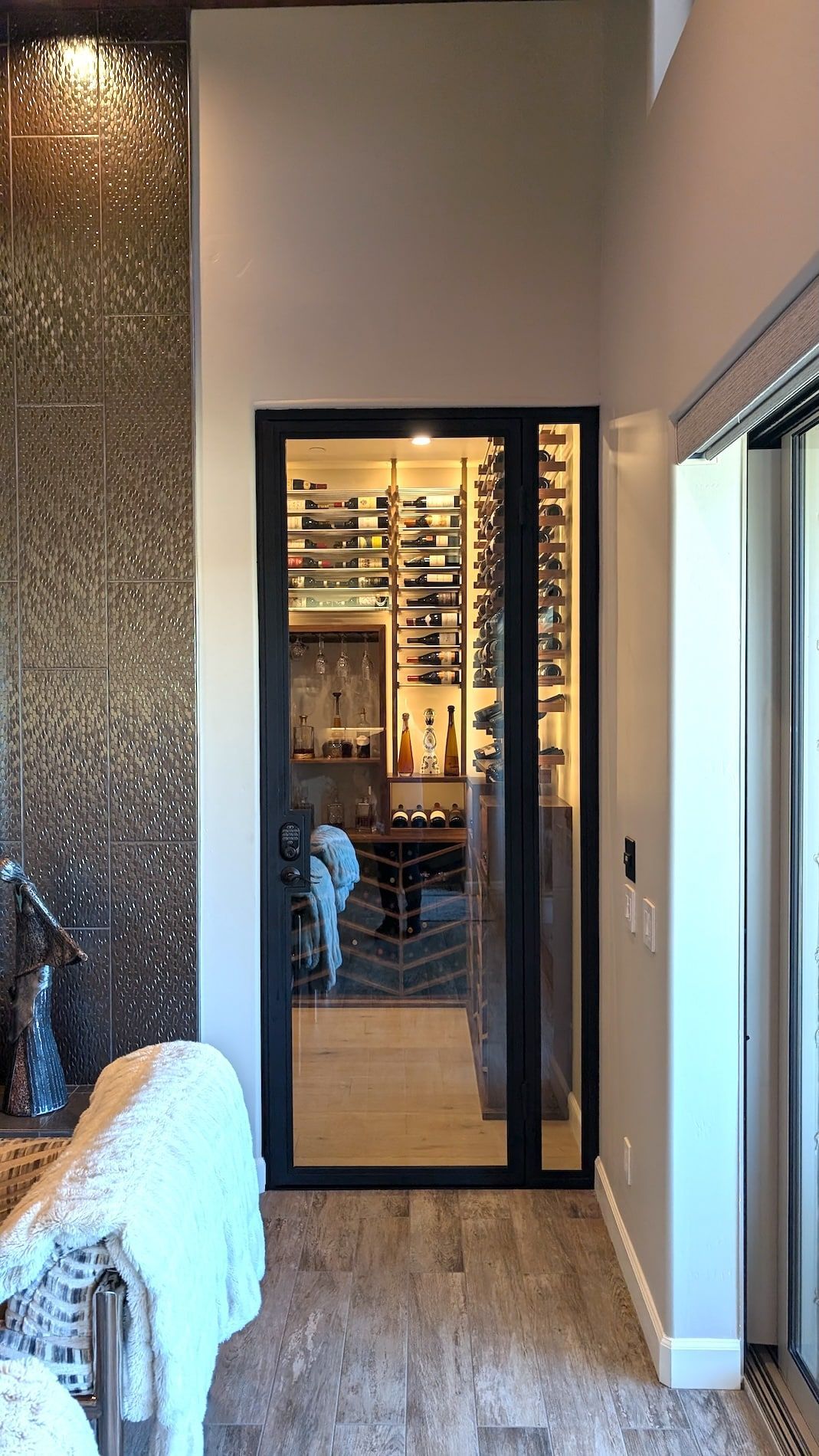
01
Cellar Size & Bottle Capacity
Size is the foundation. A 100-bottle closet conversion involves a fundamentally different scope than a 500-bottle dedicated room, which differs again from a 2,500-bottle commercial installation. Larger cellars naturally require more materials, more labor, and more complex cooling systems — but size alone doesn't determine everything. A 300-bottle cellar built with premium Spanish cedar and custom cabinetry will carry a higher price than a 500-bottle cellar with basic wooden racks and a simple cooling unit. Size matters, but it's just the starting point.
02
Construction Requirements
Where you're building shapes, complexity significantly increases. An under-stairs conversion — like our 350-bottle Anaheim Hills project — means working within an existing structure, managing airflow around stairs, and routing ducts creatively. A basement conversion may require vapor barrier installation, dehumidification solutions for humid climates, and potentially drainage work. An upper-floor dedicated room brings its own challenges: insulation requirements, HVAC routing, and electrical needs. A commercial installation like Hell's Kitchen at Harrah's adds commercial-grade cooling systems and food safety considerations on top of everything else. Every location type carries unique demands that directly shape the project scope and cost.
03
Cooling System Type & Capacity
Cooling is often the largest single cost component. A self-contained through-wall unit like WhisperKOOL is simpler and less expensive than a ducted system that runs cooling lines through walls or attics. Ducted systems — Wine Guardian Pro Series, CellarPro with attic installation — offer real benefits: hidden mechanics, quieter operation, and scalability, but they require greater installation complexity. Split systems with remote compressors add noise and flexibility advantages at an additional cost. Capacity also matters significantly — cooling a 100-bottle closet requires a 400–500 BTU unit, while a 2,000+ bottle cellar may need 5,000+ BTUs, and larger units cost more. Smart home integration with Crestron, Nest, or Honeywell adds meaningful capability but increases the project budget accordingly.
04
Materials & Finishes
Racking materials drive visible costs significantly. Spanish cedar delivers warmth and tradition, while metal racking systems — stainless steel, chrome, and black chrome — carry different cost profiles entirely. Custom cabinetry with built-in displays costs more than simple racking, and door selection makes a meaningful difference, too: a basic door versus a glass-insert Barolo door, like our Mission Viejo project's knotty Alder with beveled glass, represents a substantial price gap. Finishes — natural lacquer, stains, and paint colors — add further cost, as does lighting. LED panels and RGB systems with remote control are increasingly popular choices that can noticeably escalate the overall project budget.
05
Design Complexity
A straightforward rectangular room with simple racking is relatively easy to design and build. Custom architectural elements — curved walls, angled ceilings, built-in seating, tasting tables, and archways with display areas like the custom knotty Alder arch in our Mission Viejo cellar — increase both design and construction effort considerably. Glass walls and sophisticated enclosures cost more than standard drywall, and smart home integration, automated lighting, or remote-controlled RGB systems add further complexity and budget. Custom 3D design work adds upfront cost but pays for itself by preventing costly mistakes during construction.
06
Geographic Location & Labor Market
Labor costs vary meaningfully across Southern California, Nevada, and Arizona, and differ further from other regions nationwide. We work through a trusted network of builders and designers, and those regional rate differences are real. A Miami installation may carry a different cost profile than a Denver installation, driven not just by labor availability but also by climate-specific requirements. Miami's humidity challenges, for instance, demand more sophisticated dehumidification approaches than a drier desert climate would require. These regional factors matter and should be part of any honest cost conversation.
07
Timeline & Staging
The project timeline directly affects cost. A rushed 6-week build requires more coordinated labor and potentially premium materials to meet the schedule, while a 4-month timeline allows for better labor sequencing and cost optimization. Staged projects built in phases may also carry different economics than all-at-once builds. Your timeline flexibility, combined with project complexity, plays a meaningful role in shaping what the final investment looks like.
Comparing Cellar Approaches
Rather than specific numbers — which vary by project — here's how we think about different approaches and what they typically involve:
Entry-Level Approach
A 100–150 bottle closet conversion with through-wall self-contained cooling, simple wooden racking, a basic door, and standard lighting. The emphasis is on functionality, space efficiency, and straightforward installation.
Mid-Range Approach
A 300–500 bottle dedicated room or under-stairs conversion with ducted climate control and smart home capability, premium wood racking in Mahogany or Redwood, glass display areas, and LED lighting. The emphasis is on balanced aesthetics and function, better climate precision, and a more refined appearance
.
Premium Approach
An 800+ bottle dedicated space or commercial-scale installation with sophisticated ducted or split cooling and remote monitoring, custom cabinetry in Spanish cedar or mahogany, glass walls or sophisticated enclosures, RGB lighting with full control, and potentially an integrated cigar humidor, tasting table, or wine lockers. The emphasis is on an architectural showpiece with maximum collecting capacity, smart home integration, and commercial-grade reliability.
Each approach represents a valid decision made for different situations. The entry-level approach solves a real problem for someone with 100 bottles and limited space. The premium approach makes sense for a collector with 2,000+ bottles who wants a centerpiece for their home. Neither is inherently better — they're simply different solutions for different needs.
Why We Don't Publish Pricing
We don't list specific costs because they're genuinely variable. Two projects we quote might both be described as "a 400-bottle residential cellar," yet one could be a basement conversion requiring concrete wall vapor barriers, while the other is a climate-controlled closet in a finished room. One might include full smart home integration; the other, a standard thermostat. Those details drive the final cost significantly. Our consultation process is specifically designed to understand your situation, scope your project accurately, and provide transparent pricing based on your actual needs — not generic estimates that don't apply to your space.
Project Considerations Beyond Initial Build
We don't list specific costs because they're genuinely variable. Two projects we quote might both be described as "a 400-bottle residential cellar," yet one could be a basement conversion requiring concrete wall vapor barriers, while the other is a climate-controlled closet in a finished room. One might include full smart home integration; the other, a standard thermostat. Those details drive the final cost significantly. Our consultation process is specifically designed to understand your situation, scope your project accurately, and provide transparent pricing based on your actual needs — not generic estimates that don't apply to your space.
FAQ: Understanding Wine Cellar project
Why is climate control often the largest cost element?
Cooling systems are engineered equipment. A properly sized system — accounting for your cellar's volume, smart home integration, and precision controls — involves significant technology and labor. That investment is worth it because improper or undersized cooling systems fail, and a failing cooling system can destroy an entire wine collection. This is not an area to cut corners.
Can I reduce the project by starting with basic cooling and upgrading later?
Partially, but there's an important catch. Switching from a through-wall unit to a ducted system later requires significant reconstruction. It's far better to plan for your final cooling approach from the start. We're happy to discuss phased approaches during the consultation to find the right balance for your budget.
Does location (under stairs vs. basement vs. dedicated room) dramatically affect the project?
Yes, meaningfully so. Under-stairs conversions are often more cost-efficient due to their smaller footprint and simpler HVAC routing. Basements introduce vapor barrier requirements and potential dehumidification complexity. Dedicated room builds offer the most flexibility but require complete construction from scratch. Each location type carries its own cost implications that we walk through during the scoping process.
Should I invest in smart home integration from the start?
If you already have smart home systems — Crestron, Nest, or Honeywell — Wine Guardian Pro Series integration is absolutely worthwhile and significantly easier to install during the initial build than to retrofit later. If smart home systems aren't part of your home, standard cooling controls are completely adequate and will perform reliably.
What's the relationship between collection size and the cellar project?
A: General scaling applies — 100 bottles requires a different scope than 500, which differs again from 2,000. But the relationship isn't linear. A 500-bottle cellar with premium materials and smart integration can cost more than a 1,000-bottle cellar built with basic materials. Design choices matter just as much as size, which is why we scope each project individually.
