
Custom Wine Racks That Define Your Cellar's Character
Your wine racks aren't furniture—they're architectural features that determine how your collection is stored, displayed, and experienced. At Cachet Wine Cellars, we design custom wine racking in premium materials (natural alder, mahogany, redwood, stainless steel, cable systems, acrylic) that scale from intimate 200-bottle closet conversions to sprawling 4,000+ bottle basement installations. Our custom wine cellar racks solve four problems simultaneously: maximizing bottle capacity, maintaining proper airflow for climate control, creating visual balance and sophistication, and making bottles accessible. We've installed traditional wooden racks in high-end residential cellars and commercial-grade metal systems in restaurant display rooms. The right racking transforms your cellar from a storage closet into a destination.
What Most Wine Collectors Don't Know About Racking Design
Most people think racking is simple: drill holes, install shelves, fill with bottles. In reality, racking decisions cascade through your entire cellar.
First: racking depth affects cooling system sizing. A 16-inch-deep rack with two rows of bottles (double-deep storage) requires 40% more cooling capacity than a 10-inch single-depth rack with the same footprint—because airflow must circulate through stacked bottles. Undersized cooling + deep racking = temperature instability.
Second: racking material affects temperature regulation. Metal racks conduct heat more than wood, so a metal commercial display near a door or window requires different cooling specs than wooden racks in an interior wall space.
Third: racking configuration (cork-forward vs. label-forward, diamond bins vs. individual bottles) affects visual weight and perceived collection size. A cellar with 1,500 bottles in diamond bins and display rows feels more curated and impressive than 1,500 bottles packed tightly in cork-forward racks. Layout is psychology, not just geometry.
Fourth: accessibility matters more than capacity. A perfectly packed cellar where you can't access bottles without moving five neighbors is a failed design. The best racking balances maximum capacity with easy access and visual flow.
Premium Wood Racking: Five Species, Different Character
01
Natural Alder
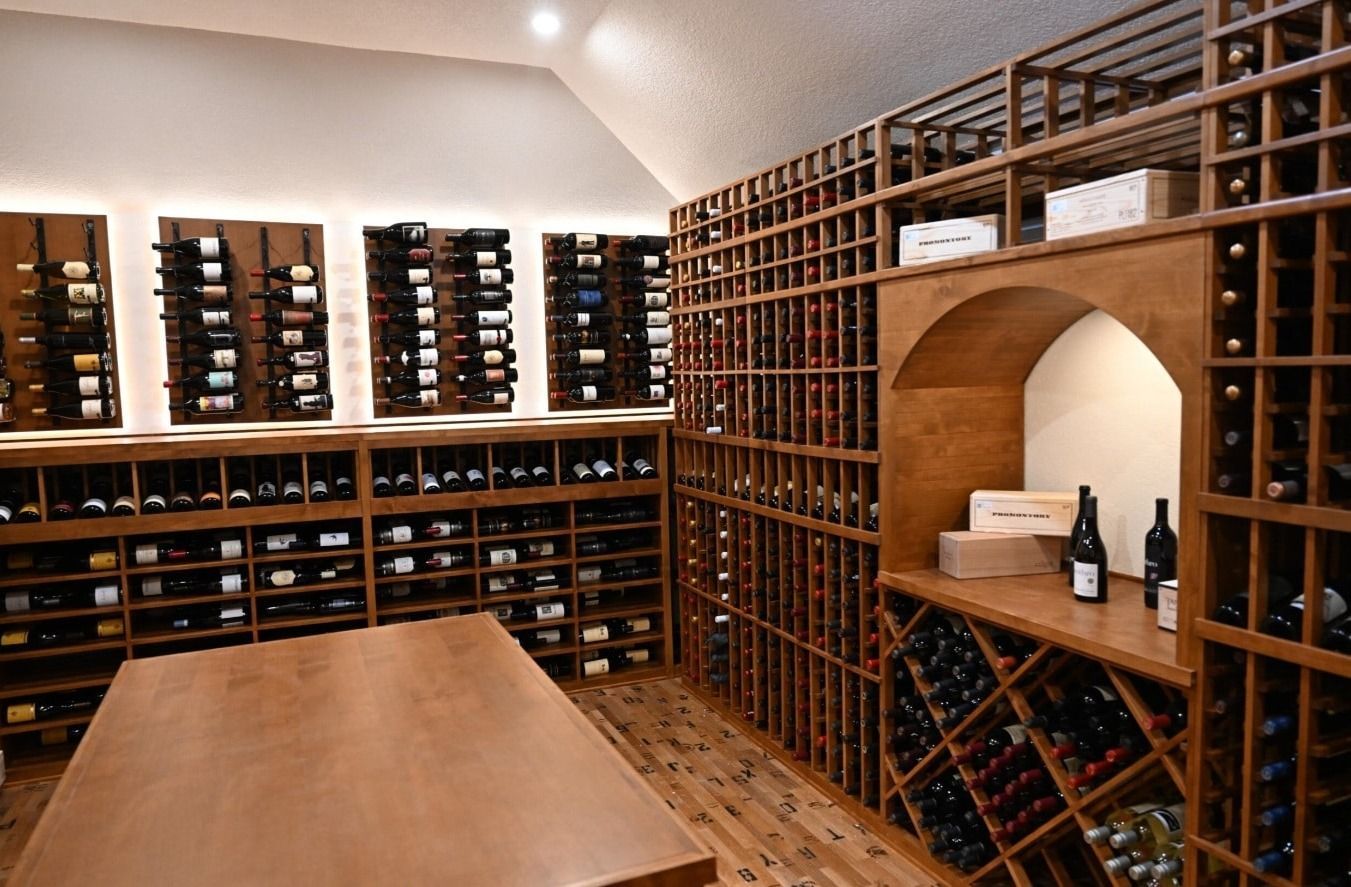
Warm honey tone, fine grain, excellent aging. Alder develops a subtle patina over decades and pairs beautifully with both contemporary and traditional aesthetics. Our Newport Beach 1,500-bottle cellar features natural alder racks at 13.5-inch depth with cork-forward storage, diamond bins, magnum racks, and display rows. Alder is our most popular choice for high-end residential because it ages gracefully and works with any cellar style.
02
Mahogany (Sapele and Malaysian)
Rich burgundy-brown, high density, traditional elegance. Mahogany resists warping in humid conditions and develops a deeper color with age. It's ideal for formal cellars and commercial applications where durability and prestige are equally important. Mahogany costs 20-30% more than alder but is justified in in-prone environments.
03
Redwood (Premium and All-Heart grades)
Warm reddish tone, naturally moisture-resistant, California heritage. Redwood is denser than pine, resists warping better, and brings regional authenticity to projects. Best for larger cellars where material longevity over decades matters more than initial cost.
04
Pine
Light cream tone, economical, hand-finished. Pine works beautifully in contemporary cellars and delivers 90% of alder's visual appeal at 40% lower cost. Properly sealed and maintained, pine lasts best for budget-conscious projects where timeline matters more than premium materials.
05
White Oak
Pale blonde, extremely dense, commercial-grade durability. White oak is our choice for high-traffic restaurant cellars where durability is non-negotiable. Costs 30-40% more than alder but will outlast the building. Every wood is hand-finished with secure glue-and-staple construction. Edges are sanded smooth to prevent label damage. Standard cubicle openings are 3.75 inches to accommodate 750ml bottles, magnums (1.5L), and specialty formats. Depths range from 10 to 18 inches, depending on single or double-deep storage. All wood systems include 1.5-inch toe-kick bases for stability and dado spacer bars to prevent lateral movement.
Contemporary Metal Racking: Modern Minimalism at Scale
Metal racking delivers clean aesthetics and label-forward visibility. Unlike wooden racks, where you flip bottles to see labels (disrupting sediment and wine quality), metal systems showcase labels permanently. This is essential for commercial cellars where staff need to identify wines quickly, and customers want visual exploration.
Stainless Steel & Powder-Coated Steel
Minimalist frames, chrome or matte black finishes. These systems mount wall-to-wall and floor-to-ceiling, maximizing capacity in compact spaces. Perfect for contemporary cellars and restaurant display rooms. Cost is 30-50% higher than wood but offers unmatched visual lightness.
VintageView Metal Peg Systems
Chrome-plated steel pegs secure bottles horizontally in label-forward position. Available in standard sizes (kit form) or fully custom wall-mounted configurations. The Evolution Series offers free-standing acrylic-panel systems with chrome rods—ideal for floor-to-ceiling displays behind glass walls or spaces where wall mounting isn't feasible. VintageView works beautifully in modern cellars and high-end restaurants where the racking itself becomes part of the design statement.
Capacity & Flexibility
Metal racking typically stores 15-20% more bottles per square foot than wooden racks because label-forward positioning is more space-efficient than cork-forward storage. Metal also accommodates frequent bottle rotation, making it essential for commercial operations.
Cable Racking: Sculpture and Storage Combined
Cable racking suspends bottles horizontally on stainless steel cables—creating clean, minimal displays that maximize airflow and light. Each bottle sits in a small cradle, suspended without touching its neighbors. This delivers superior temperature distribution, easier visibility, and a sophisticated aesthetic.
Single-Bottle Display
Each bottle suspended individually in a label-forward position. Creates a gallery-quality presentation. Perfect for smaller collections (200-500 bottles) displayed as focal points.
Double-Depth Racking
Bottles suspended deep on cable systems, maximizing storage (1,500+ bottles in a 12-foot wall) while maintaining the sleek cable aesthetic. Ideal for larger residential cellars where minimalist design matters more than ultimate capacity.
Custom Floor-to-Ceiling Designs
Cable systems scale from 8 feet to 16+ feet, creating dramatic sculptural displays. We've built cable systems in Manhattan Beach contemporary cellars, commercial wine bars, and upscale restaurant back-of-house spaces.
Why Cable Works
Superior airflow (no solid shelves blocking circulation), minimal visual weight (cables disappear, bottles float), label-forward visibility, and exceptional durability. Stainless steel cables support 500+ pounds and don't degrade. Cable systems cost 40-60% more than wooden racks but are architecturally distinctive and rarely need service.
Racking Configurations: Storage Types That Work Together
Cork-Forward Storage
Bottles sit horizontally with corks facing forward — the traditional style that protects labels and keeps corks moist. Ideal for standard 750ml bottles in residential cellars with relatively stable collections. Each cubicle holds one bottle.
Diamond Bins
Bottles angled in diamond-shaped compartments, stacked three to six deep. A single diamond bin stores eight to twelve bottles in roughly twelve inches of wall space, maximizing capacity in small footprints while adding visual interest. Works beautifully as the foundational storage system in larger cellars.
Magnum Racks
Deeper, wider compartments for 1.5L and 3L bottles, engineered with reinforced supports to handle the added weight. Essential for collectors who buy in large format.
Horizontal Display Rows
Bottles showcased individually in prominent positions, creating focal points and highlighting special vintages. A typical cellar might pair 80 percent functional storage with 20 percent display rows for visual balance.
Case Storage
Open lattice shelves for unopened cases, allowing airflow while supporting cases firmly. Essential for serious collectors and commercial cellars alike.
High-Reveal Shelves
Open shelves for glasses, decanters, wine books, or decorative pieces. One or two per cellar adds both functionality and visual sophistication.
Wine Islands and Tasting Tables
Custom-built islands or tables for decanting, tasting, and entertaining create a social hub within the storage space — perfect for collectors who spend real time in their cellars.
Semi-Custom Kit Racks
Premium Quality at 40-60% Lower Cost
Factory-direct kit racks offer a compelling middle ground: premium materials and proven quality at semi-custom pricing. Pre-manufactured components in standard sizes combine to create custom-looking designs. You choose the wood species — Premium Redwood, Northwestern Pine, or Malaysian Mahogany — the stain color, and the storage components: cork-forward racks, diamond bins, display rows, case storage, and high-reveal shelves. Lead times run six to eight weeks versus twelve to sixteen for fully custom builds, and most residential projects in the 100 to 1,500 bottle range achieve stunning results at 40 to 60 percent lower cost. The trade-off is flexibility — irregular spaces and non-standard depths can be limiting. For typical rectangular cellars, kits deliver exceptional value without sacrificing quality.
Commercial Racking
Design for Display and Revenue
Restaurant and hotel wine programs live or die on display. High-quality racking enhances the establishment's brand, creates visual focal points that drive guest engagement, and makes inventory rotation efficient. Commercial racking must accommodate diverse bottle sizes, support frequent movement, and deliver the kind of theatrical presentation that sells wine. We design commercial cellars for both purposes — closed back-of-house storage where staff work efficiently, and front-of-house display where guests see the collection and want to order from it. Commercial-grade white oak and stainless steel systems withstand daily use while maintaining luxury aesthetics.
Niccó's Steakhouse at Durango Casino Las Vegas features our commercial racking system displaying over 4,000 bottles. Hell's Kitchen in San Diego showcases 2,500-plus bottles in acrylic racks with brushed-steel ladder access. These aren't storage solutions — they're revenue-driving architectural features.
Racking Sizing: From Closet to Basement
01
200-500 bottles
Typical closet conversion or small dedicated room. Usually 8-12 feet of racking wall space. Best with semi-custom kits or cable systems. Project: from entry-level to mid-range for racking alone (plus cooling, door, lighting).
02
500-1,500 bottles
Standard residential cellar (12-20 feet of wall space or an irregular room). Mix of cork-forward storage, diamond bins, and display rows. Requires integrated cooling design. Best with semi-custom or custom wood racking. Project: entry to mid-range for racking alone.
03
1,500-3,000 bottles
Serious collector or commercial installation (20+ feet of racking or multi-wall designs). Includes wine island, diverse storage types, and premium finishes. Full custom builds. Project: mid-range builds for racking alone.
04
3,000+ bottles
Museum-grade cellars for elite collectors or commercial establishments. Multi-room designs, specialized storage (by region, vintage, format), premium materials, and display emphasis. Custom builds by appointment. Project: premium builds+. These ranges assume wood racking. Metal systems cost 30-50% more; semi-custom kits cost 40-60% less.
FAQ: Custom Wine Rack
Which wood species should I choose?
Alder is our most popular choice — warm tone, excellent aging, and compatible with any aesthetic at a mid-range cost. Mahogany offers richer color and superior moisture resistance at 20 to 30 percent higher cost. Redwood brings California heritage and natural moisture resistance. Pine delivers excellent aesthetics at around 40 percent lower cost. All species are durable when properly finished — the right choice comes down to your aesthetic vision and budget.
Can you accommodate an irregular or sloped-ceiling space?
Yes, that's our specialty. We design custom racking layouts that respond to structural pillars, sloped ceilings, and architectural constraints. Irregular spaces often result in more distinctive, memorable cellars than rectangular designs.
Do I need special maintenance for wooden racks?
Not beyond standard cellar maintenance (annual cleaning and monitoring). Our sealed finishes are designed to withstand swings. If your cellar environment is stable (±2°), wood racks require essentially zero active maintenance beyond occasional dusting.
What's the difference between cork-forward and label-forward storage?
Cork-forward keeps bottles angled with corks facing forward — the traditional style that protects corks but obscures labels. Label-forward positions bottles horizontally with labels visible, enabling quick identification — essential for commercial cellars and large collections where locating a specific bottle quickly matters. For residential collections where you know your wines well, cork-forward is the natural choice; for commercial or larger collections, label-forward earns its place.
Can you expand the rack if my collection grows?
Absolutely. If you've selected modular kit racking, expansion is simple—order additional components and have us install. Even custom wood racking can be added if the original design was modular. Plan for growth during initial design; we typically reserve 15-20% capacity for future growth.
How do you determine the right wine rack configuration for my collection?
We consider your bottle count, bottle sizes, available space, accessibility needs, and desired presentation to create a wine rack configuration that balances storage capacity with easy access and visual appeal.
Can custom wine racks accommodate different bottle sizes and formats?
Yes. Custom racking can be designed to accommodate standard 750ml bottles, magnums, larger formats, and specialty bottles. Dedicated compartments and reinforced supports can be incorporated where needed.
Are custom wine cellar racks suitable for both residential and commercial wine cellars?
Yes. Custom wine cellar racks can be designed for private homes, restaurants, hotels, wine bars, and other commercial spaces. Materials and configurations can be selected based on durability, bottle capacity, display requirements, and frequency of use.
What makes custom wine racking different from standard wine racks?
Custom wine racking is designed specifically around your cellar's dimensions, collection, bottle formats, and design goals. This allows for better use of irregular spaces, integrated display areas, specialized storage, and a more cohesive architectural appearance than standard racks.
How much bottle capacity can custom wine racks provide?
Custom wine racks can be designed for collections ranging from approximately 100 bottles to more than 5,000 bottles. The final capacity depends on the available space, rack configuration, bottle sizes, and the balance between storage and display areas.
Can wine racks be designed around doors, columns, and other architectural features?
Yes. Custom wine racks can be built around doors, columns, corners, arches, niches, and other architectural features. The design can use otherwise difficult spaces while maintaining a cohesive look throughout the cellar.
Can I combine different wine rack styles in the same cellar?
Yes. A cellar can combine cork-forward racks, diamond bins, display rows, case storage, magnum racks, and high-reveal shelving. Mixing storage styles helps maximize capacity while creating designated areas for featured bottles and accessories.
Are wine racks designed to work with a wine cellar cooling system?
Yes. Racking dimensions and configurations can be considered as part of the overall cellar design so that bottle storage, airflow, insulation, and cooling requirements work together effectively.
Can wine rack designs include dedicated areas for wine bottles on display?
Yes. Dedicated display rows and feature sections can be incorporated to highlight special vintages, collectible bottles, or favorite wines. These areas can serve as visual focal points without sacrificing the cellar's functional storage capacity.
Can custom wine racks be designed to match the style of my home?
Yes. Custom wine racks can be tailored in materials, finishes, configurations, and detailing to complement traditional, contemporary, modern, or transitional interiors. This helps the wine cellar feel like an integrated part of the property rather than a separate storage area.
