
Wine Cellar Mistakes to Avoid: Real Scenarios from 20+ Years
We've built 500+ wine cellars and seen every mistake — some costly to fix, some that destroy entire collections. This guide walks through the ones we encounter most often and how to avoid them. Learn from others' expensive lessons so you don't repeat them.
Mistake 1: Undersizing the Cooling System
The Scenario: A homeowner budgets for cooling and chooses the smaller, cheaper unit. "Our cellar is only 300 bottles — we don't need much." Year one: fine. Year two, during summer heat: temperature drifts to 62°F. Year three: the system struggles to hit 55°F. By year four, it runs constantly and still can't cool below 60°F. Wine is aging too fast, and the damage is already done.
01
What Goes Wrong
Undersized systems perform adequately in mild seasons but fail during peak heat. In Phoenix or Las Vegas, the gap between a properly sized and an undersized system becomes obvious within a single summer.
02
The Cost
System replacement plus years of wine aging improperly — a combination of financial loss and collection damage that far exceeds what proper sizing would have cost upfront.
03
How to Avoid It
Have a professional calculate your cooling load based on cellar volume, insulation quality, location, and ambient temperature. Size the system for your climate's worst-case scenario, not average conditions. Your cooling system installer will do this calculation — make sure they do.
Mistake 2: Skipping or Misplacing the Vapor Barrier
The Scenario
A contractor cuts corners or misunderstands the requirement. "We'll use good insulation — a vapor barrier isn't necessary." Or worse: "Let's put the vapor barrier on the outside where it makes logical sense." Three months after completion, humidity is at 78% and climbing. Six months in, mold appears on labels. Inspection reveals the vapor barrier is either missing or installed on the wrong side. Correcting it requires opening walls and rebuilding from scratch.
How to Avoid It
Insist on a continuous vapor barrier installed on the warm, interior side of insulation and get it in writing before work begins. Verify the installation visually before drywall goes up. Do not allow drywall installation until you have seen the vapor barrier in place with your own eyes.
The Cost
Significant remediation expense — opening walls, installing the vapor barrier correctly, drying out the space, and rebuilding the interior finish.
What Goes Wrong
Without a proper vapor barrier, moisture infiltrates from exterior walls, humidity rises uncontrollably, and mold and decay follow quickly.
Mistake 3: Poor Door Sealing
The Scenario
The door doesn't close tightly. A gap at the bottom lets conditioned air escape and outside air infiltrate. Temperature drifts upward, humidity fluctuates, and the cooling system runs constantly, trying to compensate. Your 55°F cellar is actually running 58–62°F — not because the system is inadequate, but because the door doesn't seal.
What Goes Wrong
Door gaps undermine everything else. Even with perfect insulation and a properly sized cooling system, a leaky door compromises the entire environment.
The Cost
Door replacement or weatherstripping repair, plus the accumulated impact of years of suboptimal storage conditions on your collection.
How to Avoid It
Test the door seal before final project acceptance — it should close firmly with no visible gaps. Specify automatic door bottoms, as in our Mission Viejo installation, to ensure a tight seal at the floor. Check the seal annually as part of routine maintenance.
Mistake 4: Ignoring Humidity in Dry Climates
01
The Scenario
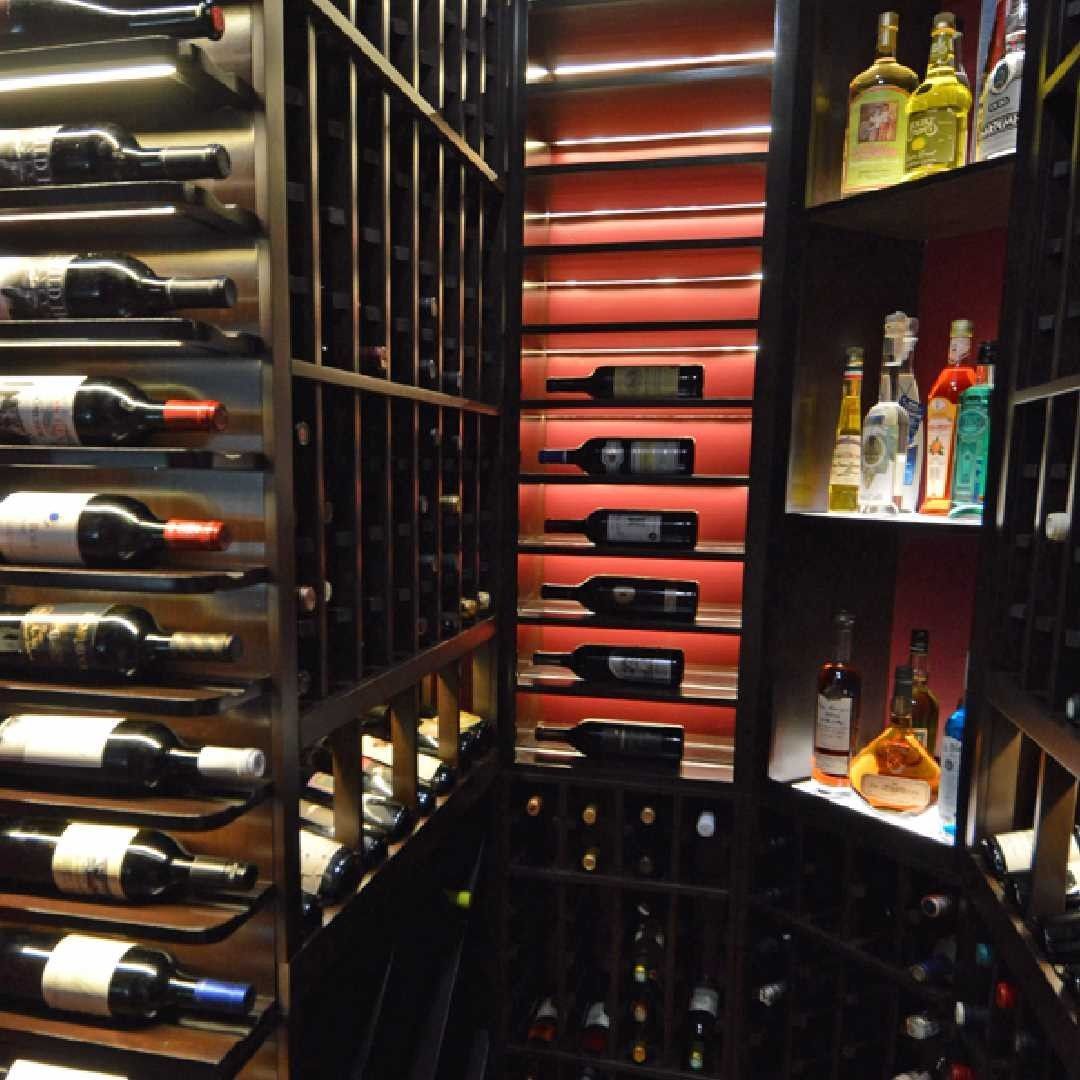
A Phoenix collector builds a cellar without humidification. Ambient humidity is 20–30%, and the cooling system lowers it further. The cellar runs at 35% humidity. Corks dry out, air infiltrates the bottles, and the wine oxidizes. Within 3–5 years, valuable bottles are undrinkable.
02
What Goes Wrong
Dry climates naturally have low humidity, and cooling systems remove additional moisture from the air. Without supplemental humidification, levels stay dangerously low. Dried corks allow air infiltration, and oxidation quietly destroys the collection.
03
The Cost
A potentially significant wine collection loss, plus the additional expense of retrofitting humidification equipment that should have been included from the start.
04
How to Avoid It
In arid climates, plan for humidification as part of the initial build — not as an afterthought. Monitor humidity regularly and keep it above 50%, targeting 60–70%. This is a standard part of professional cellar design in desert regions.
Mistake 5: Choosing Racking Based on Price Instead of Application
The Scenario
A collector chooses pine racking because it's the cheapest option. Eight years later, the wood is cracking, water-damaged, and deteriorating. The racking fails, hundreds of bottles need repositioning, and the cost to replace everything far exceeds what quality materials would have cost upfront.
How to Avoid It
Choose materials for longevity, not just initial price. Spanish cedar and mahogany last 25–30 years. Alder lasts 15–20 years with proper care. Pine should be avoided for any collection of real value. Calculate the total cost of ownership over 20 years — not just the upfront purchase price.
What Goes Wrong
Cheap materials fail quickly, and the combined cost of replacement and disruption to the collection always exceeds the initial savings.
The Cost
A modest initial saving on materials, followed by a significantly larger expense to remediate the failure and rebuild — a poor trade-off by any measure.
Mistake 6: No Drainage Planning (Basements)
The Scenario
A basement cellar is built without considering drainage. Heavy rain or a rise in the water table causes water to pool near or inside the cellar. Humidity spikes, the vapor barrier is compromised, and wine is at risk. What should have been a straightforward build becomes an expensive remediation.
What Goes Wrong
Basements are below grade and inherently prone to water intrusion. Without proper grading and drainage, water will eventually find its way in — it's a matter of when, not if.
The Cost
Basement waterproofing remediation plus potential wine loss — a combination that significantly exceeds what proper drainage planning would have cost upfront.
How to Avoid It
Address drainage before breaking ground on a basement cellar. Ensure the grade slopes away from the home, gutters drain well clear of the foundation, and interior or exterior drainage solutions are in place if the water table is high. Consult a basement waterproofing contractor before cellar construction begins — not after the first flood.
Mistake 7: Wrong Glass Thickness
01
The Scenario
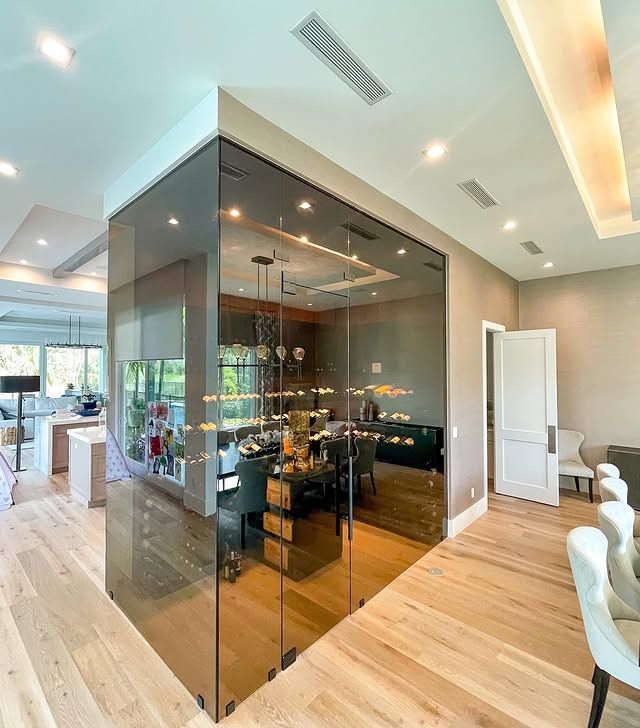
A collector opts for glass walls but specifies standard window glass at 3/8 inch. Under temperature and humidity stress, the glass cracks. Insulation value is poor, and without dual-pane construction, condensation forms between the surfaces. What looked stunning in the design phase becomes a costly structural problem.
02
What Goes Wrong
Wine cellars place demands on glass that standard window installations are not engineered to handle. Tempered glass for safety, dual-pane construction for insulation, and UV-blocking for wine protection are all necessary — not optional upgrades.
03
The Cost
Glass replacement plus potential wine damage if water infiltrates through cracked or poorly sealed panels.
04
How to Avoid It
Specify tempered, dual-pane glass at a minimum of 1/2-inch thickness. UV-blocking is ideal for any serious collection. Work with a glass contractor who has specific experience in wine cellar installations — not a standard window installer unfamiliar with the thermal and humidity demands involved.
Mistake 8: Excessive Light Exposure
The Scenario
A collector installs bright, dramatic lighting throughout the cellar. Wine is exposed to intense light for extended periods. UV accelerates aging and cork degradation. After five years, bottles that should be in their prime taste oxidized and flat.
What Goes Wrong
Wine is sensitive to light, particularly UV. Prolonged exposure accelerates aging in ways that cannot be reversed. Excessive illumination is a slow, invisible form of wine damage.
The Cost
A ruined or prematurely aged collection, plus the expense of replacing the lighting system — both of which far exceed the cost of specifying the right lighting from the start.
How to Avoid It
Use warm, soft lighting — recessed LEDs and accent lights at low brightness. Turn the lights off when the cellar isn't in use. If dramatic lighting is important for entertaining, use it selectively in those moments rather than as a constant display condition.
Mistake 9: DIY Electrical Without Professional Coordination
The Scenario
A homeowner has a friend handle the cooling system's electrical work. The work isn't to code, connections are unsafe, and the fire and electrocution risk goes unnoticed until something goes wrong. Insurance won't cover the damage because the work was never permitted or inspected.
What Goes Wrong
Cooling systems draw significant current and require professional, permitted electrical work. DIY electrical in a wine cellar is genuinely dangerous — not just to the cellar, but to the home and everyone in it.
The Cost
Rewiring by a licensed electrician, plus potential fire damage, safety liability, and insurance complications that could have been avoided entirely.
How to Avoid It
Use a licensed electrician for all cooling system electrical work. Pull the permits. Have the work inspected. This is not a place to cut corners or save money — the risks simply aren't worth it.
Mistake 10: No Monitoring System
The Scenario
A cellar is built, the cooling system is installed, and no monitoring is put in place. The homeowner assumes everything is working. The cooling system fails silently — no obvious noise change, no visible sign. The temperature rises above 65°F and goes unnoticed for two weeks. By the time the problem is discovered, significant wine damage has already occurred.
What Goes Wrong
Without monitoring, failures go undetected. A cooling system can fail without any obvious external signs. You have to measure conditions to know they're right — assumption is not a strategy.
The Cost
Potentially significant wine loss plus cooling system repair — a combination that far exceeds the cost of basic monitoring equipment.
How to Avoid It
Install monitoring from day one. A basic hygrometer-thermometer checked weekly provides a meaningful safety net at minimal cost. WiFi-connected monitoring that sends real-time alerts to your phone is even better for high-value collections. Either way, this is inexpensive insurance against an entirely preventable loss.
FAQ: Avoiding Mistakes
Which mistakes are most expensive to fix?
Vapor barrier failure tops the list — correcting it requires opening walls and can cost thousands of dollars. Structural water damage is even more severe, potentially running into tens of thousands. Cooling undersizing requires full system replacement, which is costly both in equipment and in the wine that ages improperly in the meantime.
Can I fix mistakes post-build?
Some mistakes are relatively straightforward to correct after the fact — adding monitoring equipment, improving door sealing, or retrofitting humidification. Major mistakes are a different story. Vapor barrier failure, undersized cooling, and structural issues require opening walls or partial rebuilding, making them significantly more expensive and disruptive to address post-completion.
How do I prevent mistakes as a homeowner?
Work with experienced, specialized contractors rather than general builders unfamiliar with wine cellar requirements. Get multiple opinions on design and engineering decisions. Verify that all work meets code and is properly permitted. Monitor temperature and humidity consistently after the build — early detection of a developing problem is far cheaper than fixing a failure. Vapor barrier problems are the mistake we're called to fix most often. It's entirely preventable with proper installation and verification before drywall goes up.
