
Wine Cellar Doors: Sealing Your Climate While Making a Statement
A cellar door serves four purposes simultaneously: sealing the climate-controlled environment against warm air infiltration, blocking UV light to protect wine from photodegradation, making a design statement as the cellar's first impression, and providing smooth, reliable access for regular use. The right door is engineered for your specific climate and insulation strategy — not simply chosen for appearance.
At Cachet Wine Cellars, we design and install frameless glass wine cellar doors for modern, transparent aesthetics that maximize views; framed glass doors for design flexibility and decorative options; metal doors for dramatic architectural statements; and wooden doors for warmth, craftsmanship, and traditional elegance. Each material delivers different insulation properties, visual impact, and maintenance considerations. Door selection cascades through the entire cellar design affecting cooling system sizing, lighting placement, racking layout, and visual hierarchy. We treat it as a critical design decision, not an afterthought.
Why Wine Cellar Doors Matter: More Than Just Entry
Most homeowners think of their cellar door primarily as an aesthetic feature. In reality, it is mechanical and aesthetic in equal measure. From a mechanical standpoint, the door's R-value directly influences cooling system sizing. A single-pane glass door rated R-2 to R-3 requires 30 to 40 percent more cooling capacity than a high-performance insulated door rated R-8 to R-10 — a difference that affects equipment cost from the outset. Poor gaskets and threshold seals allow conditioned air to escape, increasing dehumidification demands and cooling system runtime.
From an aesthetic standpoint, the door is the first thing guests see. A frameless glass door with the right hardware transforms a functional entrance into an impressive display. A beautifully finished wooden door makes the cellar feel like a destination rather than a utility room. A contemporary metal door becomes an architectural feature in its own right. Whatever the material, the door frames the entire cellar experience before a single bottle comes into view.
Understanding Door Insulation: R-Values, Gaskets, and Threshold Seal
01
R-value
measures insulation performance — higher is better. Single-pane glass rates R-2 to R-3; double-pane R-4 to R-6; triple-pane R-6 to R-8. Insulated wooden doors reach R-4 to R-6, while insulated metal doors with thermal breaks achieve R-8 to R-10. For wine cellars, we target a minimum of R-5 — double-pane glass or equivalent. If insulation elsewhere is budget-constrained, a higher door R-value compensates somewhat; if insulation is premium throughout, door R-value becomes less critical, though still important.
02
Gaskets
the rubber seals around the door perimeter — are equally critical. A poorly sealed door loses two to three degrees of temperature daily and allows humidity to escape continuously. Quality gaskets compress evenly, seal completely, and resist degradation over time. We specify commercial-grade gaskets rated specifically for wine cellar environments.
03
Threshold seals
where the door meets the floor, are where most amateur installations fail. A gap of just one-eighth of an inch at the threshold undermines the entire seal. Professional installations address this with automatic door bottoms — rubber gaskets that compress as the door closes — or recessed threshold designs that seal completely and reliably.
Door Type Comparison: Glass, Metal, Wood
| Door Type | Best For | Insulation | Maintenance | Cost | Design Character |
|---|---|---|---|---|---|
| Frameless Glass | Contemporary, minimal, transparency | R-6-8 | Weekly cleaning (fingerprints) | Modest–Mid range project | Modern, clean, shows collection |
| Framed Glass | Design flexibility, traditional elegance | R-6-7 | Moderate (frame finishes, gaskets) | Mid-range project | Classic, sophisticated, customizable |
| Metal | Dramatic, architectural statement | R-8-10 | Minimal (sealed finishes) | High-end project | Contemporary, bold, industrial |
| Wooden | Warmth, craftsmanship, classic appeal | R-4-6 | Regular (finish maintenance, seals) | Entry–Mid level builds | Traditional, elegant, bespoke |
Design Decisions That Affect Your Door Choice
Space and Access
Does your cellar have room for a full-swing door? Frameless glass and wooden doors typically swing inward, requiring three feet of clearance. Under-stair cellars may need French-style or sliding doors instead. We evaluate access requirements before any door selection is made.
Lighting Impact
A glass wine cellar changes how cellar light reads from outside a brightly lit interior behind glass creates a striking display. If you prefer privacy or softer ambient light in the surrounding space, metal or wooden doors are the better choice.
Maintenance Philosophy
Glass shows fingerprints and condensation. Metal finishes require minimal cleaning, though brushed finishes collect dust. Wooden doors need periodic seal maintenance. Choose based on your tolerance for upkeep.
Climate Compatibility
In humid climates, glass doors can show condensation on cool mornings — harmless, but aesthetically imperfect. Wooden doors in high-humidity cellars need sealed finishes to prevent water absorption. We match door type to your specific climate conditions.
Why Door Placement Matters More Than People Realize
During the 3D design phase, door placement is treated as part of the integrated cellar design rather than a standalone decision. North-facing doors receive less direct sun, reducing solar heat load and making them ideal for glass. South-facing doors experience high solar exposure, where wooden or metal options are the stronger choice. Placement also influences racking layout — a door on the east wall, for instance, gives the west wall optimal visual presence. And cooling system return air routing factors in as well; return air should never pull directly from the door opening. Every element connects.
The Mission Viejo Barolo Door Example
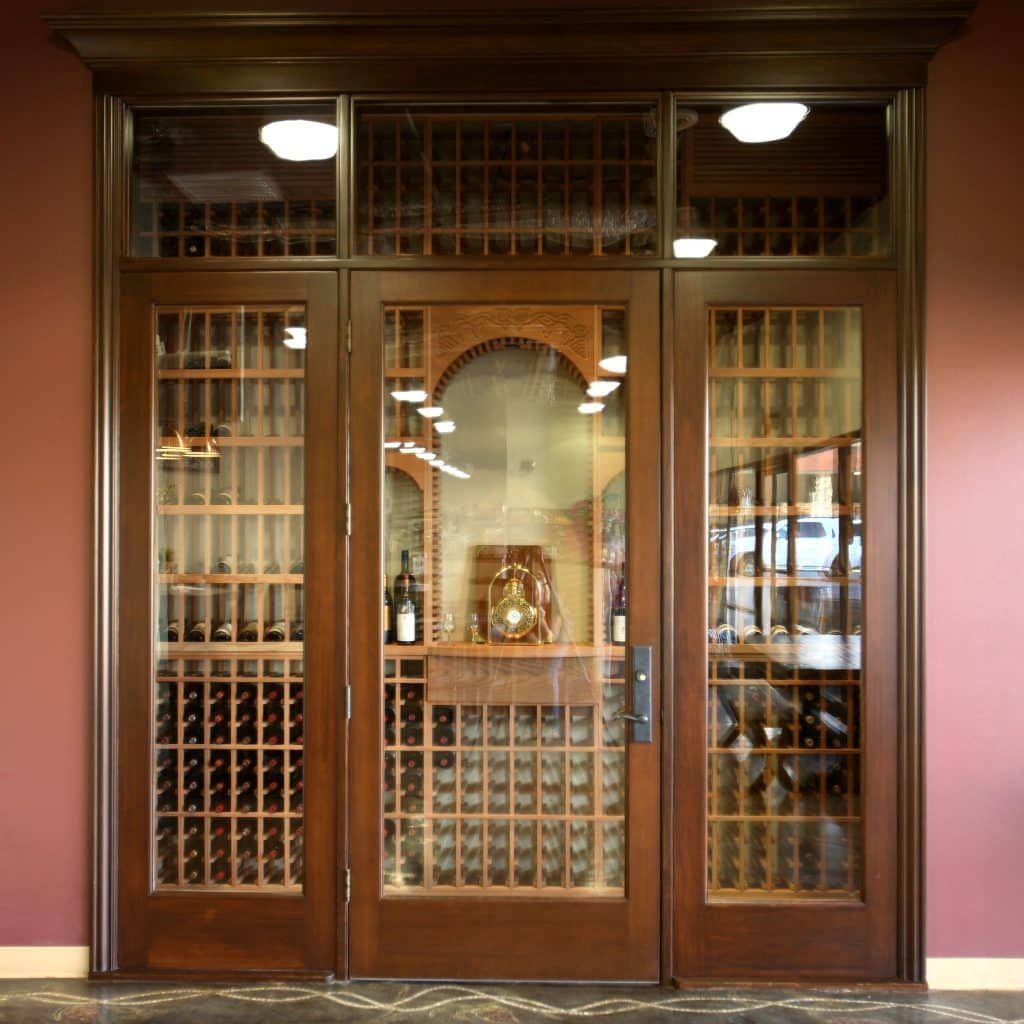
The Mission Viejo cellar features a Barolo-style wooden door — a traditional arched frame with beveled glass panels that the homeowner specified as the focal point of the design. Integration required careful engineering. The door's R-value of approximately 3.5 fell below our typical target, so we compensated with R-19 wall insulation rather than the standard R-13, and a high-performance glass-wall exterior rated R-8. The door finish — natural wood with a clear coat — highlights the grain and architectural detail. It was positioned on the north-facing exterior wall to minimize solar heat gain, fitted with invisible automatic door bottoms for a perfect threshold seal, and cooling return air was routed from the opposite wall to prevent warm air from being drawn directly through the door opening. The result is a door that functions as a stunning architectural feature and performs thermally without compromise — integrated design in practice.
FAQ: Wine Cellar Door
Can I use a standard exterior door instead of a wine cellar door?
Not effectively. Standard doors aren't engineered for environments and lack proper gaskets/seals. They'll warp, fail, or leak within 2-3 years. Always use wine cellar-specific doors engineered for the environment.
Which door type provides the best insulation?
Insulated metal doors (R-8-10) provide the best insulation, followed by thick glass systems (R-6-8). But door insulation alone doesn't determine cellar performance—wall insulation, cooling system sizing, and seal integrity matter equally.
Do glass doors show condensation?
Condensation on glass doors can occur on cold mornings when exterior air is cool, and the cellar air is warm and humid. It's harmless and temporary — clearing as temperatures equalize — and proper ventilation minimizes it further. In practice, it's an aesthetic inconvenience rather than a genuine problem.
Can I have a glass door if I want privacy?
Yes. Tinted, frosted, or opaque glass options exist. You get light control while maintaining the sophistication of a glass door. Discuss options during design.
How long do wine cellar doors typically last?
With proper maintenance — periodic seal checks, finish refreshes, and hardware adjustments — a quality cellar door lasts 20 to 30 years. The upfront investment in a well-made door pays for itself many times over across that lifespan.
What makes a wine cellar door different from a standard interior door?
A wine cellar door is designed to help maintain the cellar's controlled temperature and humidity. Proper insulation, weatherstripping, gaskets, and threshold sealing reduce conditioned-air loss and help the cooling system operate efficiently.
What size should a wine cellar door be?
The ideal door size depends on the cellar layout, available wall space, racking configuration, and how the cellar will be accessed. We design the opening and door dimensions around the complete cellar rather than selecting a standard size first.
Should a wine cellar door open inward or outward?
Most wine cellar doors are designed to open inward, but the best swing direction depends on the available clearance, racking placement, safety considerations, and surrounding architecture. During the design process, we determine the door swing as part of the overall layout.
Are frameless glass doors suitable for climate-controlled wine cellars?
Yes. Properly specified insulated glass and correctly sealed hardware can make frameless glass doors an effective choice for wine cellars. They are particularly useful when homeowners want the wine collection to remain visually connected to the surrounding space.
How do I prevent air leaks around a wine cellar door?
Air leakage can be minimized with properly fitted perimeter gaskets, insulated door construction, and a well-sealed threshold or automatic door bottom. Professional installation is important because even small gaps can affect temperature and humidity stability.
Do wine cellar doors need special hardware?
Wine cellar doors may require hardware selected for the door's weight, dimensions, material, and frequency of use. Hinges, handles, closers, locks, and automatic door bottoms should all work together without compromising the door's seal.
Can a wine cellar door be customized to match my home's interior?
Yes. Wine cellar doors can be customized through material selection, wood species, glass configuration, finishes, hardware, framing, and architectural detailing. This allows the entrance to complement the home's existing design while serving the functional needs of the cellar.
Can I add decorative glass to a wine cellar door?
Yes. Decorative, beveled, textured, or specialty glass can be incorporated into many wine cellar door designs. The glass selection should still be evaluated for insulation, UV exposure, privacy, and the cellar's climate-control requirements.
Does the wine cellar door affect the size of the cooling system?
Yes. Door construction, glass area, insulation value, orientation, and air sealing can all influence the cooling load of a wine cellar. Door specifications should therefore be considered when sizing the cellar's cooling system.
What type of door is best for a small wine cellar?
For a small cellar, the best option depends on the available clearance and desired appearance. A compact insulated wooden door can provide a traditional look, while a properly designed glass door can make a smaller cellar feel more open and visually connected to the surrounding room.
