
Do Wine Cellars Add Home Value?
It's a question we hear frequently from homeowners considering a wine cellar: Will it increase my home's resale value? The answer is yes — but not in the way you might think. A wine cellar in a mid-range home adds value differently than one in a luxury property. Geography matters too, and so does cellar quality. Understanding the real ROI dynamics helps you make decisions based on what actually happens in your market, not on assumptions.
The Home Market
Wine cellars have a strong appeal in luxury homes, particularly in markets like Southern California, Nevada, and Arizona, where high-value properties cluster. In this segment, a well-executed wine cellar — 1,000–2,500 bottles, professional cooling, quality materials — is a meaningful amenity that resonates with serious buyers. Appraisers recognize wine cellars as legitimate home improvements, not whimsical additions. A high-end residential cellar can represent a 6–7% improvement in appraised home value, and in luxury markets where buyers expect this level of finish, that percentage is significant.
What Appraisers Actually Value
Modern appraisers understand wine cellars and evaluate them across several key dimensions.
01
Climate Control Sophistication
A cellar with professional cooling — Wine Guardian Pro Series, CellarPro, or a ducted system with smart home integration — appraises higher than one with a basic through-wall unit. Professional climate management signals a commitment to wine preservation, not just storage.
02
Construction Quality
Proper insulation, vapor barriers, sealed doors, and a fully climate-controlled space represent real construction value. Appraisers recognize the difference. A basement conversion with proper vapor barrier and R-19 insulation is worth meaningfully more than a hastily finished room.
03
Capacity & Design
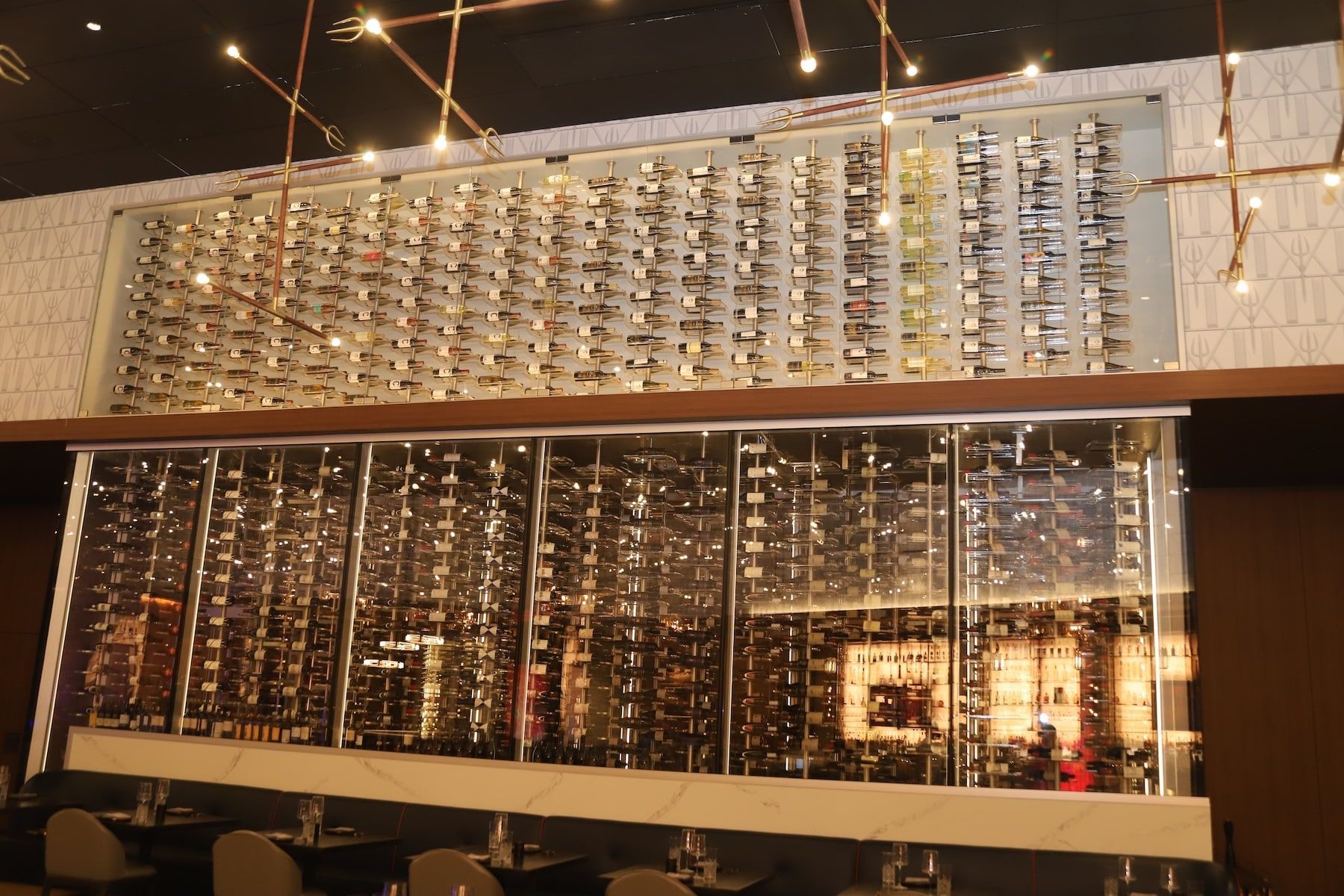
A 1,500-bottle cellar with organized racking carries more value than a 300-bottle space. A professionally designed cellar with 3D renderings and proper flow outperforms ad-hoc construction. Commercial-quality installations — like our Hell's Kitchen at Harrah's with 2,500+ bottle capacity and acrylic racking — are recognized as premium improvements.
04
Materials & Finish
Spanish cedar racking, glass enclosures, custom cabinetry, and professional lighting all contribute to appraised value. A simple wooden wine rack in a basement doesn't carry the same weight as a fully finished wine room with integrated lighting and architectural detailing.
05
Smart Home Integration
Wine Guardian Pro Series compatibility with Crestron, Nest, or Honeywell systems is increasingly recognized as a premium feature in luxury home appraisals.
What Doesn't Appraise Well
There are also wine cellar mistakes that don't improve home value.
DIY Construction Without Professional Climate Control
A basement with wooden racks and no cooling system may look appealing, but without proper climate control, it won't be appraised as a wine cellar. Temperature fluctuations destroy wine and damage the space over time.
Undersized or Cheap Cooling
A through-wall unit insufficient for the space's thermal load doesn't perform well, and appraisers recognize inadequate cooling when they see it.
Poor Insulation or Vapor Barrier
A cellar built in a damp basement without proper vapor barrier installation carries real mold risk. Appraisers recognize that risk and discount value accordingly.
Zoning or Permit Issues
A cellar built without following local building codes or obtaining proper permits may not be recognized as a legitimate improvement. Always work with local inspectors from the start.
Over-Improvement in Modest-Priced Homes
A premium wine cellar installation in a modestly priced home is an over-improvement — it won't add proportional value. In those markets, an appropriately scaled entry-level build appraises better and delivers stronger ROI.
Real Estate Agent Perspective
Luxury real estate agents in our key markets (Orange County, San Diego, Las Vegas, Phoenix, Miami) recognize wine cellars as significant selling features, particularly in the range. A well-executed cellar:
- Attracts serious collectors and wine enthusiasts
- Signals a well-maintained, luxury property
- Differentiates the property in competitive markets
- Appeals to high-net-worth buyers who actually use the space
Agents consistently report that quality wine cellars help close sales in competitive luxury markets. A $2M ocean view home featuring a 2,000-bottle custom cellar — like our Manhattan Beach glass wall project design — drew 15 serious buyers over two months, making the cellar a significant selling point. However, agents are equally clear that a poorly executed cellar actively hurts home value. Visible moisture issues, inadequate cooling, and cheap finishes signal problems to prospective buyers and raise concerns about repairs. The key is straightforward: if you're building a cellar partly for resale value, build it right. A quality cellar adds value; a problematic one subtracts it.
Wine Cellar ROI by Market & Home Value
Understanding realistic expectations matters when evaluating ROI.
In mid-range homes, a wine cellar typically delivers an ROI of 50–75% — solid, but not exceptional. At this price point, the cellar is a luxury feature rather than a core selling point. Build it because you'll use and enjoy it, not primarily for resale value.
In high-end residential properties, a quality cellar becomes a meaningful home feature and a legitimate selling point, with ROI typically ranging from 70–90%. Buyers at this level notice and appreciate the investment.
In luxury properties, a premium cellar is practically an expected amenity — and ROI reflects that, ranging from 75–85%. A well-executed cellar is nearly essential at this price point; a poorly built one is a liability.
These are general ranges, not guarantees. Your specific market, cellar quality, and overall home features all affect the actual numbers.
The Real Value Question: Enjoyment vs. Resale
Here's what we've learned after 20 years: the wine collectors who get the most satisfaction from their cellars built them because they genuinely wanted a better way to live with their wine — not primarily for financial return. Yes, a quality cellar in a luxury home will likely appreciate and support resale value. But you'll live with that cellar for 5–15 years before selling. If you spend a quarter million dollars building a spectacular space you rarely use or enjoy, the ROI mathematics don't matter much.
Think of it this way: the question isn't just "will this add value?" It's "will I use and enjoy this enough to justify the investment, regardless of whether it adds dollar-for-dollar value?" If the answer is yes, build it. If the motivation is mostly resale value, scale back to something more modest that still meaningfully improves your daily life. Our most satisfied clients built cellars they actually use — not cellars optimized for a spreadsheet.
Market-Specific Considerations
Your location matters significantly:
Southern California (Orange County, San Diego, LA)
Wine cellars are increasingly common in luxury homes and recognized as valuable amenities. Quality cellars appraise well and help sell homes. Our portfolio in this region is extensive, and we see consistent positive feedback from appraisers.
Las Vegas & Arizona
In a hot, dry climate where wine preservation is genuinely challenging, climate-controlled storage is recognized as practically necessary for serious collectors. Wine cellars are appraised very well in the luxury market here, and buyers understand their value immediately.
Florida & Humid Markets
Wine cellars are valuable but face real humidity challenges. Buyers recognize proper humidity management as critical, and a professionally cooled cellar with integrated dehumidification is worth significantly more than one without it.
Denver, Seattle & Mountain Markets
Wine cellars are less common in these regions, making them more of a novelty. ROI is often lower than in coastal markets, though serious collectors still highly value quality cellars, given the different relationship with local wine culture.
Miami & High-End Markets
Wine cellars are expected amenities in premium properties, with strong appraisals and broad buyer appeal. Our commercial partnerships with hotels and fine dining establishments demonstrate how premium wine storage drives both revenue and brand perception at scale.
FAQ: Wine Cellars & Home Value
Should I build a wine cellar as a project?
No. Build a cellar because you want to collect and enjoy wine at home. A quality cellar in a luxury home will likely improve resale value, but that should be a secondary benefit, not the primary motivation. If the decision is based solely on project ROI, a wine cellar is probably not the right investment for you.
Will a wine cellar help me sell my home faster?
In luxury markets, a quality cellar can attract serious buyers and meaningfully differentiate your property. In moderate markets, it's less of a selling point. Your real estate agent will have the best read on what resonates in your specific market.
What if I build a wine cellar and then need to move before I can enjoy it?
It's a real consideration worth thinking through carefully. Wine cellars are built into homes and don't move with you. If there's a realistic possibility you'll relocate within 2–3 years, a major cellar investment may not make sense. If you're committed to staying 10 or more years, it's a much easier decision.
Can I build a modest cellar now and expand it later?
Partially. You can design the initial build with future expansion in mind, which helps significantly. However, retrofitting major changes — like switching from self-contained to ducted cooling — requires substantial reconstruction. If possible, plan for your ultimate cellar size from the start.
Do appraisers understand wine cellars?
Modern appraisers increasingly do, particularly in markets with a concentration of luxury homes. Professional construction, proper climate control, and quality materials are all recognized as legitimate improvements. Poorly executed or DIY cellars, however, may not be recognized at all — or may raise more concerns than they resolve.
Will a wine cellar make my home harder to sell?
Not if it's well-executed. It may reduce appeal to buyers with no interest in wine, but it strongly attracts the buyer who does. In luxury markets, a quality cellar is a clear positive. In more modest markets, it tends to be neutral to slightly positive — rarely a liability when built properly.
