
Professional Wine Cellar Cooling: The Foundation of Everything
The wine cellar cooling system is the single most important component in your wine cellar. Get it wrong, and nothing else matters. Even perfect racking and an expensive door won't save wine stored in a cellar that swings between 50°F and 70°F or holds 40% humidity. At Cachet Wine Cellars, we engineer cooling systems to maintain 55°F (±2°) and 60-70% humidity—the precise environment fine wine requires to age gracefully. We partner with five industry-leading manufacturers (WhisperKOOL, CellarPro, Wine Guardian, Breezaire, US Cellar Systems), each offering different capacities, efficiency profiles, and installation approaches. Our cooling specialists calculate your exact needs based on space size, insulation quality, door type, ambient temperature, and collection size—then recommend the optimal wine cellar cooling unit. We install, commission, test, and maintain these systems to ensure reliable operation.
What Most Wine Collectors Don't Know About Wine Cooling
Wine preservation sounds simple: keep it cool and dark. In reality, three hidden factors determine whether a cooling system succeeds or fails.
First, temperature stability matters more than absolute temperature. Wine tolerates a steady 50°F better than 55°F, swinging between 50 and 60 degrees daily. This is why oversizing is as damaging as undersizing — a 1,200-cubic-foot cellar with a 2,000 BTU system will short-cycle, creating the very swings that age wine prematurely. The same cellar with a correctly sized 1,500 BTU system runs continuously at a steady 55°F.
Second, humidity interacts with temperature in ways most people miss. At 55°F, 65 percent humidity is ideal. At 60°F — common in undersized systems — that same humidity level creates condensation on walls, equipment, and bottle capsules, accelerating corrosion and label damage. Humidity-capable cooling isn't optional; it's foundational. A temperature-only unit cannot solve humidity problems.
Third, passive cellars are a myth that destroys collections. Even a cool basement swings five to fifteen degrees seasonally and two to five degrees daily. Professional wine cellar refrigeration isn't a luxury it's required infrastructure. Without it, your cellar is slow-motion wine destruction.
Understanding BTU Requirements and Heat Load Calculation
Cooling system capacity is measured in BTU (British Thermal Units) per hour. A 1,200 BTUH system removes 1,200 BTU of heat per hour. The right capacity depends on the total heat load: space size (larger rooms accumulate more ambient heat), insulation quality (R-values of walls, ceiling, and doors), door type and frequency of opening, ambient temperature outside the cellar, and the bottles themselves (each bottle represents latent heat). Here's how we calculate it: A 200 sq ft basement cellar with standard construction (R-13 insulation) in Southern California experiences daily temperature swings of 3-5°F. It requires roughly 1,200-1,500 BTUH to maintain a steady 55°F. A 400 sq ft cellar requires 2,000-2,500 BTUH. A 600+ sq ft cellar requires 3,000-4,000 BTUH. These are ballpark estimates; actual requirements depend on insulation quality and ambient temperature extremes in your region. A cellar with R-19 insulation and a low-U-value door requires 20-30% less capacity than a poorly insulated space. This is why integrated design matters: better insulation reduces cooling requirements, lowering energy costs and equipment size. The Mission Viejo project we mentioned earlier actually needs 40% less cooling capacity than typical because we specified R-19 wall insulation and a high-performance door upfront. Most cooling failures happen because systems were undersized (selected without proper heat load calculation) or oversized (leading to short-cycling and temperature instability).
Ducted vs. Self-Contained: Installation Approaches
01
Self-Contained Units
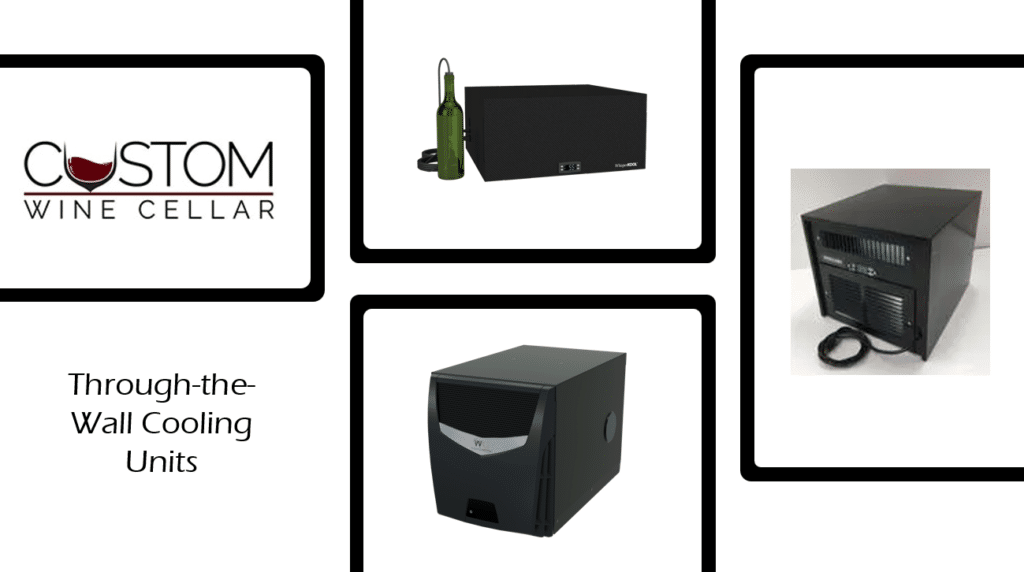
A single cabinet that cools and dehumidifies without external ducting — portable, easy to install, and effective in tight spaces. WhisperKOOL and Breezaire offer excellent options in the 500 to 2,000 BTUH range. Best for closet conversions and small rooms where ducting isn't feasible. The trade-offs: the unit occupies two to three square feet of floor or wall space, and the compressor and fan are audible, though quieter premium models are available.
02
Ducted Through-Wall Units
The evaporator sits inside the cellar; the condenser mounts through the wall or basement rim joist to the exterior. Ideal for basements and new construction, where ducting can be integrated into framing. The capacity range of 1,200 to 3,500 BTUH makes these well-suited to permanent installations where noise isn't a primary concern. CellarPro and US Cellar Systems specialize in ducted systems.
03
Ducted Ceiling-Mounted Units
Return air pulls from high in the cellar; cooled air is ducted to ceiling or floor vents. The evaporator is hidden in the attic or crawlspace, with the condenser routed to the exterior. Our preference for residential remodels is invisible, efficient, and unobtrusive. Wine Guardian offers excellent ceiling-ducted systems with smart home integration.
04
Split Systems
The evaporator and compressor are separated and connected by refrigerant lines, offering the most flexibility in placement. Wine Guardian's Pro Series uses split-system architecture with 24V integration for Crestron, Nest, and Honeywell smart home control.
The right approach depends on your space, noise tolerance, and smart home integration goals — something we work through during the site assessment.
The Five Cooling Brands We Recommend: Comparison Overview
| Brand | Best For | Capacity Range | Installation | Smart Home | Typical Cost Range |
|---|---|---|---|---|---|
| WhisperKOOL | Residential, compact spaces, quiet operation | 500–2,000 BTUH | Self-contained or through-wall | None | Modest Project – Mid Range |
| CellarPro | Made-in-USA precision, variable speed, efficient | 1,800–3,500 BTUH | Ducted through-wall, ceiling-mounted | None | Substantial Project+ |
| Wine Guardian Pro Series | Smart home integration, commercial-grade, ducted | 1,200–3,000 BTUH | Ducted split-system | Crestron, Nest, Honeywell | Mid Range to Premium |
| Breezaire | Reliability, wine-specific engineering, value | 500–2,000 BTUH | Self-contained or through-wall | Sentry III+ controls | Entry-Level Builds |
| US Cellar Systems | California-engineered, custom ducting, precision | 1,800–3,500 BTUH | Ducted into attic/basement | None | Mid Range Project+ |
Why Humidity Control Is Non-Negotiable
A cooling system that controls temperature while ignoring humidity will destroy a collection through different means than no cooling at all. Wine corks are hygroscopic — they absorb and release moisture based on ambient humidity. At 40 percent humidity, corks shrink, wine seeps out, and oxygen enters the bottle, oxidizing the wine rapidly. At 80 percent or above, labels peel, capsules corrode, and mold takes hold. The sweet spot is 60 to 70 percent — the range that mirrors the humidity of Burgundy, Bordeaux, and Napa Valley, where wine evolved to age properly.
Temperature-only cooling systems can't solve this. If you live in a dry region like inland Southern California or Arizona, or a wet one like Miami or the Pacific Northwest, humidity-capable cooling is non-negotiable. WhisperKOOL's newer units, all CellarPro systems, Wine Guardian's Pro Series, Breezaire's Sentry III+ controls, and US Cellar Systems all include humidity management as standard. During commissioning, we verify that your cellar maintains both temperature — 55°F ±2° — and humidity — 60 to 70 percent — simultaneously.
Smart Home Integration: Wine Guardian Pro Series with Crestron and Nest
Wine Guardian's Pro Series offers 24V control integration, connecting your cooling system directly to your smart home ecosystem. Crestron, Nest, and Honeywell can all communicate with Wine Guardian units, allowing you to monitor temperature and humidity from your phone, adjust setpoints remotely, and receive alerts the moment conditions drift out of range. For serious collectors — especially those with cellars in second homes or properties they don't visit daily — that real-time visibility is genuinely valuable. Smart home integration adds 20 to 30 percent to the cost, but the peace of mind it delivers is difficult to put a price on. If you have an existing Crestron or Nest system, Wine Guardian integrates smoothly; if you're building a new smart home cellar from scratch, we coordinate with your AV integrator to ensure everything works together from day one.
Common Cooling Failures and How to Prevent Them
01
Undersized Equipment
Most common failure. A cooling system selected without proper heat load calculation undersizes for the space. Result: the system runs continuously, humidity doesn't drop enough, and temperature oscillates. Fix: require heat load calculation upfront; don't guess.
02
Poor Ducting Design
Second most common. Ducting with kinks, insufficient insulation, or improper sizing creates pressure drops and reduces cooling capacity. A duct that should deliver 500 BTUH actually delivers 350 BTUH because of constriction. Fix: Have your cooling specialist (not a general HVAC contractor) design ductwork.
03
Inadequate Insulation
A cellar with R-13 walls and a single-pane glass door requires 40% more cooling than one with R-19 walls and a high-performance door. Fix: integrate cooling and insulation decisions upfront.
04
Blocked Return Air
If the cellar evaporator return air is blocked by racking or boxes, the system can't cycle properly. Fix: leave clearance around evaporator vents; don't rack right up against them.
05
Condensation on Cooling Equipment
When cooling equipment isn't sized for humidity control or the cellar humidity is above the setpoint, water condenses on coils, drips into the pan, and drains improperly. Result: mold grows, smell develops, equipment corrodes. Fix: specify humidity-capable cooling; maintain 60-70% humidity; drain the condensate pan to the proper location (typically a floor drain or an external line).
06
Lack of Maintenance
Dirty cooling coils, clogged filters, and unserviced compressors fail prematurely. Fix: annual maintenance (coil cleaning, filter replacement, system inspection) prevents 95% of failures. Many Cachet clients include maintenance plans for this reason.
The Complete Cooling Installation Process
Phase 1: Consultation & Heat Load Calculation
We assess your space (square footage, insulation, door type, ambient temperature swings) and calculate exact cooling requirements. We discuss your budget, noise tolerance, and any smart home integration needs.
Phase 2: System Selection & Quotation
We recommend the optimal cooling system (brand, capacity, and installation method) and provide a detailed quote that includes equipment, ducting, electrical work, and labor.
Phase 3: Site Preparation
We identify where the evaporator will be mounted (ceiling, wall, or floor), route the return air and ducting paths, determine where the condenser exhaust will vent (exterior wall, through the attic, or through the rim joist), and confirm electrical requirements with a licensed electrician.
Phase 4: Installation
Our team (or our partner network) installs the cooling system, tests all connections, and verifies that refrigerant lines are properly insulated and secured.
Phase 5: Commissioning & Testing
We run the system, monitor temperature and humidity for 30-60 minutes, verify it reaches and maintains the setpoint, test the thermostat, and confirm condensate drainage. We document all settings and provide you with a commissioning report.
Phase 6: Training & Maintenance Plan
We walk you through daily operations (setpoint, shutdown during the off-season, if applicable, and filter replacement frequency). We discuss maintenance options: annual DIY filter cleaning, or a paid 40-day check / 6-month interim / 12-month full-service plan through Cachet.
Regional Climate Considerations: SoCal, Nevada, Arizona, National
Cooling requirements vary dramatically by region. Southern California coastal areas experience moderate temperature swings and low humidity, requiring systems that manage excess heat without heavy-duty humidity control — though marine layer can create occasional humidity spikes. Nevada and Arizona's inland areas face extreme temperature swings and very low humidity, demanding large heat load management and active humidification. The Midwest and East bring seasonal extremes and variable humidity, where basements stay cool but ambient variance is wide. The Pacific Northwest and Miami sit at the opposite end — high ambient humidity year-round makes dehumidification the primary challenge, not cooling.
For national projects, we work with regional builders and cooling specialists who understand local climate patterns. But the underlying principle is universal: calculate heat load and humidity requirements for your specific climate, then select and size equipment accordingly. No two cellars require identical cooling systems, because no two cellars experience identical climates.
FAQ: Cooling System
How much does a cooling system cost?
Ranges from entry to premium builds depending on capacity, brand, installation complexity, and smart home integration. We discuss pricing during your consultation based on your specific space and system requirements.
Can I use a standard HVAC system instead?
Not effectively. Standard HVAC systems are designed for comfort (70°F, 40-50% humidity). Wine cellars need precision (55°F ±2°, 60-70% humidity) and specialized controls. Standard systems cycle on/off too frequently, creating temperature swings. Always use wine-specific cooling equipment.
Do I need a humidifier or a dehumidifier?
Depends on your region. Dry climates (Arizona, Southern California inland) may need humidification capability; wet climates (Miami, Pacific Northwest) need dehumidification. Your cooling specialist evaluates your space and ambient humidity patterns, then recommends accordingly. Wine Guardian and some CellarPro systems include both capabilities.
Can the cooling system be installed after the cellar is built?
Yes, but it's easier and cheaper to integrate it during construction. Retrofitting requires routing new ducting, finding wall or ceiling space for equipment, and dealing with existing racking. If you're upgrading an existing cellar, we'll work around what's in place—but budget more for labor and expect more constraints.
How often does the cooling system need maintenance?
Filter cleaning or replacement every 3-6 months (annual if DIY, included in maintenance plans). Annual coil cleaning and system inspection prevent 95% of failures. We offer 40-day post-installation checks, 6-month interim service, and 12-month full-service plans. Many clients choose annual maintenance; some choose basic DIY filter maintenance. Either way, regular attention prevents costly failures.
What if the power goes out?
Wine is resilient. A 24-hour power outage might see the temperature rise 5-10°F (depending on insulation and ambient temperature), but wine won't be damaged. Longer outages are more concerning. Consider a backup generator or uninterruptible power supply if power reliability is a concern in your area. We'll discuss this during the consultation.
How do I know what BTU cooling capacity my wine cellar needs?
The required BTU capacity depends on your cellar’s size, insulation, door type, ambient temperature, and how often the door is opened. Cachet Wine Cellars performs a heat load calculation to determine the appropriate system size rather than relying on a generic BTU estimate.
What is the ideal temperature and humidity for a wine cellar?
A professionally controlled wine cellar should generally maintain around 55°F with a ±2°F range and 60–70% relative humidity. Consistent conditions are more important than simply reaching a specific temperature because frequent temperature fluctuations can negatively affect long-term wine aging.
What is the difference between a self-contained and ducted wine cellar cooling system?
A self-contained system combines the cooling components into one unit and is often suitable for smaller cellars or closet conversions. A ducted system distributes conditioned air through ductwork and can keep the equipment out of sight, making it a good option for larger cellars, remodels, and custom installations.
Which wine cellar cooling brands do you install?
Cachet Wine Cellars works with several leading wine cellar cooling manufacturers, including WhisperKOOL, CellarPro, Wine Guardian, Breezaire, and US Cellar Systems. The recommended brand and model depend on the cellar's cooling requirements, installation configuration, noise preferences, efficiency goals, and smart-home needs.
Does wine cellar insulation affect the size of the cooling system I need?
Yes. Proper insulation reduces the amount of heat entering the cellar and can significantly reduce the cooling capacity required. Wall and ceiling R-values, door performance, and overall construction quality are all considered when determining the appropriate cooling system.
What happens if a wine cellar cooling system is too large for the space?
An oversized cooling system can cool the cellar too quickly and shut off before properly stabilizing temperature and humidity. This short-cycling can create temperature fluctuations and inadequate humidity control. Proper heat load calculations help ensure the system is correctly sized for consistent operation.
Can a wine cellar cooling system be hidden in a ceiling, attic, or crawlspace?
Yes. Depending on the cellar design, ducted systems can be installed in an attic, crawlspace, basement, or other concealed location. Conditioned air is then delivered through strategically placed vents, providing effective cooling without making the equipment a prominent part of the cellar design.
Can I monitor my wine cellar temperature and humidity remotely?
Yes, certain wine cellar cooling systems can integrate with smart-home controls and monitoring platforms. For example, compatible Wine Guardian systems can work with smart-home environments such as Crestron, Nest, and Honeywell, allowing collectors to monitor cellar conditions and receive alerts remotely.
How does the local climate affect wine cellar cooling requirements?
Local climate can significantly affect cooling requirements. Hot, dry regions may require greater cooling capacity and humidity management, while humid climates may require stronger dehumidification. Cachet Wine Cellars considers regional temperature and humidity conditions when sizing and selecting your cooling system.
How often should a wine cellar cooling system be serviced?
Regular maintenance helps keep the system operating efficiently and reliably. Filters and coils should be checked and cleaned as recommended by the manufacturer, while the overall system, refrigerant performance, drainage, and controls should be inspected periodically by a qualified professional.
