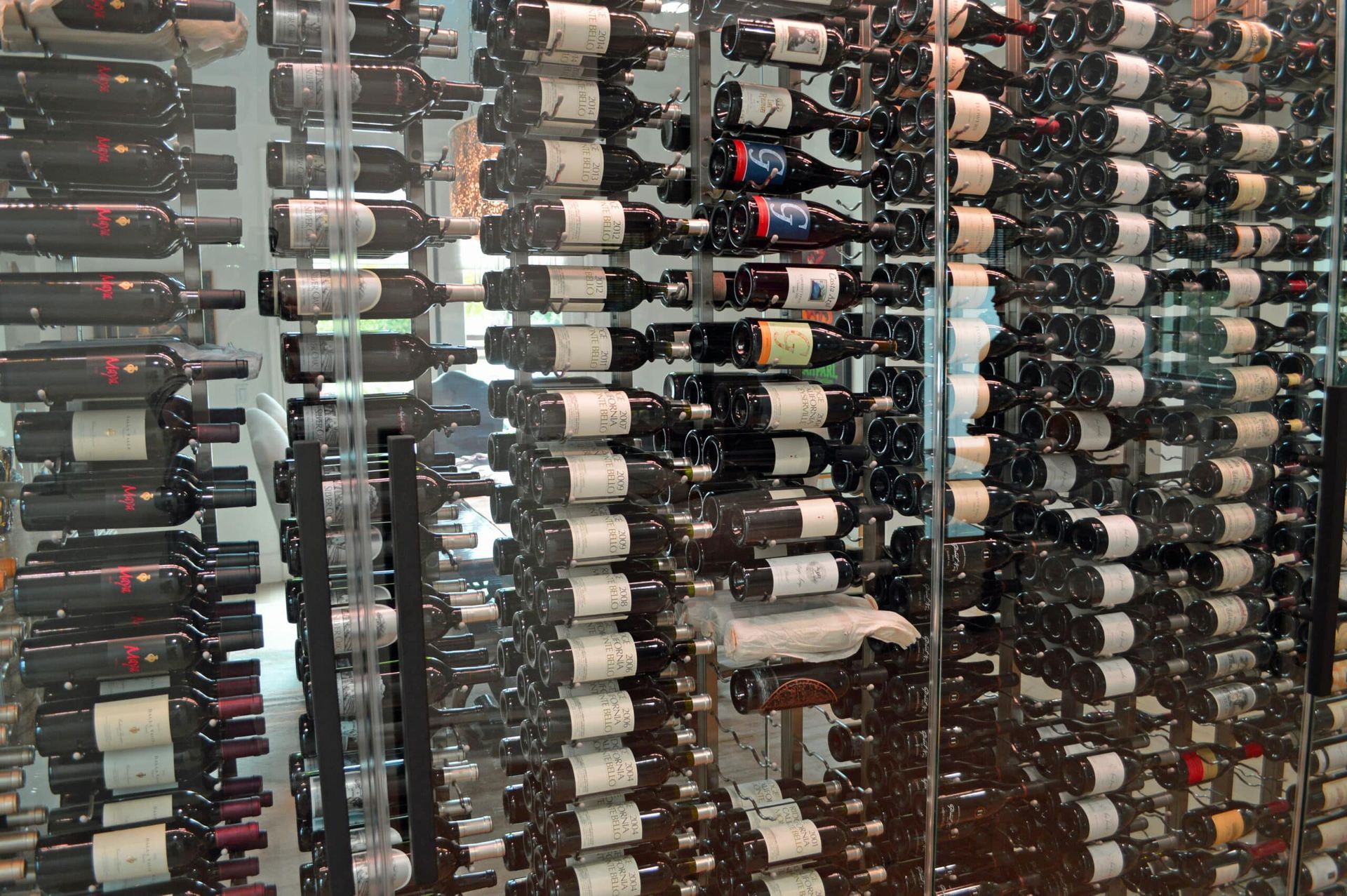
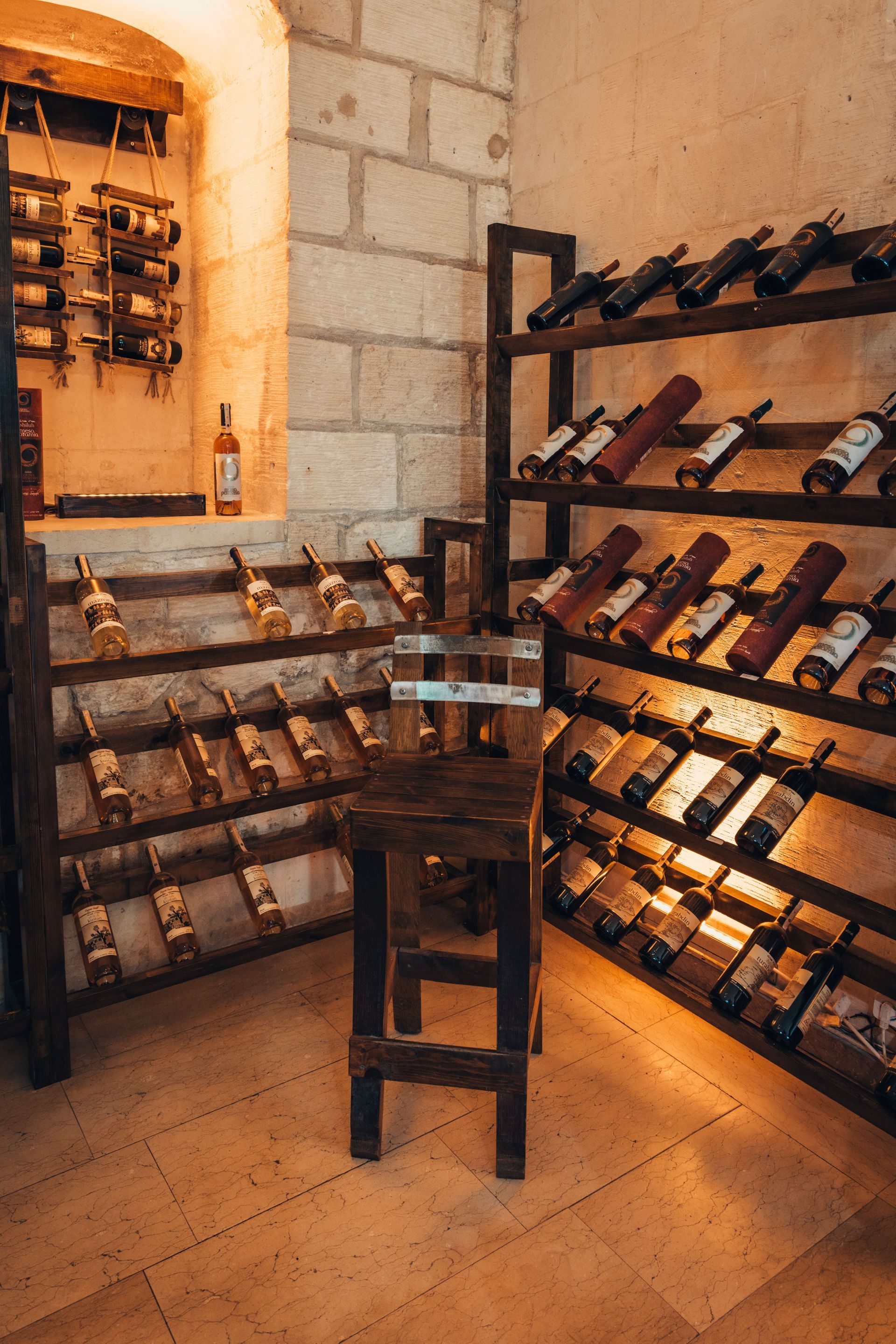
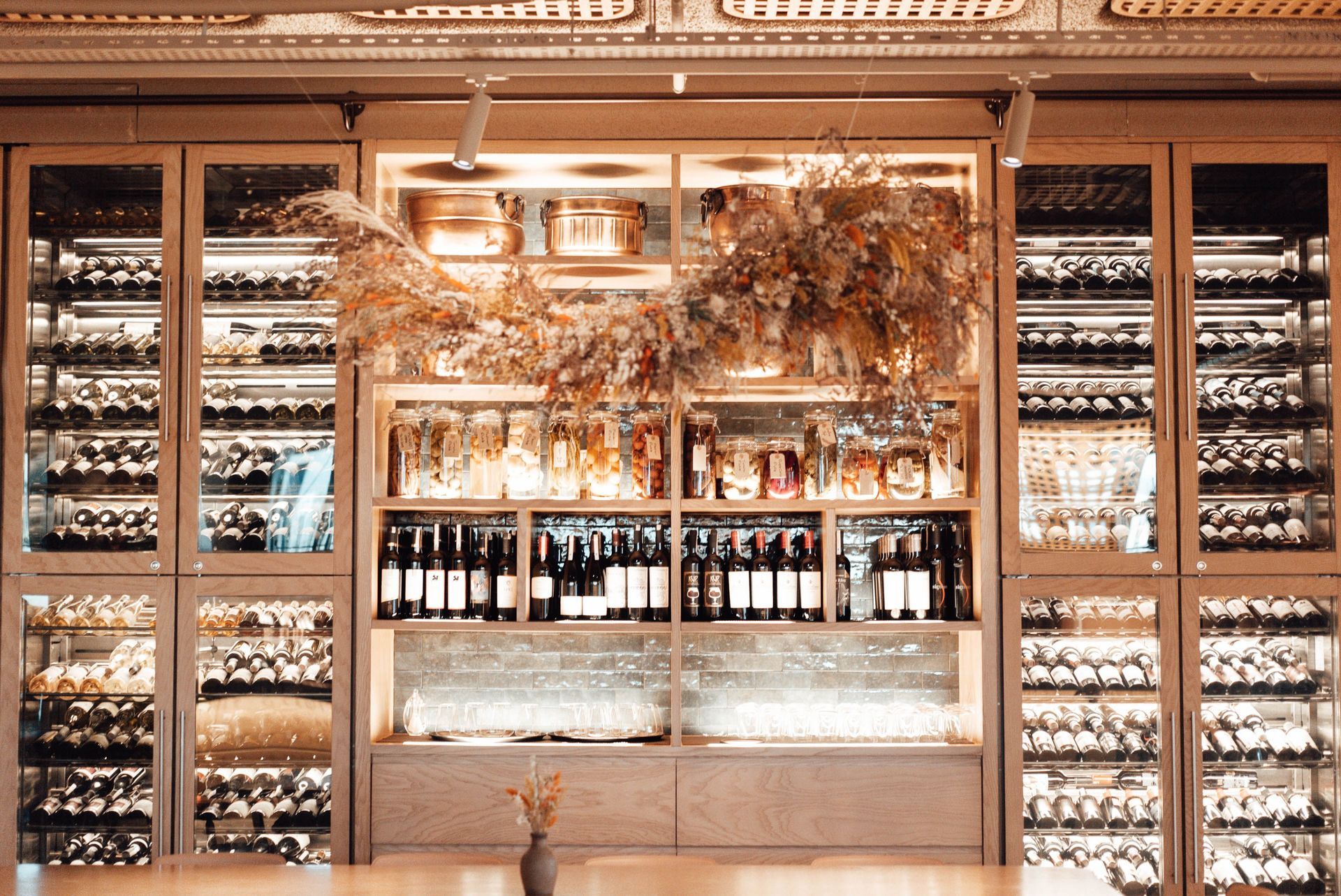
Before you choose a rack style, stand in the cellar doorway and look at the wall in front of you. Whatever sits at eye level there is the first thing every guest reads, and in a standard rack that is a row of cork ends. A display row is the part of a wood rack built to fix that: a single run of bottles, one per column, tilted so each label faces the room while the wine still touches the cork. Deciding where that run goes, and how much of the wall it uses, is work you can finish on a drawing before a single board is cut.
How a Display Row Holds a Bottle
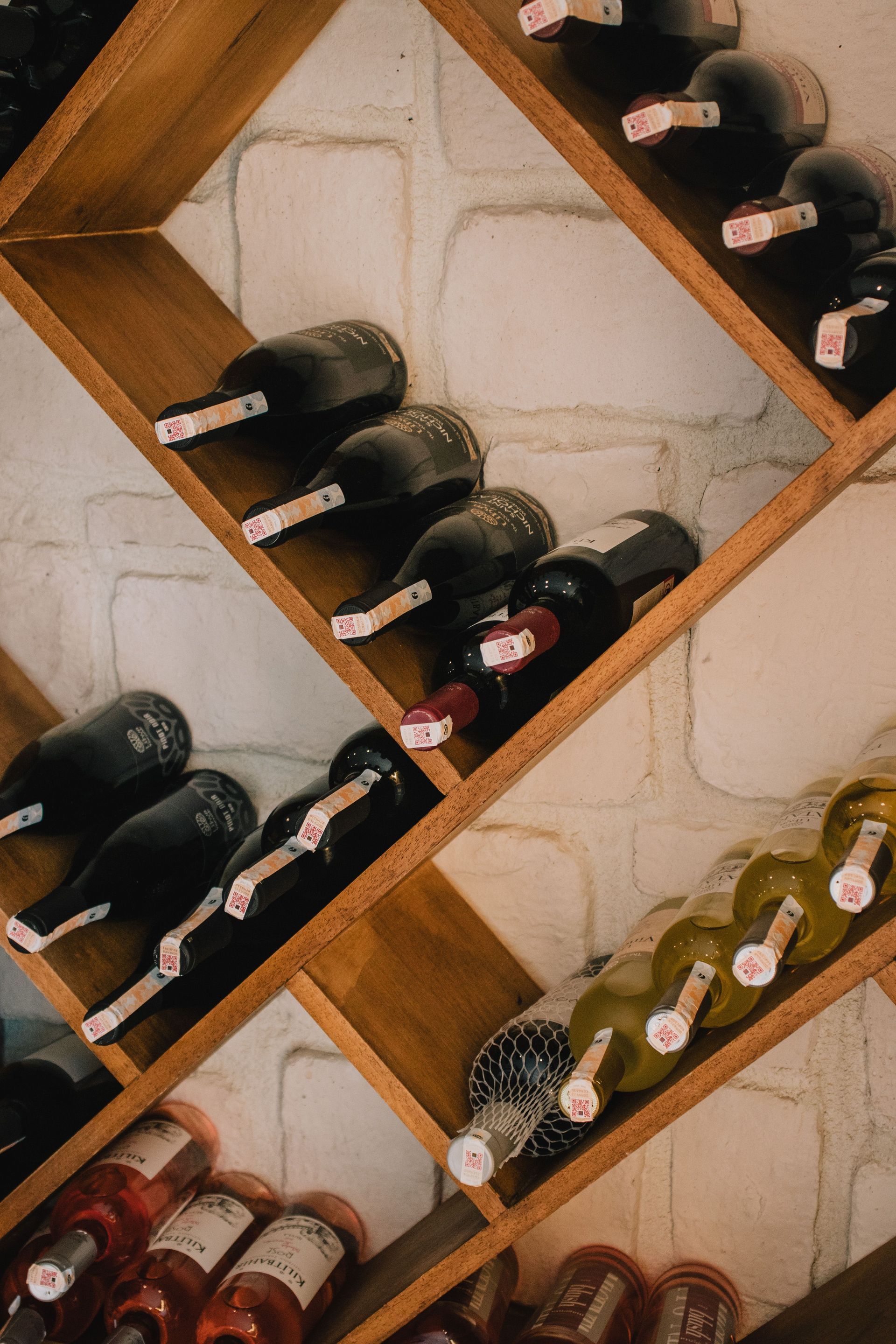
A standard rack cubicle holds a bottle lying flat with the neck facing out, so the viewer sees a cork end and a thin band of glass. A display row changes the cradle. Each column rests its bottle at an angle with the label turned outward. The angle is slight enough that the wine stays against the cork, which is why a display bottle can be stored for the long term and not only shown for a week before it is opened.
The cork matters because a cork that stays wet stays swollen and sealed, while one left dry can shrink and let air in. A bottle stood fully upright loses that contact. A bottle laid flat keeps it. The tilted display bottle sits between the two positions, and the design works only while the tilt stays small enough to leave the cork covered by wine.
The columns in wood rack kits are 3 3/4 inches across, sized for standard bottle shapes. A display row on the same wall is drawn on the same column lines as the racking around it, so the uprights stay aligned from the toe-kick up to the top of the wall.
High Reveal and Low Reveal Compared
The two names describe how much of each bottle the row shows. A high-reveal row presents more of the bottle face, so the label reads from across the room. A low-reveal row shows less, which keeps the row slimmer and leaves more of the surrounding rack intact. The word "high" refers to the amount revealed, not to a position high on the wall.
Both rows do the same job and carry the same two parts: a one-bottle-per-column cradle and a light valance above it. The choice between them is a choice about how much attention a given bottle should get and how much wall you can give up.
The table below sets the two side by side as a planning aid. The exact tilt and projection vary from build to build, so the drawing settles the numbers for your room.
| Question |
High reveal |
Low reveal |
| How much of the bottle shows |
More of the label face |
Less of the label face |
| Where it fits in a wall |
A feature row at the focal point |
Repeated rows along a section |
| What it asks of the wall |
More height per row |
Less height per row |
| Best for |
Bottles guests should read first |
A steady line of labels without crowding the rack |
The Valance and the LED Strip
Above each display row sits a light valance, a narrow wood hood that runs the width of the row. It hides the LED ribbon mounted beneath it, so a guest sees the glow on the bottles and not the strip. Without the hood, the strip glares at anyone standing in front of it and its wiring shows.
The valance also gives the lighting a place to live. A ribbon strip needs a flat, protected mounting face and a path for its power feed, and the hood supplies the face. The feed path is far easier to settle before the walls close, because the power has to reach the hood from outside the rack.
CAUTION
LED wiring, the power feed and the connection to the cellar's circuit are an electrician's job. Ask the designer to mark the feed path on the drawing, and leave every live connection to the electrician.
Where the Row Sits in an Elevation
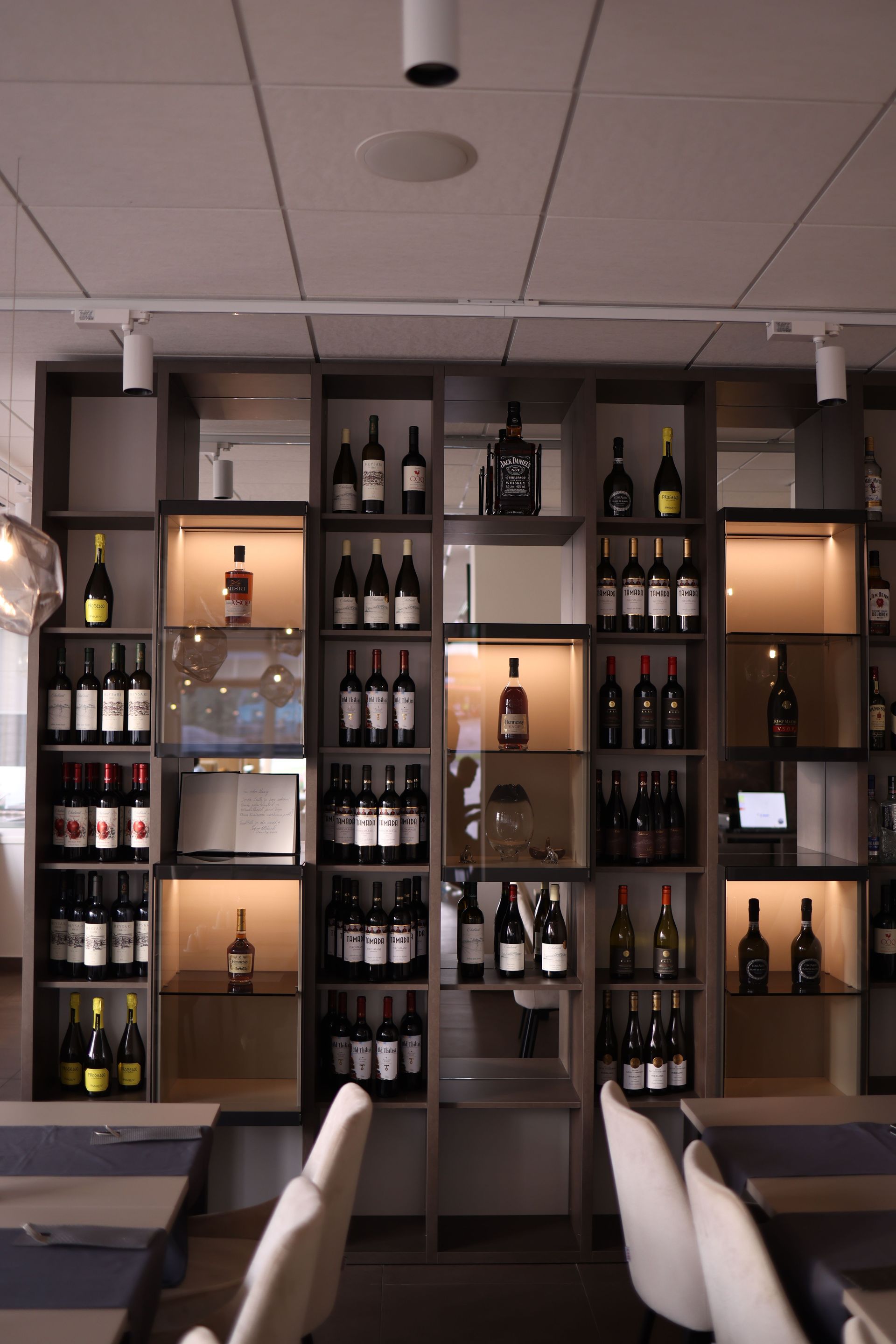
An elevation is the flat drawing of one wall as if you were facing it, with every rack, bin and shelf drawn to scale. On that drawing, the display row belongs where the eye lands first. The sightline from the door decides it: draw the line from the doorway across the wall and put the row where that line meets the rack.
Below the row, the wall can carry bins or case storage that nobody needs to read. Above it, the rack can go back to ordinary cubicles. A row placed low gets read only by a person who bends. A row placed near the ceiling makes guests tip their heads back to read it.
A single high-reveal row at the focal point, with low-reveal rows repeating along the same wall, gives the eye a route across the room. Draw the valance with the row, too. It adds its own height to the band, so the first ordinary cubicle above the row starts higher than it would on a plain wall.
What the Row Costs in Capacity
Every bottle in a display row is a bottle that is not stored the dense way. In a bulk bin, bottles stack on top of one another in the same compartment, so one opening holds several. In a display row, one column holds one bottle. The row also needs more vertical space than a flat run, because a tilted bottle takes more height and the valance takes more again.
The cost shows up in two places: the bulk bottles the band could have held, and the ordinary cubicle rows the taller band displaces. Neither number is the same on every wall, which is why the count belongs on the drawing. A wall built for a large collection might use one display row and keep everything else dense. A wall built for show can afford several.
The practical response is to treat display rows as a ration. Give the best bottles the tilted cradle and let the rest of the collection live in the denser racking nearby.
Steps to Place a Display Row on Your Drawing
- Stand at the cellar door and pick the wall that fills your view. That wall carries the display row.
- Draw the sightline from the doorway to the rack and mark the height where it lands. Place the row there.
- Choose one high-reveal row for the focal bottles. Add low-reveal rows only if the wall can give up the height.
- Draw the valance above each row and keep the next rack band clear of it.
- Ask the designer for the wall's bottle count with the display rows and without them, and compare the two numbers.
- Mark the LED feed path and power source so the framing is ready before the walls close.
- Decide which bottles go in the rows. Pick bottles you intend to keep for a while, since the wine rests against the cork in the display position.
When to Call the Designer and the Electrician
Bring in the cellar's designer when the wall count changes, when you want display rows added to a wall that is already framed, or when you are mixing wood racking with another material. The designer redraws the elevation and returns the new capacity.
Bring in an electrician for everything that carries current: the feed to the valance, the connection to a circuit, and any later change to the lighting. Do the planning on paper and hand the live work to the licensed trade.
A display row works best kept short. One well-placed run, lit and read from the doorway, does more for a cellar than a whole wall of tilted bottles.
Frequently Asked Questions
Is the display row a separate piece added to the rack?
In kit racking it is built into the same run as the cubicles around it and tied in by the horizontal dado spacer bars, so it is drawn and built with the rack and not hung on the wall afterward.
Can the LED strip be added after the rack is built?
Yes. The valance is there so LED ribbon can be added to a row at any point, which means a row built unlit can be lit later once an electrician finds a route for the feed. Asking for a conduit or pull string at framing keeps that route open.
Does a display row work in a double-deep run?
Yes, as a row of single positions inside it. Double-deep racks are 23 inches deep and hold a second bottle behind the first, while a display row keeps one bottle per position, so the row's count stays single while the cubicles above and below it double. The drawing shows both counts.
Can a display row sit beside metal racking?
Yes. One finished cellar pairs metal racks above with wood bins below, and a wood display row can sit in a mixed wall of this kind. The wood and metal sections need their column lines drawn together so the edges meet cleanly.
How many display rows does one wall need?
No set number applies. One redwood room shows four on a single wall: one high-reveal row and three low-reveal rows. That is a design choice for the wall, so ask for a layout showing the bottle count at one row and at four.
How close to the floor can a display row sit?
The rack stands on a 1 1/2 inch toe-kick base, so the lowest row starts above it. A row near the floor is read only by someone crouching, so the drawing keeps display rows nearer eye height.
See your wall's bottle count with and without a display row â the tilted rows' cost in capacity shows up on the drawing before any racking is cut. Cachet Wine Cellars serves Orange County and Southern California. Call (949) 569-7857.
Call (949) 569-7857