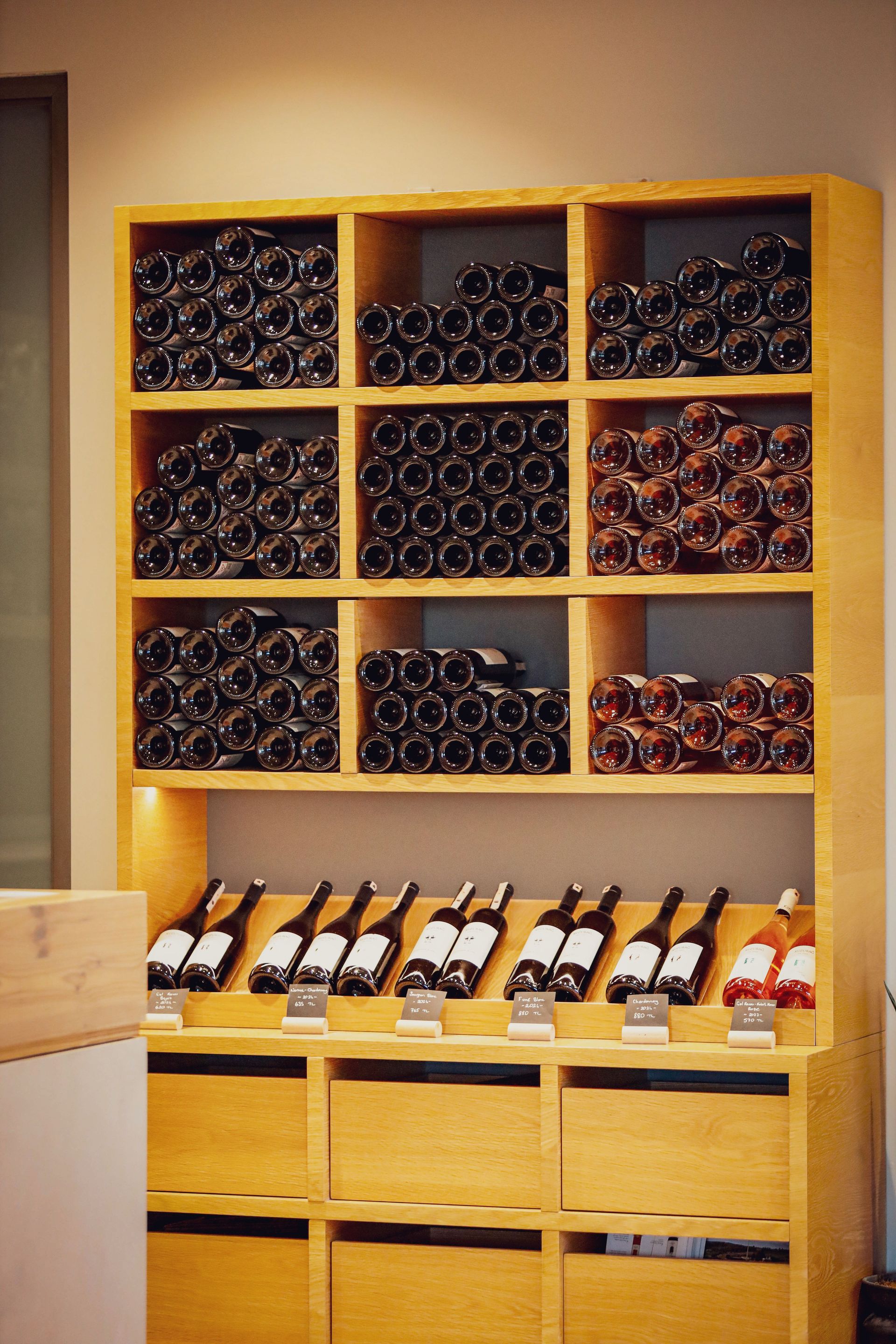
Start by writing down two numbers for the wall in question: how many bottles it has to hold, and how many of those a guest or shopper should be able to read without touching. The gap between those two numbers decides the rack. A label-forward rack lays each bottle parallel to the wall with the full label facing out, and a cork-forward rack points the neck at the room and shows the cork and capsule. Each orientation gives something up, and the choice comes down to depth, capacity and how easily the collection reads.
Start With the Job the Wall Has to Do
Every wall in a commercial space does one of three jobs, and the jobs pull the rack choice in different directions.
Selling or recommending:
a wall that helps a guest or shopper choose has to show labels. Region, producer and varietal sit on the label, and a cork-forward row hides all three behind a capsule.
Storing:
a wall that holds the bulk of the inventory has to fit the most bottles into the least floor and wall area. Here the label matters less than the count.
Doing both:
a feature wall that is also working storage, which is where mixing the two orientations earns its place.
Name the job before looking at a single rack. A wall that tries to do all three with one orientation ends up too sparse to hold the stock or too dense to read.
How Each Orientation Holds a Bottle
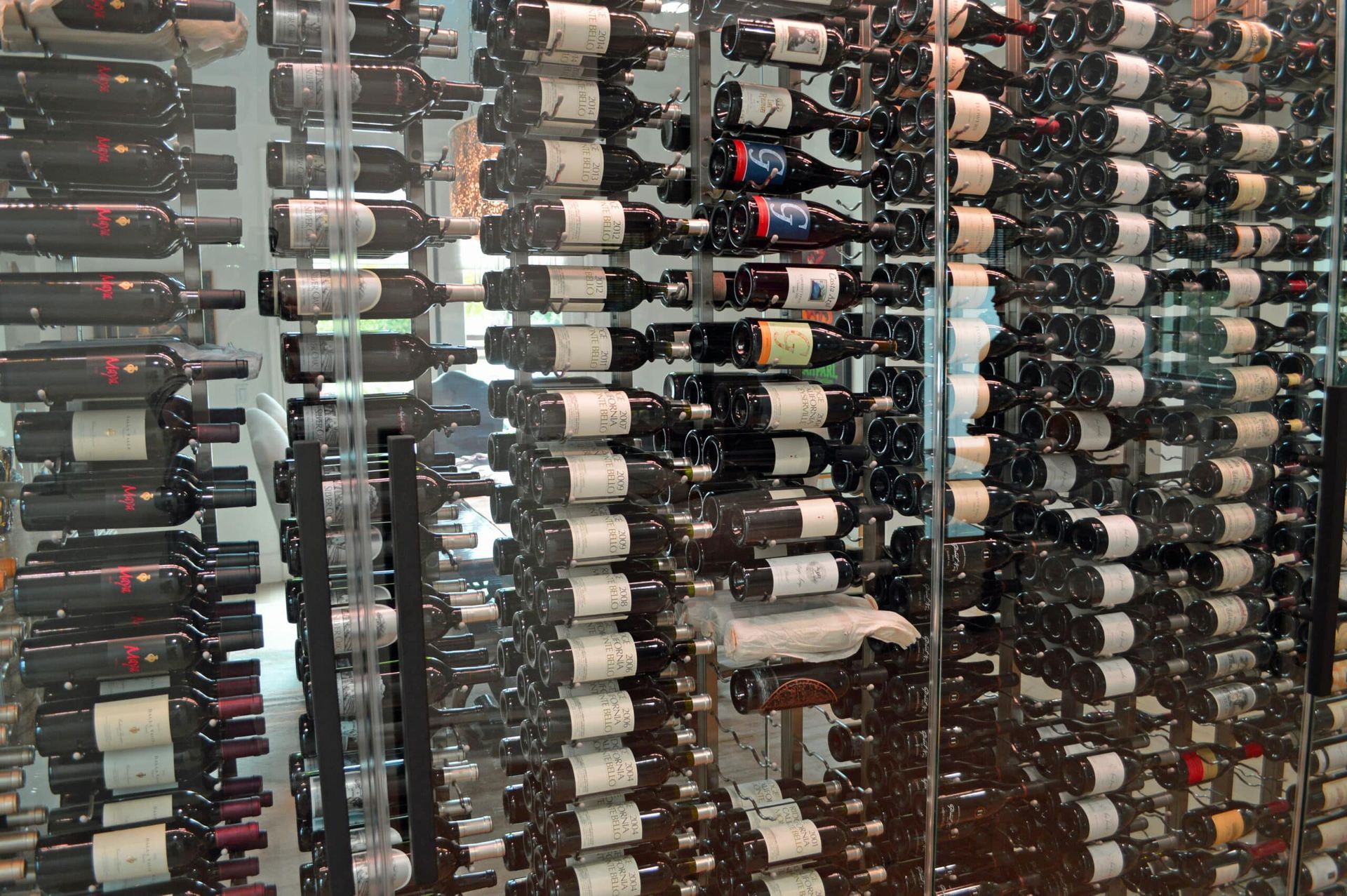
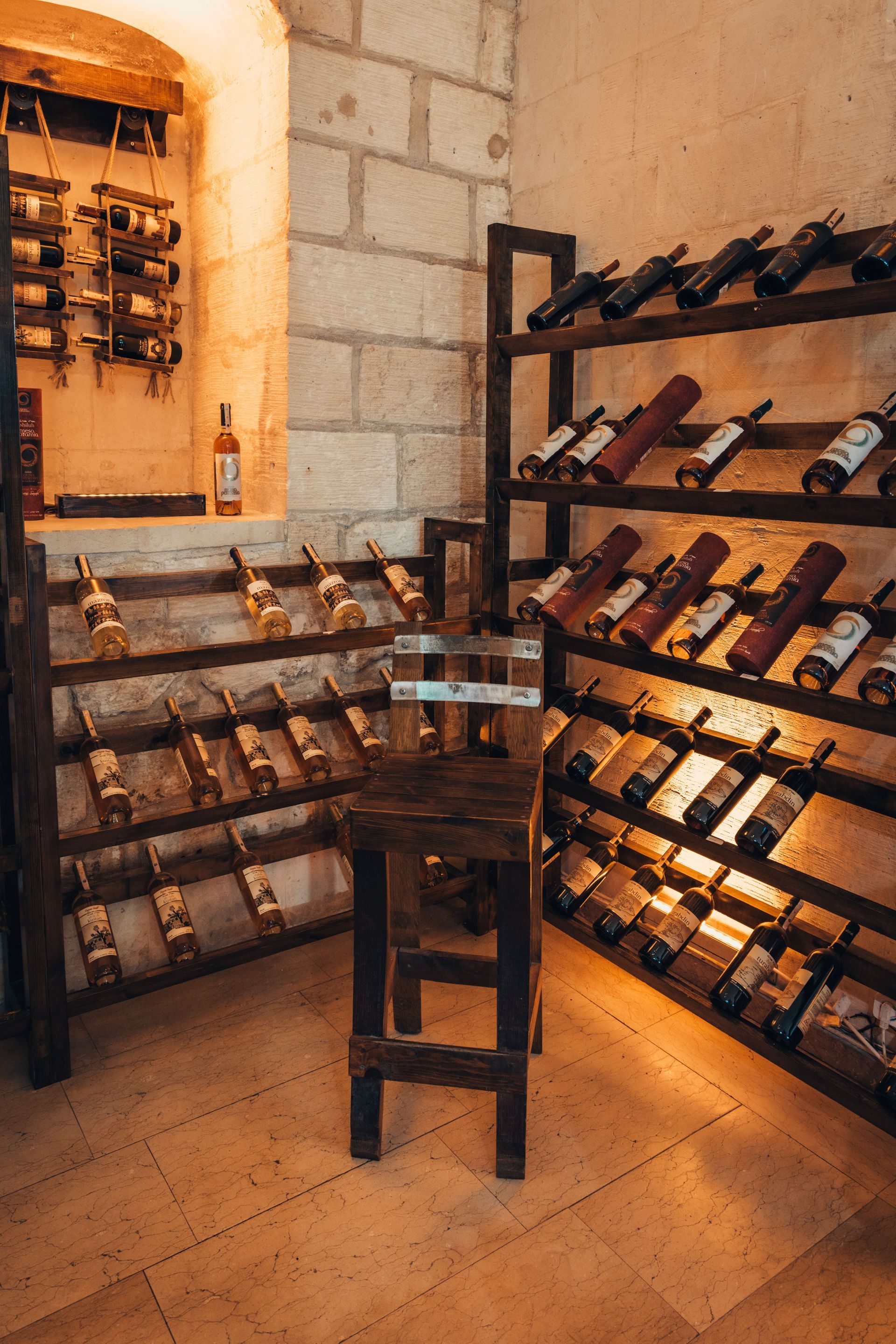
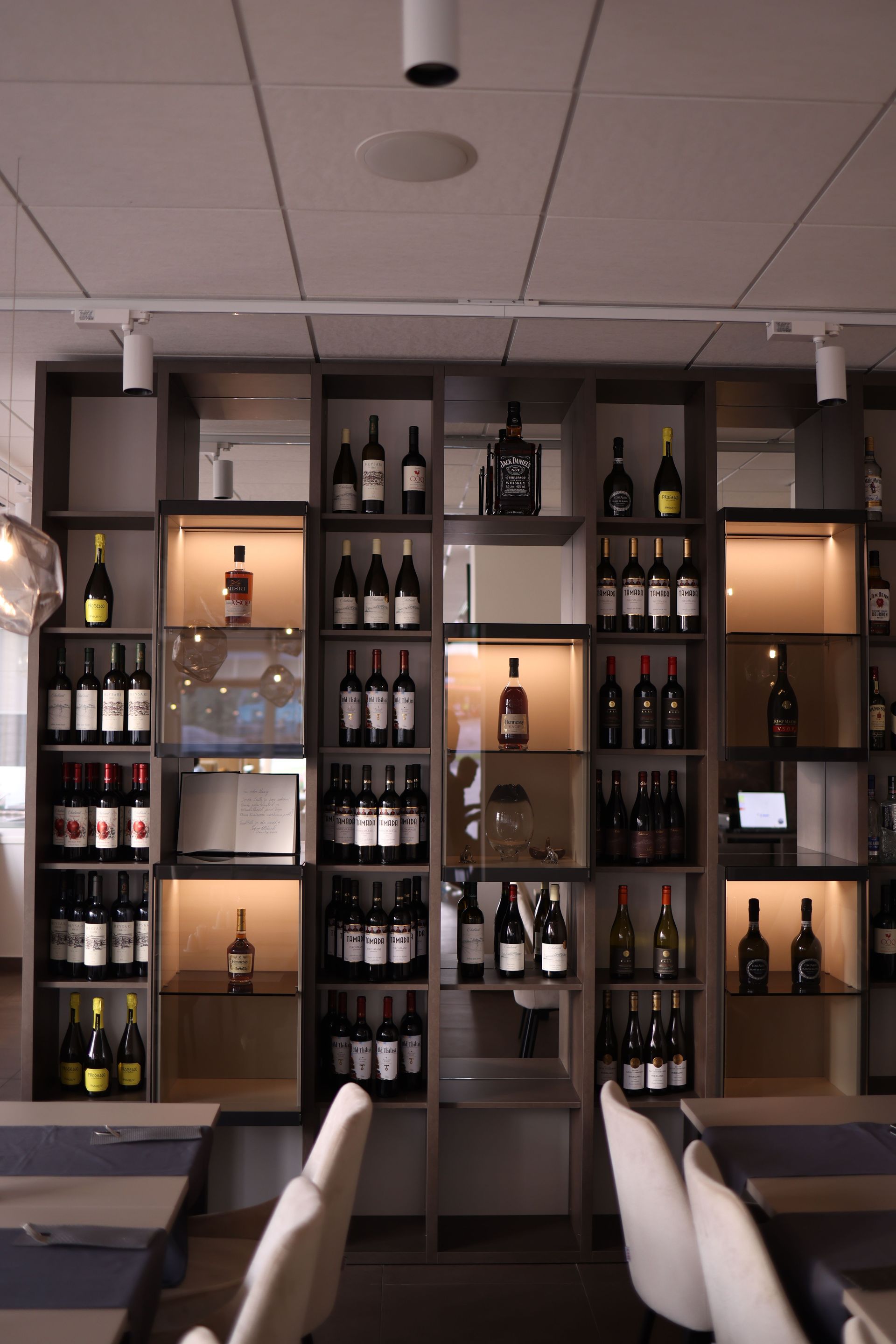
In a label-forward rack, the long dimension of the bottle runs along the wall. Each bottle sits in its own cradle, on a slim rod, or on a pair of pegs, and the label faces straight out. Because the bottle lies sideways to the room, every bottle uses a run of wall roughly as wide as the bottle is long, and the rack itself can be shallow, since the bottle does not point into the wall. Label-forward rails and pegs also come two and three bottles deep, which wins back some of the count while only the front label shows.
In a cork-forward rack, the long dimension of the bottle runs into the wall. The bottle slides into a cubicle (on a wood rack, about 3 3/4 inches wide) or onto a rod, and the neck points at the room. Each bottle uses only a bottle's width of wall, so a row holds more bottles per foot. The cost is depth: each bottle takes a full bottle length out from the wall, and the walkway in front has to leave room for that depth.
Both orientations keep the bottle horizontal. What changes is which end of the bottle faces the room.
Compare Depth, Capacity, and Readability
The table below sets the two orientations side by side on the points that decide a commercial layout.
| Point |
Label-forward |
Cork-forward |
| Rack depth |
Shallow; the bottle lies along the wall |
Deep; the bottle runs into the wall |
| Bottles per foot of wall |
Fewer, unless the rack is two or three deep |
More |
| What a guest reads |
Full label |
Cork and capsule |
| Handling to find a bottle |
Low; read and pull |
Higher; identify, then pull |
| Best role |
Featured and recommended bottles |
Bulk and back-up stock |
Depth is the number that catches owners out. A cork-forward wall spends depth and saves width; a label-forward wall does the reverse. In a narrow corridor or a shallow alcove, a label-forward wall can be the only orientation that fits at all, while a long, deep wall lets cork-forward hold a larger share of the stock.
TIP
Tape the planned rack outline on the wall, then stand where a guest usually stands. If a label on the top row cannot be read from that spot, lower the row or move the seating before anything is ordered.
How Staff and Guests Handle Each Wall
Handling is where the two orientations feel different day to day. On a label-forward wall, a bottle is identified by looking, so a server or shopper can read a whole row, decide, and lift out one bottle. The neighbors stay where they are.
On a cork-forward wall, the label is hidden inside the cubicle or behind the neighboring bottle's shoulder. Finding a specific vintage can mean sliding a bottle partway out to read it, then sliding it back. Every extra touch is a chance to scuff a label or knock the neighboring bottle, and in a busy service the habit of checking by pulling slows the pour.
That cost is manageable when the same two or three people work the wall and know where things sit. It grows when the wall is shared across shifts, when a guest is invited to browse, or when the inventory turns over weekly and the positions keep changing. In those cases the label-forward share of the wall should rise, even though it lowers the bottle count.
Steps to Choose for Your Space
Work through these in order, and bring the answers to the designer.
- Measure the wall, then the walkway.
Record the usable wall width and height, and the clear distance from the wall to the nearest table or aisle. This tells you how much depth a cork-forward rack can take.
- Count the stock by bottle shape.
Separate standard bottles from wider-shouldered sparkling bottles and large formats. Odd shapes need wider spacing or their own section.
- Pick the bottles to feature.
These are the bottles you most want a guest to choose, and they are the label-forward candidates.
- Assign the rest to cork-forward storage.
Everything that does not need to be read from across the room can go in the denser orientation.
- Place the featured rows at the sightline.
Eye level is the strongest position, so the label-forward rows go there and the cork-forward rows sit above and below.
- Decide how staff will find a hidden-label bottle.
The cork-forward section needs a way to name what is in it, settled before the rack is built.
A designer can turn these six answers into a drawing that shows the bottle count for each orientation on your exact wall, which is a better test than any rule of thumb.
Which Spaces Suit Each Orientation
Label-forward suits any space where a person decides by looking: a tasting room, a hotel lobby, the wall beside a host stand, a wine shop floor where shoppers browse without staff. The wall is part of the selling, so readability wins over capacity.
Cork-forward suits any space where the wall is storage first: a back-of-house room, a long corridor wall, a basement cellar that only staff enter. Capacity wins there.
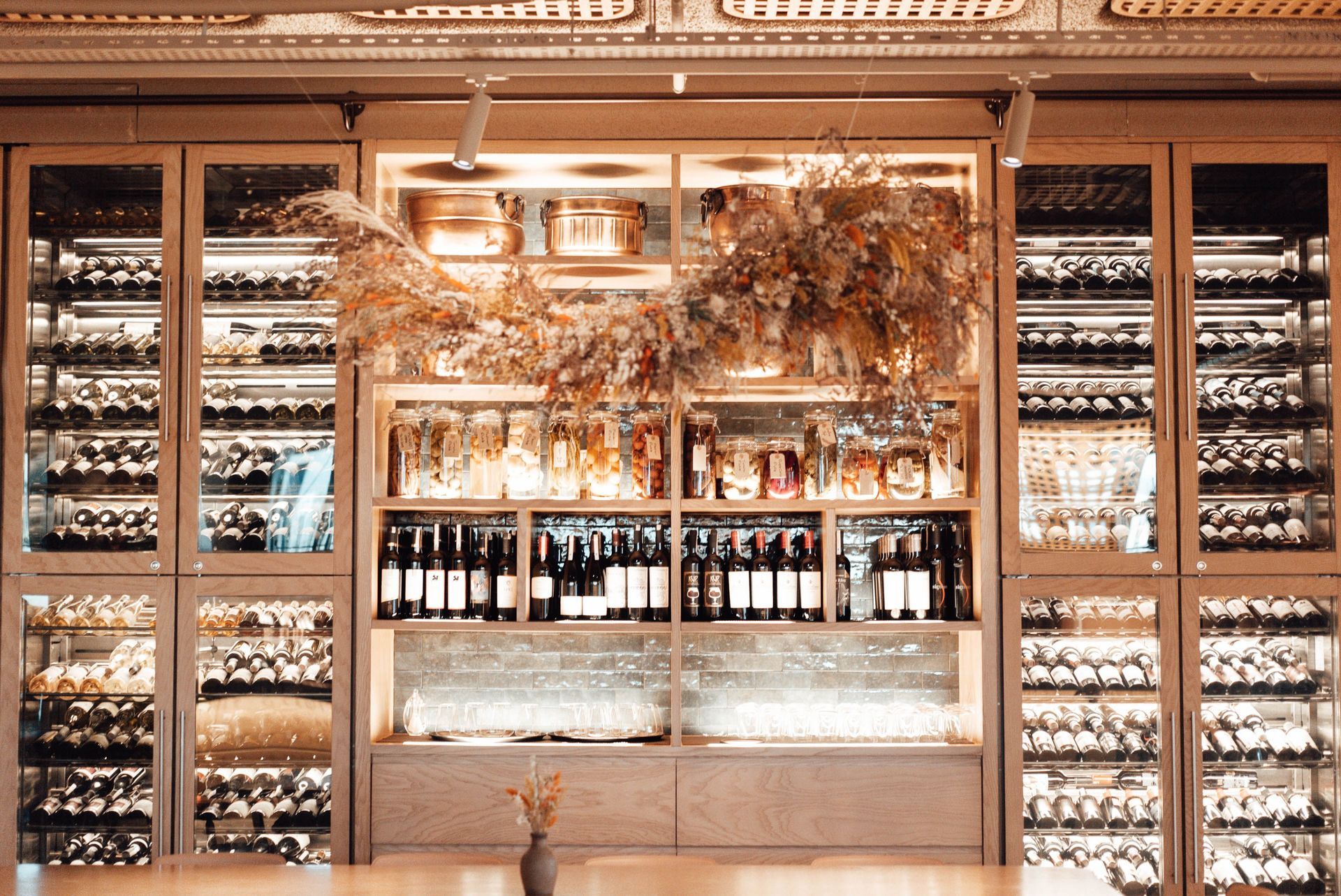
A mixed wall suits the space between those two, where guests see the wall but staff also pull stock from it. Featured rows face out at eye level and the dense storage sits above and below, which shows a chosen selection without giving up the stock behind it.
Metal systems cover all three layouts. Slim rods and single-bottle cradles give the label-forward look, and rods that project from the wall hold bottles cork-forward in a way that appears to float.
When to Call a Wine Cellar Designer
Choosing the orientation is a planning job you can do yourself. Mounting is not. A full wall of bottles carries a heavy load, and every mounting point has to land on something that can take it.
CAUTION
Leave mounting to the rack installer, who confirms what sits behind every fixing point before the first bottle goes on. Do not load any rack until the installer has signed off on the wall behind it.
A wine cellar designer also checks the points a catalog picture hides: whether the rod spacing fits your actual bottle shapes, whether the rack depth clears the walkway, and whether the lighting leaves labels readable without adding heat or glare. Bring the six answers from the steps and the designer can work from them.
The strongest wall puts labels where a guest decides and density where the stock lives. Measure the wall first, and trust the drawing over any capacity number printed on a rack.
Frequently Asked Questions
Will pulling bottles tear the labels?
A well-made rack is built to prevent it. Wood rails are sanded so rough edges cannot catch paper, and some metal rods carry soft rubber rings that grip the neck and base of the bottle. Ask to see a rail or ring up close, and run a thumb along it before approving the rack.
Can a label-forward wall hold magnums and sparkling bottles?
Yes, in positions sized for them. Wide sparkling bottles and large formats need their own cradle spacing, so they belong in a row or section of their own, apart from a run sized for still wine. Give the designer the exact bottles you stock and ask for that spacing on the drawing.
Does a display wall need to be cooled?
A display wall outside a cooled room suits bottles that will be opened soon. Bottles meant to rest for years belong in a room held at about 55 degrees Fahrenheit with humidity between 50 and 70 percent, so a cooled cellar for storage plus a display wall for featured bottles is a workable split.
Can a cork-forward wall still help guests choose?
Yes, with a card or tag at the head of each column naming the wine, region or producer. One card per column keeps the wall clean and lets a guest scan across rather than reading a tag per bottle. A wall sorted by region reads quickly even with no labels showing.
Does the orientation change how the wine keeps?
No. Both orientations hold the bottle horizontally, which keeps the wine in contact with the cork. If a display row angles bottles at all, the tilt should stay at 15 degrees or less so the corks do not dry out.
How deep does a multi-deep label-forward rack get?
A single-deep horizontal rack measures about 6 inches from the wall, and a three-deep version about 13 1/2 inches. The front bottle shows its label and the two behind it add count, so a shallow wall can carry more stock while staying readable at the front.
Request a rack layout for your wall â bottle counts for each orientation on your exact wall length, with the guest-readable rows marked. Cachet Wine Cellars serves Orange County and Southern California. Call (949) 569-7857.
Call (949) 569-7857