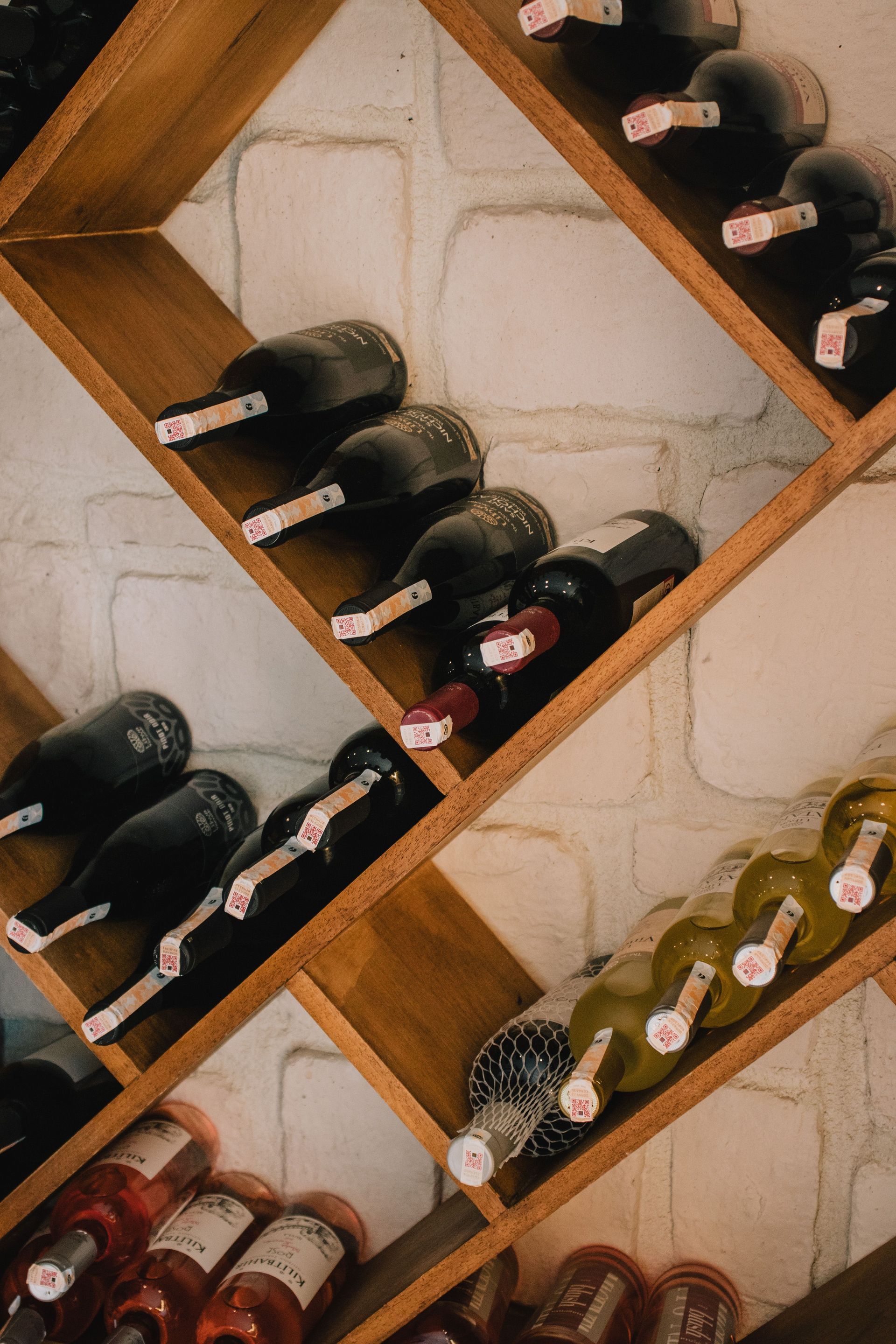
You buy a case of one wine, and the wall you planned has a slot for every bottle but no sensible home for twelve of the same label. The same wall may also have no flat spot where a decanter and glasses can sit while you pour. Both problems come from racking built entirely of single-bottle openings, and a lattice X-bin is the part of a rack kit made for them. Two crossed lattice strips split one bin into four triangles, and each triangle holds a pile of bottles lying on their sides. The table below links each symptom to its cause and to what a bin changes.
| Symptom |
Cause in a slot-only wall |
What a bin changes |
| A case of one wine ends up in twelve separate openings |
Each opening is sized for exactly one bottle |
One triangular pile takes the whole purchase in one place |
| Nowhere to rest a decanter or a carried bottle |
The racking runs to the ceiling with no horizontal surface |
A tabletop spans the bins at working height |
| The wall reads as a grid of identical holes |
Every opening repeats the same size and rhythm |
The crossed strips break the grid into a diagonal pattern |
| Part of the wall width goes to divider strips |
Every bottle sits between two vertical strips |
Bottles in a pile touch each other with no divider between |
How the X Divides a Bin
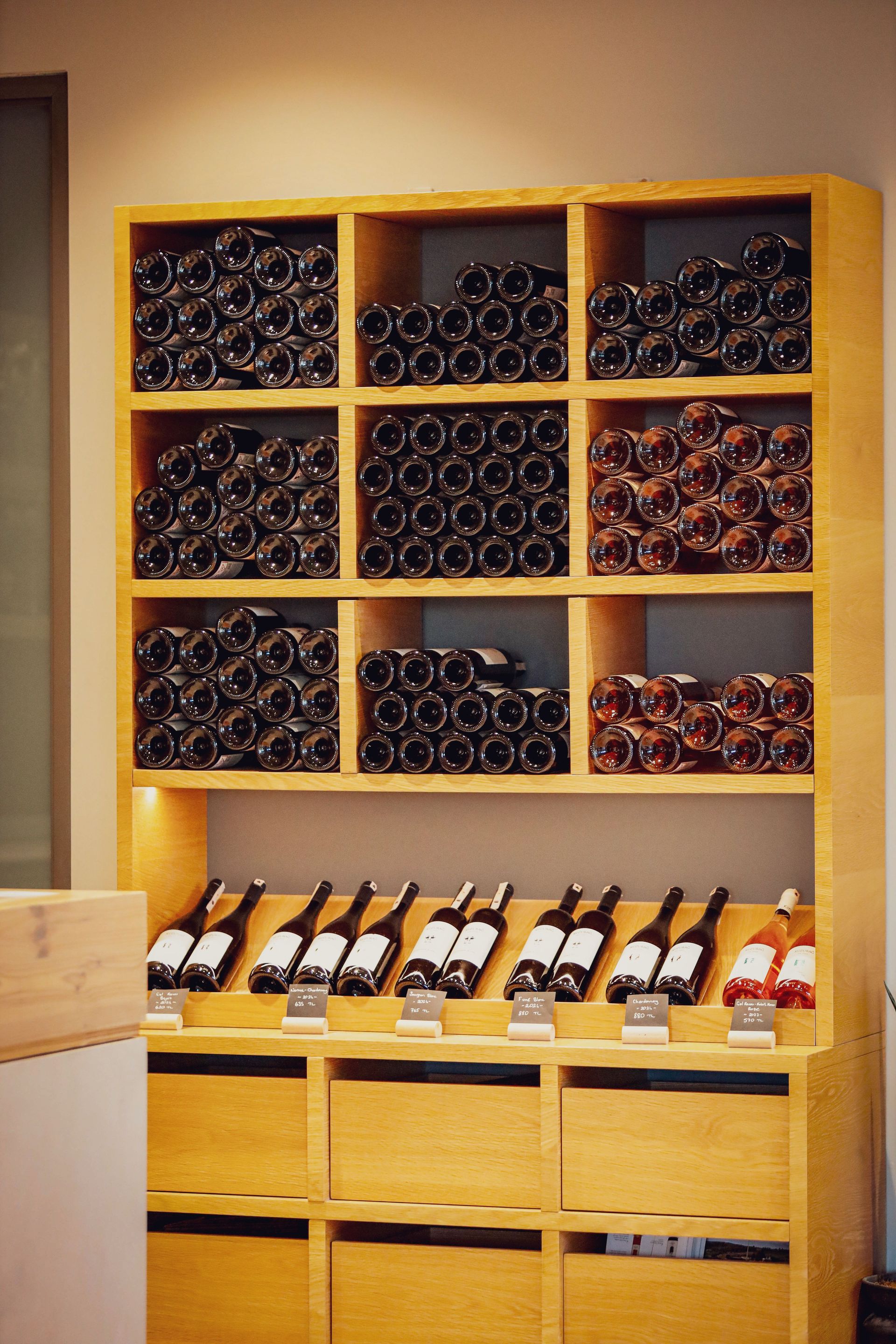
A bin is an open box with no vertical strips inside it. The lattice strips run diagonally from corner to corner and cross at the center, which leaves a triangle at the top, one at the bottom, and one on each side. Bottles are laid on their sides with the neck toward you, and each row rests on the row beneath it and against the sloped strips beside it. The strips stop the outer bottles from rolling out of the stack, a job a pile would otherwise need a wall for.
Lattice means the strips are crisscrossed wood with open gaps between them, so a bottle touches only the strip edges and its neighbors. A solid divider would cover a long stretch of glass. The gaps leave much of each bottle's surface open to the room air, and they keep the bin light to the eye.
The geometry also sets the shape of the pile. A bottom triangle is widest at the floor end and narrows to a single bottle at the crossing, so the stack is stable and the point bottle is the first to come out. The top triangle is the reverse: the widest row sits at the top edge and the strips converge below it. The two side triangles have their widest rows at mid height. Width goes to bottles in every case, because nothing stands between one bottle and the next.
A single-deep slot, by contrast, is a cubicle about 3 3/4 inches across, sized so any standard bottle slides in and rests alone. It is a fine holder for one bottle and a wasteful holder for twelve.
Where Bulk Bins Beat Individual Slots
Bins earn their place when the same wine arrives in quantity. A collector who buys by the case for everyday drinking, for a party, or for a wine meant to be opened over several seasons gets a pile that is counted at a glance. Twelve bottles sit together, and the wall tells you the stock by looking at it. In a slot wall the same case spreads across a dozen openings, and the question of whether any is left needs a walk along the whole run.
Bins also help where the wall is short. A bay a few feet wide cannot take many columns of slots, yet the triangles stack bottles into the corners that slots leave as dead space. Where a pile fills the bin, no strip stands between bottles, so the same width of wall holds more of one wine than a run of single openings.
A third case is the wine you plan to drink within the year. Those bottles never need individual handling, so they do not need individual openings. Putting them in a bin leaves the slot columns free for the bottles that deserve their own address.
Last, a bin changes the look of a long wall. A run of slots reads as a perforated sheet. A bin run introduces diagonals, and when bins alternate with slot columns the eye has a place to rest.
TIP
Set the wine you will open soonest in the bin's bottom triangle, where the point bottle leaves first without moving the others, and keep the top triangle for wines that will sit longer.
Where Individual Slots Still Win
The same feature that makes a pile compact makes it harder to sort by wine and year. Every bottle in a triangle bears against its neighbors, so pulling one from the lower rows can shift the ones above. A wine you mean to leave untouched for years is better placed in a slot, where nothing leans on it and nothing moves when the bottle beside it is removed.
Labels are the second limit. In a pile the visible end is the base or the neck, and the label sits against the wood or another bottle. A slot, especially one with a display row, shows what it holds. If you choose by label, a bin hides your inventory from you.
Mixed lots are the third. A bin with two vintages of one producer, or one bottle of each of five wines, turns into a puzzle, because there is no row or address to say which bottle is which. The bin works as a single-wine container, so it fits a cellar where a case is a unit and breaks down in one where each bottle is a distinct decision.
The fourth is bottle shape. A bin's triangle fits bottles of similar diameter, but a pile of oversize or oddly shaped bottles can lean awkwardly against the strips. Keep the unusual shapes in racking cut for them.
The Lattice and the Air Around the Bottles
A lattice face lets room air reach the bottles at the edge of each pile. The bottles inside the pile touch each other and have less open surface, so the outer rows meet the air first and the inner ones follow. Nothing in that geometry changes what the cooling unit has to do, but it does mean a bin is open to the room and is not a sealed cabinet.
Airflow is a layout question as much as a rack question. Being lattice does not exempt a bin from the clearance in front of a through-the-wall unit. A designer reads the unit's discharge direction and the rack faces from the same drawing and keeps bins out of the stream. A pile that overhangs a vent blocks it, and the drawing is where that gets caught.
The lattice also takes finish. A wood bin rack can be stained to match the slots beside it, so a mixed wall reads as one piece of furniture even when the bottle count per square foot varies from column to column.
A Tabletop Over the X-Bins
A tabletop is where the bin wall picks up a second job. A flat surface at working height gives you a place to set a decanter, line up glasses, rest a bottle you just carried in, or lay out a tasting. Without it, the person pouring holds a bottle in one hand and has nowhere for the other.
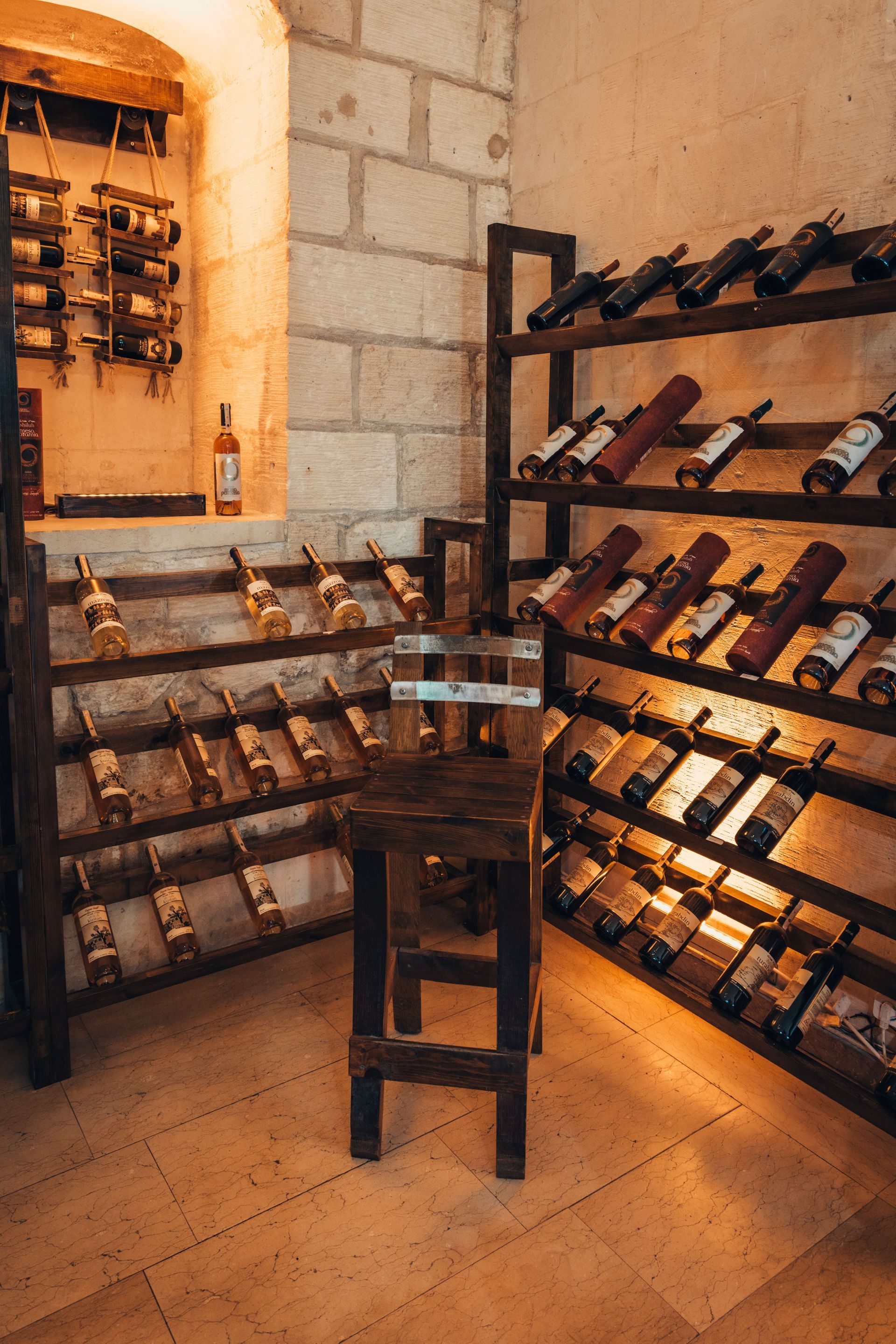
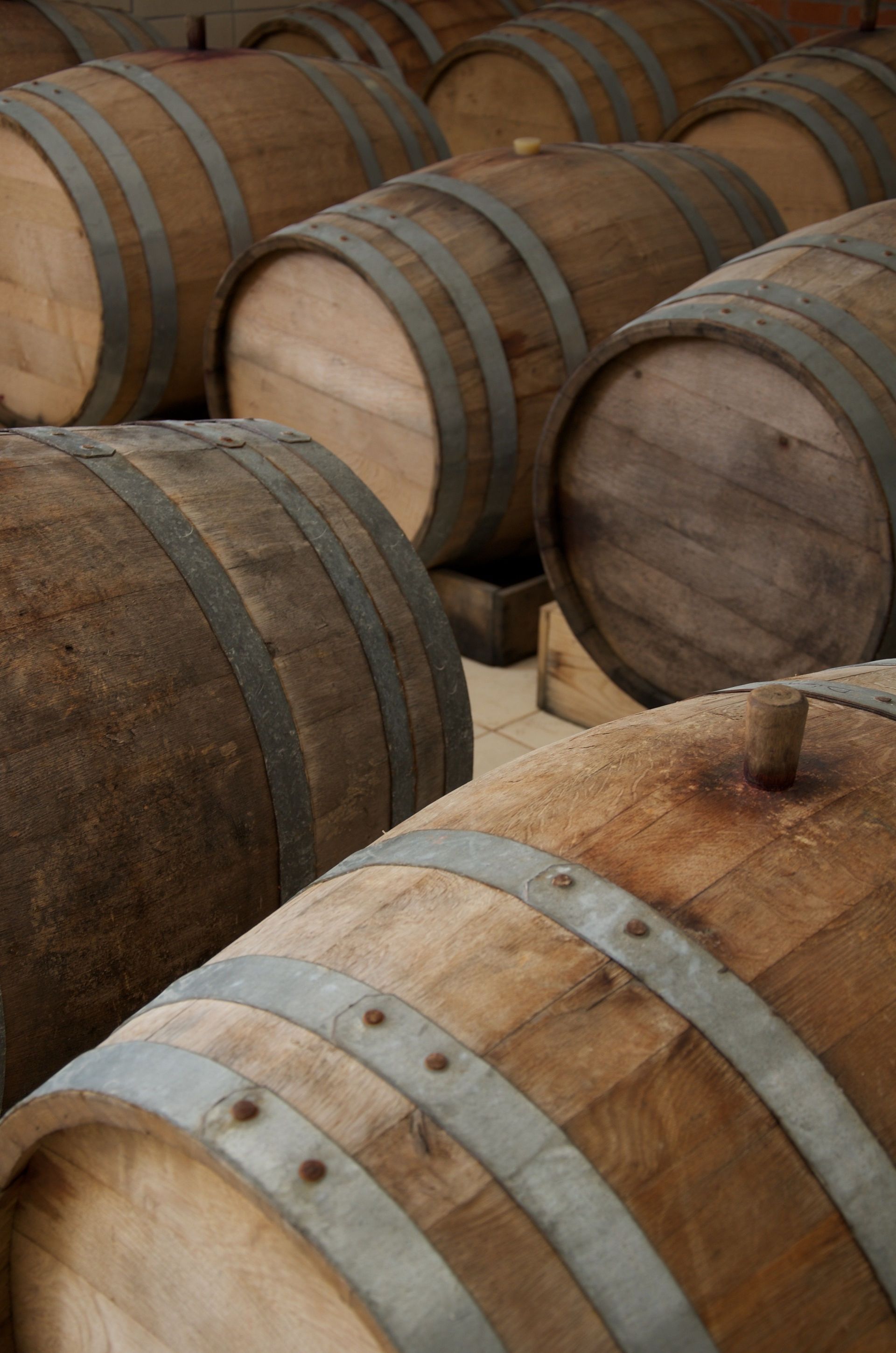
Reclaimed barrel wood is one choice for that surface. The bins below the top stay open at the front, so the bottles are reachable from the same standing position as the pouring.
The tabletop changes the bin's size, and that is a trade the drawing has to show. A full-height X-bin has tall triangles. When a tabletop sits at working height, the bin beneath it is shorter, the triangles are smaller, and each pile holds fewer bottles. The designer weighs the lost bottle count against the surface and can place the table over a low run of bins, beside a tall run, or between two tall racks.
The tabletop also takes space from the aisle. A surface that projects into the walkway by a few inches changes the clearance, and a decanting spot at the end of a run needs room for a person to stand and open a bottle. If the cellar door swings in, the swing arc and the tabletop edge must be checked against each other.
CAUTION
A cellar's cooling unit, its circuit and any lighting are fitted by a licensed HVAC/R technician and an electrician. Never move a unit's vents or block them with a tabletop or piled bottles; ask the designer to redraw the layout.
Placing Bins on Your Drawing
Start with a purchase list, not a rack list. Group the bottles by wine, and mark every wine you buy by the case or drink at a steady pace. Those are the bins. Every wine you buy in ones and twos, and every wine you want to age without disturbing, goes in a slot column.
Then set the bins at heights you can reach. Keep the bins you open most between knee and shoulder height, so nobody kneels or climbs for an everyday bottle. Place the tabletop where the person pouring will stand, close enough to the door that a guest can be served without walking through the aisle. Keep the bin faces clear of the cooling unit's front clearance.
Last, ask the designer for the bottle counts per bin from the drawing. Pile counts depend on bin width and height, and a printed count beats a guess.
Bins and slots are tools for different bottles. The wall that holds up best is one where every bottle has the holder that suits how you buy, drink and keep it.
Frequently Asked Questions
How many bottles does one triangular pile hold?
The count follows from the rows. If a pile has five bottles along its base and each row above is one shorter, it holds fifteen: five, four, three, two and one. Six along the base gives twenty-one. The real number depends on the bin's width and height, so the designer reads it off the drawing.
Do the moldings and top shelf come with an X-bin kit?
No. The trim moldings and any top shelf are separate line items from the rack kit, so list them on the order with the bins, or the run arrives without its trim and top.
Can an X-bin rack be taller than six feet?
Yes. In the traditional kit series the six-foot rack is the base unit, and a seven- or eight-foot run is built by stacking an extender above or below it. The extender can be a bin section or a cubicle section, so the added height can carry more bins or more single slots.
Will the lattice scratch a label?
The wood edges are sanded smooth by hand, and each holder is glued as well as stapled in place, so there is no rough corner or loose piece to catch the paper, though in a pile the label faces another bottle, so the strips are rarely the part that touches it.
How does an X-bin differ from a rectangular bin?
A rectangular bin has no crossing strips, so bottles lie in flat rows and the face of the stack is square. Some rectangular bin racks are sized to take whole cases as well as loose bottles. An X-bin makes four piles, with the strips holding the stack's edges.
Can the lattice style match the rest of the wall?
Yes. The wood species and stains offered for a kit apply to its lattice bins as well as its slots, and racks can be mixed on one wall. A kit run can also be combined with custom sections, so one bin can sit where a custom column begins.
List the wines you buy by the case for a wine cellar designer â the drawing can size each bin and the tabletop to your real pile counts. Cachet Wine Cellars serves Orange County and Southern California. Call (949) 569-7857.
Call (949) 569-7857