How Bottle Color Decides a Wine's Light Strike Risk
Choosing Between Them for a Specific Run
QUICK ANSWER: Light strike is a photochemical fault, not a heat problem. Riboflavin in wine absorbs violet-blue light and oxidizes methionine into volatile sulfur compounds. Clear glass transmits far more of that range than antique green or amber.
Run your inventory and split it in two. On one side, everything in dark glass: the Bordeaux in antique green, the Rhône in dead leaf, the Barolo under a heavy olive punt, the Burgundy bottles whose shoulders you cannot see through even under a bright lamp. On the other side, everything where the wine itself is visible through the glass. Provençal rosé. A good deal of Prosecco and Cava. Flint-bottled Champagne and the growers who have moved to clear glass for their blanc de blancs. Sauvignon Blanc and Pinot Grigio from producers who want the color on the shelf. Sweet wines and late-harvest bottles in tall clear flutes.
In most serious collections the second pile is the smaller one, and in a cellar built around age-worthy reds it can be a very small fraction of the bottle count. That second pile is the whole subject here. The first pile is largely taking care of itself, and nothing below is an argument for blacking out the cellar.
The reason the split matters is that the bottle is the primary filter between a light fixture and the wine, ahead of the room, the door, and the shelf. Two bottles sitting the same distance from the same LED, one in flint and one in antique green, are receiving meaningfully different doses of the only wavelengths that matter for this fault. So the design question in a cellar is never "is light bad." It is which bottles in this particular collection need distance, shielding, or a different rack position, and which ones can sit under a display light indefinitely without anyone thinking about it again.
The Reaction That Makes the Fault
Light strike, or goût de lumière, is a photochemical fault. It has nothing to do with warmth and it is not a version of cooked wine. The mechanism is a light-driven reaction between two things already dissolved in the wine.
The first is riboflavin, vitamin B2, present in wine at low concentrations and acting as the photosensitizer. Riboflavin absorbs light in a specific range, moves to an excited high-energy state, and needs electrons to come back down. The second is methionine, a sulfur-bearing amino acid, along with related sulfur compounds in the wine. Methionine acts as the electron donor. The reaction degrades it, and the products are volatile sulfur compounds: methanethiol and dimethyl disulfide are the two the enology literature names most often.
Those compounds are what you smell. Wet wool, boiled cabbage, struck rubber, drains, a general dirty-reduction character sitting on top of fruit that was fine before. In white wine the loss is often broader than the off-aroma alone. Research published in PNAS in 2022 on flint-bottled white wines described a degradation of varietal aroma identity, meaning the wine loses what made it recognizable as its own grape at the same time the sulfur notes arrive.
Recognizing it in the glass: the fault tends to build rather than blow off. A young reductive note from bottling will often soften with air in the glass or after a short decant, while a light-struck character usually holds or grows more insistent as the wine opens. The other tell is inconsistency within a single case: if one bottle shows cabbage and struck rubber and the next two from the same case pour clean, exposure history rather than the wine itself is the likely difference, and the bottle that sat outermost on a lit shelf is the one to suspect.
Two consequences follow for anyone storing wine. Riboflavin is not evenly distributed across styles, and the reaction is driven by a narrow band of wavelengths rather than by brightness in general. Both of those give you something to work with.
The Wavelengths That Do the Work
This is where a lot of cellar lighting advice stops one step short.
The widely cited work on light-struck taste puts the active range at roughly 370 to 450 nanometers. Riboflavin's absorption maxima in model wine solutions are reported around 370 and 442 nanometers, with absorption continuing to fall off across the low 500s. Look at where that sits. The lower end sits inside UV-A, but the bulk of the range is plain visible light: violet and blue, the part of a white beam your eye reads as the cool edge of the spectrum. That is precisely why light strike shows up in retail coolers and under ordinary display lighting rather than only in sunlight.
It also explains why moving a cellar onto LED settles less of this than it appears to. Most white LEDs produce light from a blue emitter sitting behind a phosphor coating, which leaves a peak in the blue region of the output. Taking ultraviolet and infrared out of that output removes two real loads and sharply reduces photochemical risk. It does not reduce the risk to nothing for a clear bottle standing under a bright, long-running display. The spec that comes out of this is color temperature: a warm 2700K to 3000K LED carries proportionally less blue in its output than a 4000K or cooler one, so warm white is the right call for any run where clear bottles are on show.
TIP: The blue pump peak inside a white LED sits near 450 nanometers, the top edge of the active band, whatever color temperature the fixture is rated at. Warm white lowers the blue fraction around that peak without removing it.
Bottle Glass Is the First Filter
Glass color is not a styling decision made by the producer alone. It is a filter with measurable behavior in exactly the range that matters.
Flint, meaning clear glass: the least protective by a wide margin. It passes the violet-blue band close to unimpeded, which is why every published comparison of glass colors puts flint at the exposed end. Put the same white wine into flint and into green glass, expose both, and the flint-bottled wine picks up the fault sooner and carries it more intensely.
Antique green and dead leaf: substantially protective. These are the traditional Bordeaux and Burgundy colors, and the protection is a side effect of the color itself, so it cannot wear off or be stripped. In situ measurements published in OENO One in 2023 reported clear bottles transmitting up to about 35 percent of the harmful UV-violet range, against up to about 8 percent for bluish-green glass. Treat those as figures from one measurement campaign rather than a universal constant, because glass thickness, tint formulation, and the curvature of the bottle at the point measured all move the number.
Amber and near-opaque dark glass: the most protective of the common colors. Writing on the rising use of clear bottles, Jancis Robinson has put amber's blocking of harmful light at 90 percent or more, and the same protective logic is why amber persists in beer packaging, where the same riboflavin chemistry produces the same skunked character.
The practical read is that a heavy dark Bordeaux bottle is substantially self-protecting, and a flint bottle is carrying almost none of the load. The wine inside a clear bottle is depending entirely on where you put it.
Distance Changes the Dose Faster Than You Expect
Irradiance from a small source falls off with the square of distance. Double the gap between an emitter and a bottle face and the light landing on that face drops to roughly a quarter of what it was. The relationship is an approximation, exact for a point source and looser for a long linear strip or a heavily diffused fixture, but the direction is reliable and the magnitude is large.
That single fact does most of the work in a cellar. Moving a clear-glass display row from directly beneath a puck to a position a foot or so further off the emitter is not a marginal improvement. It changes the dose that bottle face accumulates by a large multiple, for no cost and no visible change to the room. It is also why a fixture tucked tight into the underside of a shelf above a clear bottle deserves more thought than the same fixture over a row of dark reds.
Ambient cellar levels of 100 to 200 lux and task levels of 300 to 500 lux are sensible working targets, and the payoff for holding to them is cumulative. A storage run kept at 150 lux instead of 400 delivers a little over a third of the exposure to the same bottle face across a year of standing in the same position. Bright enough to read a label and find a bottle is the whole requirement.

Duration Is the Variable You Actually Control
Dose is intensity multiplied by time, and time is the input a homeowner has complete authority over.
A cellar that is lit for the twenty minutes someone is in it, several times a week, is a fundamentally different exposure environment from a glass-walled display cellar lit for twelve hours a day so the room reads well from the living space. Both can be correct choices. They are not the same problem, and they should not get the same lighting plan.
Occupancy control: the cheapest protection available. A door switch or occupancy sensor on storage-zone lighting means the deep racks are dark whenever nobody is in the room, which for most collections is nearly all the time.
Zone separation: put display lighting and storage lighting on separate circuits so the show can stay on without the whole cellar staying on with it. Wire the storage circuit to the occupancy sensing above and the deep racks go dark whenever the room is empty, whatever the display rows happen to be doing.
Dimming: running a display run at a fraction of full output during the hours nobody is looking at it reduces intensity and duration together.
Rack Position Decides What Gets Exposed
Everything above resolves into a layout decision, and it is worth making deliberately rather than discovering it later.
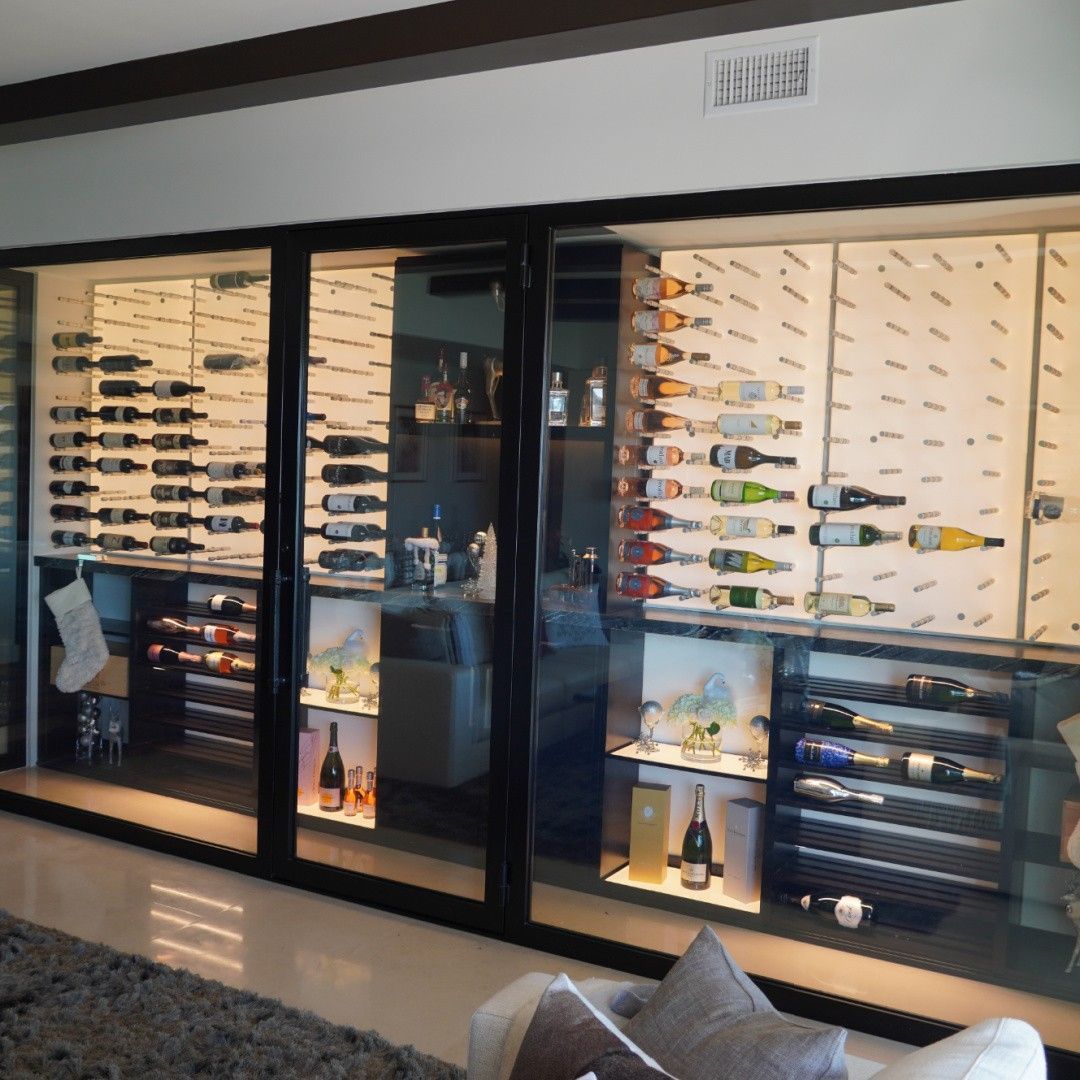
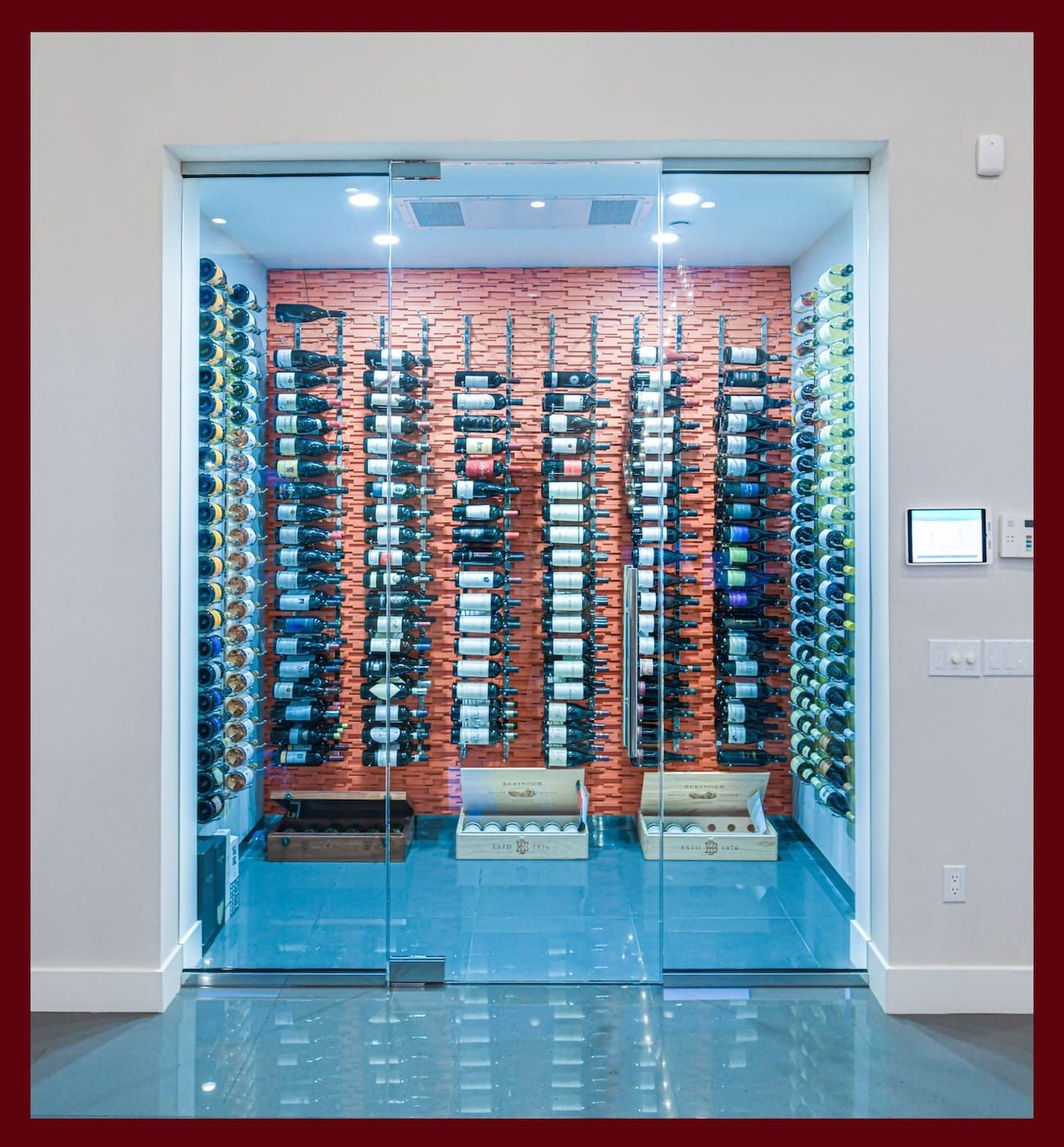
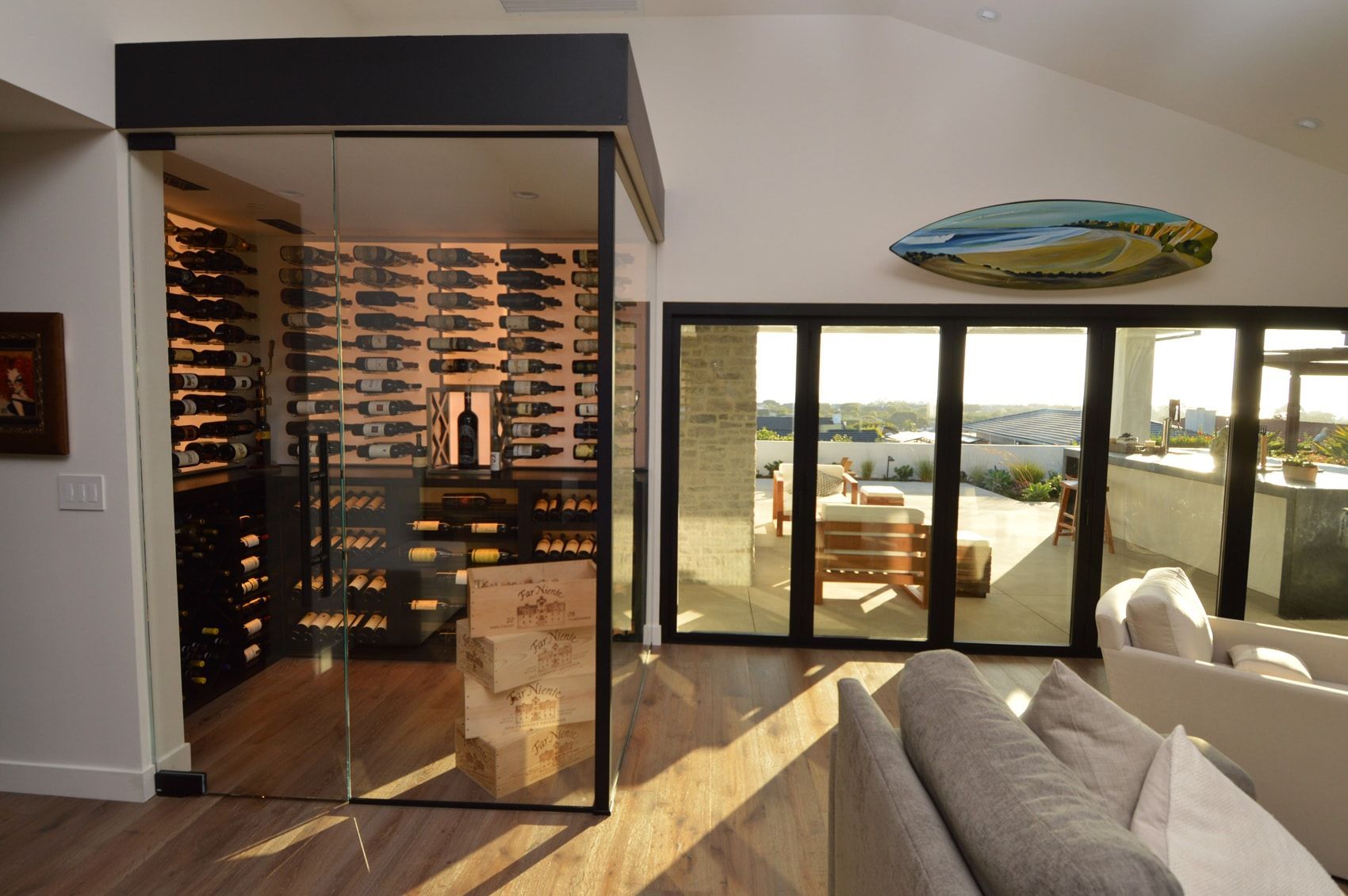
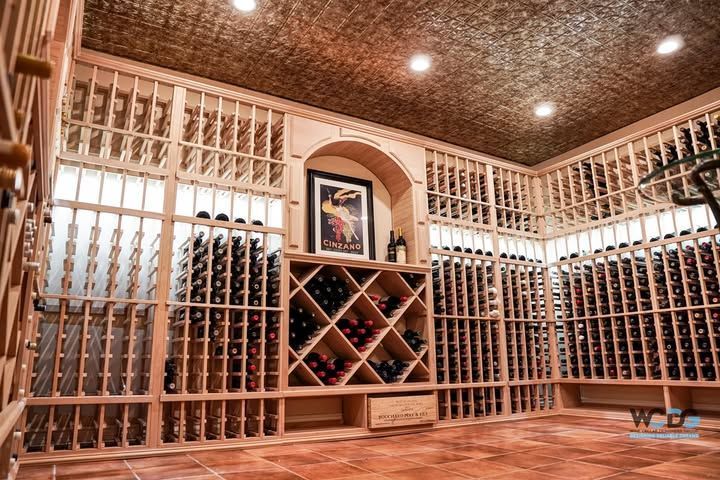
Sort the racking by what each position does. Display rows, label-forward presentation racks, and cable systems in a glass-walled cellar are the high-exposure positions: the bottle face is turned outward toward the viewer and toward the fixture, and in a glass cellar it may also be catching whatever daylight reaches the adjoining room. Cork-forward horizontal racking, diamond bins, and magnum racks in the body of the cellar are the low-exposure positions, with bottles mostly shading each other and presenting only a base or a neck to any beam.
Then match the bottles to the positions. Flint-bottled Champagne, rosé, and clear-glass whites belong in the interior racking, the lower bins, and the shaded runs. If a clear bottle needs to be on display because it is beautiful and that is the point of a display cellar, put it there knowing it is a short-horizon bottle. Rosé and most clear-bottled sparkling wine are meant to be drunk young anyway, so a bottle on show for a few months before it is opened is a reasonable trade.
Reserve the display rows and the label-forward positions for dark glass. A Bordeaux bottle in antique green will show beautifully under a warm accent light and is carrying its own filter while it does. That is the whole design move: the bottles that photograph well are largely the bottles that can take the light, and the bottles that need shade are mostly ones you were going to drink within a year or two regardless.
Sort once, at the design stage, and you never have to think about it again.
Frequently Asked Questions
Does light strike affect red wine the same way?
Red wine is doubly protected. It typically carries less riboflavin than white wine, and it holds a heavy load of phenolics and anthocyanins that absorb strongly across the violet-blue region, so the liquid itself acts as a second filter behind the glass. A red in a clear bottle still loses color stability faster than one in green glass, but the classic sulfur fault is overwhelmingly a white, rosé, and sparkling wine problem.
Is light strike the same thing as oxidation?
No, and the distinction has a practical edge. Light strike leaves reduced sulfur compounds behind, where oxidation leaves aldehydes and browning. That means the usual oxidation defenses do not apply to it. Generous free sulfur dioxide, an inert-gas headspace, or a tight screwcap with low oxygen transmission will not protect a wine from light strike, and a bottle can be in excellent condition against oxidation while still being fully light-struck.
Can a winery reduce the risk before the wine is bottled?
Yes, and much of the exposure is decided in the cellar rather than in the shop. Riboflavin is released by yeast during fermentation, and extended lees contact tends to raise the level in the finished wine, so yeast strain selection and lees handling both move the number. Bentonite fining can reduce it further. Researchers have also tested glutathione as a mitigating addition, with results that appear to depend on dose rather than pointing to a simple fix.
Does the glass in a cellar door or wine wall block the damaging range?
Partially, and less than most people assume. Laminated glass with a polyvinyl butyral interlayer blocks nearly all UV below about 380 nanometers, which is worth having, but it transmits most of the violet-blue light above that threshold, and that is the larger part of the active range. Low-emissivity coatings mainly target infrared for thermal performance rather than the short visible wavelengths. Glazing helps at the margins; it does not replace bottle color or position.
Can a light-struck bottle recover?
Sometimes, partly, and only early. The literature describes an initial phase where the reaction products can interconvert and the character may fade if the bottle is returned to darkness, before the fault sets permanently. At the table, sommeliers sometimes use brief contact with clean copper to bind volatile thiols, a practice borrowed from treating reductive faults, with mixed evidence and a real risk of stripping aroma along with the off-note. Treat prevention as the only reliable answer.
Are producers doing anything about clear bottles?
Several things, though not uniformly. Some glassmakers now supply UV-absorbing flint formulations that keep the visual clarity of clear glass while attenuating part of the damaging band. Some producers ship clear-bottled wines inside opaque full-body shrink sleeves or heavily screen-printed bottles, which is effective while the sleeve is on. Others have simply moved rosé and blanc de blancs back into tinted glass. The market has not converged, so the bottle in front of you is still the thing to judge.
Get the clear-glass share of your collection counted before the racking layout is fixed — a plan built from your actual bottle list puts the flint and the rosé where the light does not reach. Cachet Wine Cellars designs and builds custom wine cellars from Irvine, California, with a lifetime warranty on every installation. Call (949) 569 7857.
Recent Posts