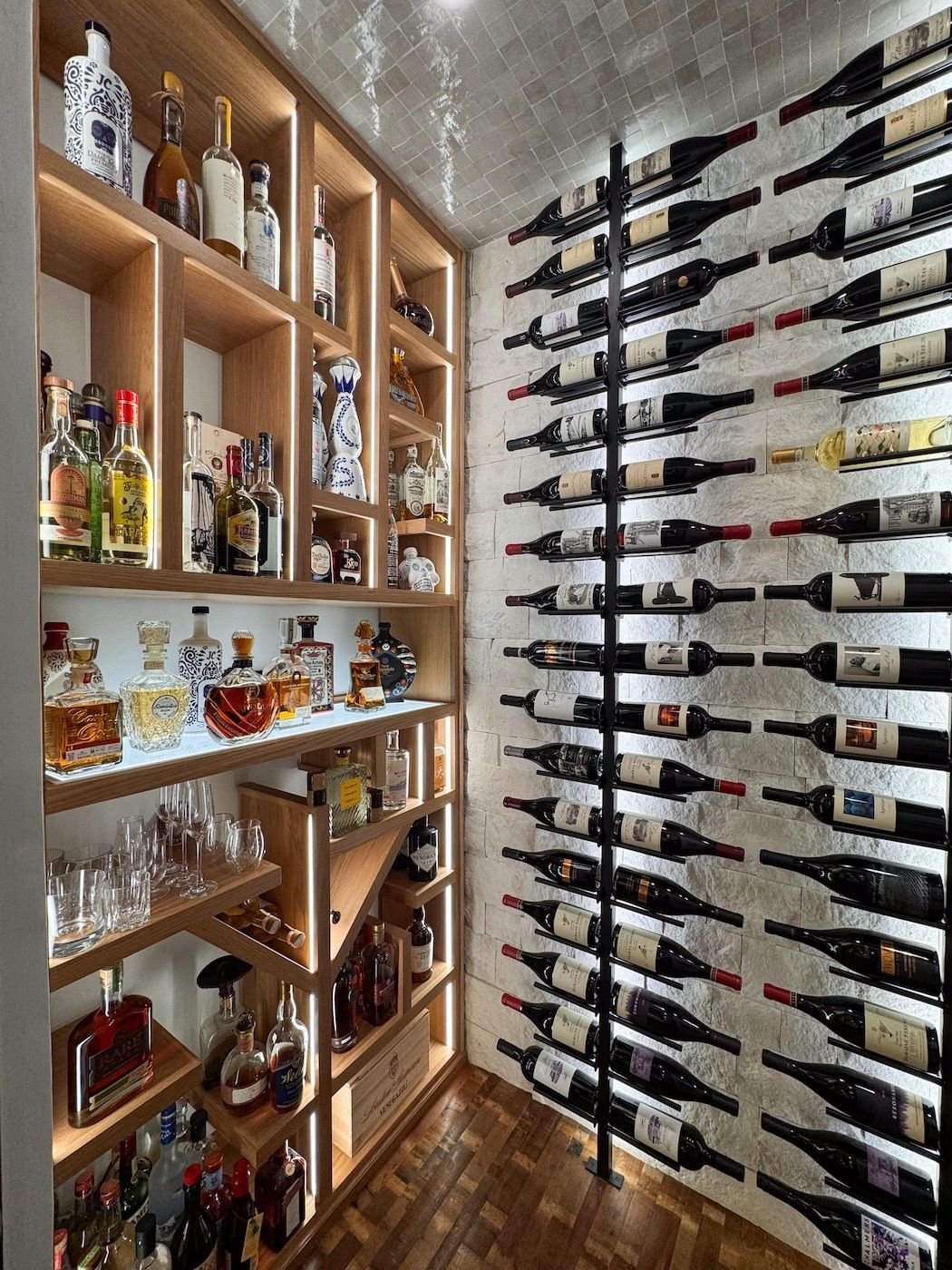
Metal Wine Rack Lighting: Control Every Reflection
Choosing Between Them for a Specific Run
QUICK ANSWER: Metal and acrylic racking reflect light instead of scattering it, so the fix is not more or less brightness. Match fixture aim, shielding, and finish selection to the specific surface, and the reflection stops landing where you stand.
A surface either scatters an incoming beam across many directions or returns nearly all of it in one, and that single distinction sets the whole plan for lighting a metal or acrylic wine rack.
Wood racking is diffuse from grain to finish coat; saw texture and open pores scatter a beam before it ever leaves the wood, which is why a fixture mounted above a wood-faced rack lights the wood and stops there. Metal and acrylic racking components behave the opposite way, to different degrees depending on finish, so a lighting plan built for wood does not simply carry over. The highlight showing up on a chrome peg or an acrylic panel is a separate problem from a hot spot on the bottle glass beside it: it comes from the racking hardware's own finish, and the fix runs through the metal or acrylic itself.
Polished and Chrome-Plated Steel: The Hard, Small Highlight
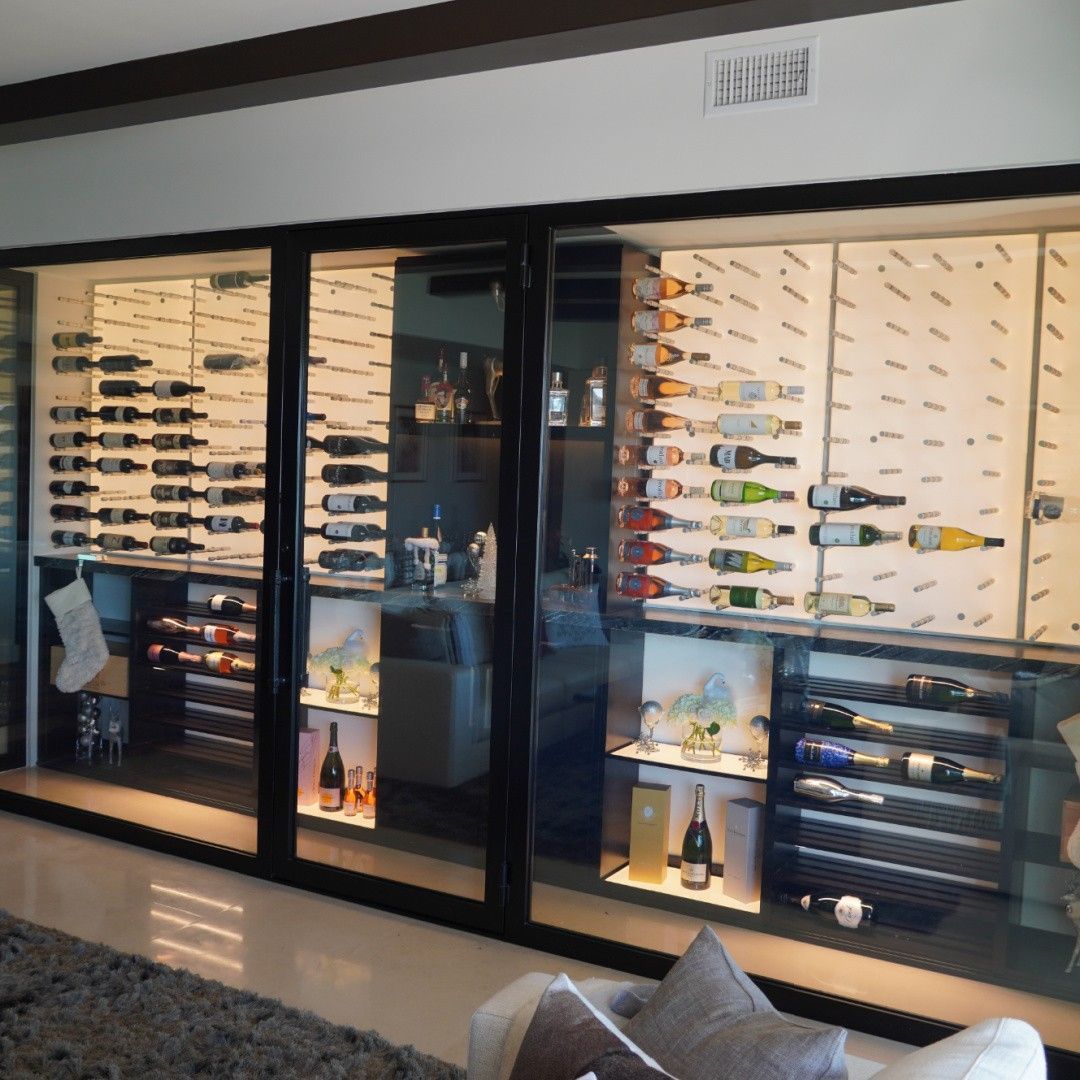
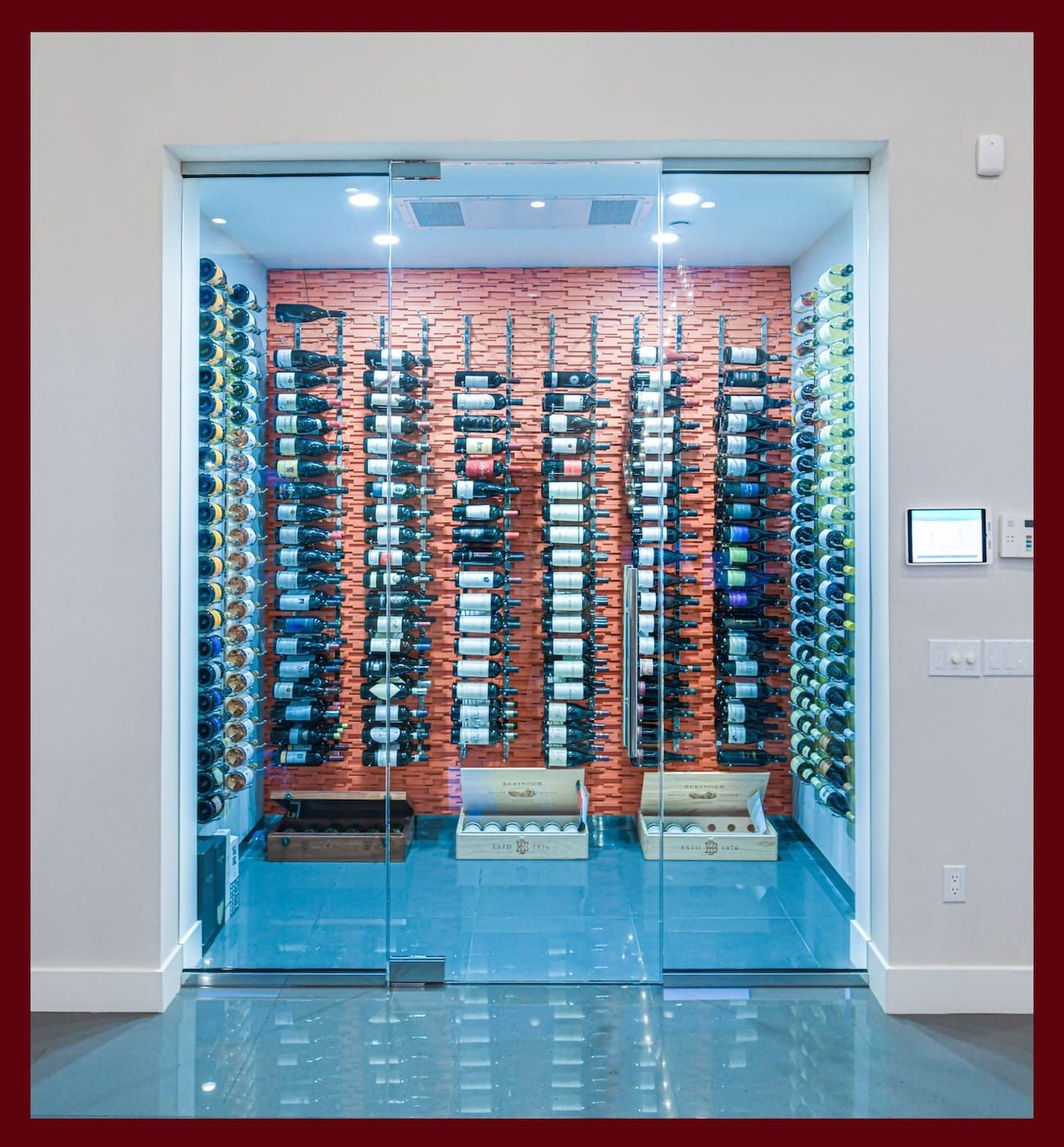
Chrome-plated steel peg systems are the most common source of a hard, concentrated reflection in a metal-racked cellar. Plating leaves a mirror-smooth, highly reflective surface on purpose, since that finish is part of the label-forward look the system is built around. Aimed squarely at it, a compact accent fixture does not read as a lit peg; it reads as a small, intense point of light sitting on the peg, close in size and shape to the fixture's own lens.
Because a peg's curved surface is small, the specular return concentrates into a tight spot rather than spreading into a wash, and that spot shifts as the viewer's position changes. Pegs sit at a fixed spacing and a fixed depth into the rack, so once a fixture's position is set, the highlight tends to repeat down the row at roughly the same point on each peg. Near the coast, salt-laden air favors brushed stainless or powder-coated hardware over standard chrome-plated steel for corrosion reasons, which happens to be the same finish choice that softens the reflection.

Brushed and Satin Steel: A Highlight Smeared Along the Grain
Brushed and satin steel finishes are created by drawing an abrasive across the metal in one direction, which leaves parallel micro-grooves too fine to feel but large enough to change how the surface handles light. A brushed surface stretches an incoming beam into a narrow streak running parallel to the grooves, instead of returning it as the single point polished chrome does.
The streak's direction is fixed by how the sheet was finished before it became a rack frame or peg support, and a fixture's aim does not change that direction. A fixture positioned along the line of the grain tends to produce a longer, more visible streak; the same fixture shifted to strike across the grain shortens it. That grain direction stays fixed no matter how large or small the finished frame turns out to be.
A brushed finish rarely disappears completely, but it trades one problem for a smaller one: a streak is easier to shield with fixture position than a hard point is, because it is already spread across more of the surface instead of concentrated on one spot.
Powder-Coated Steel: Where Most of the Reflection Disappears
Powder coating fuses a textured polymer layer onto the steel frame, and that texture is what changes the optics. The coating's microscopic texture scatters light across many directions at once, closer to how wood behaves than how bare or plated steel behaves. A matte or textured powder coat in black or another dark tone comes closest to eliminating a visible highlight.
A finish switch to powder coat does not change what the racking can do structurally, only how it returns light. It does not remove reflection completely: a powder-coated frame under a fixture aimed directly at it from very close range can still show a faint sheen at the edges and around fasteners, where the coating is thinnest and the geometry is sharpest. The behavior sits between wood and polished metal rather than matching either one exactly.
TIP: Order a finish sample of the actual peg or panel and view it under the specified fixture at two different aim angles; the angle where the return disappears from normal sightlines is the one worth specifying before fixtures ship.
Clear Acrylic Panels: Edge-Glow from Light That Never Left the Panel
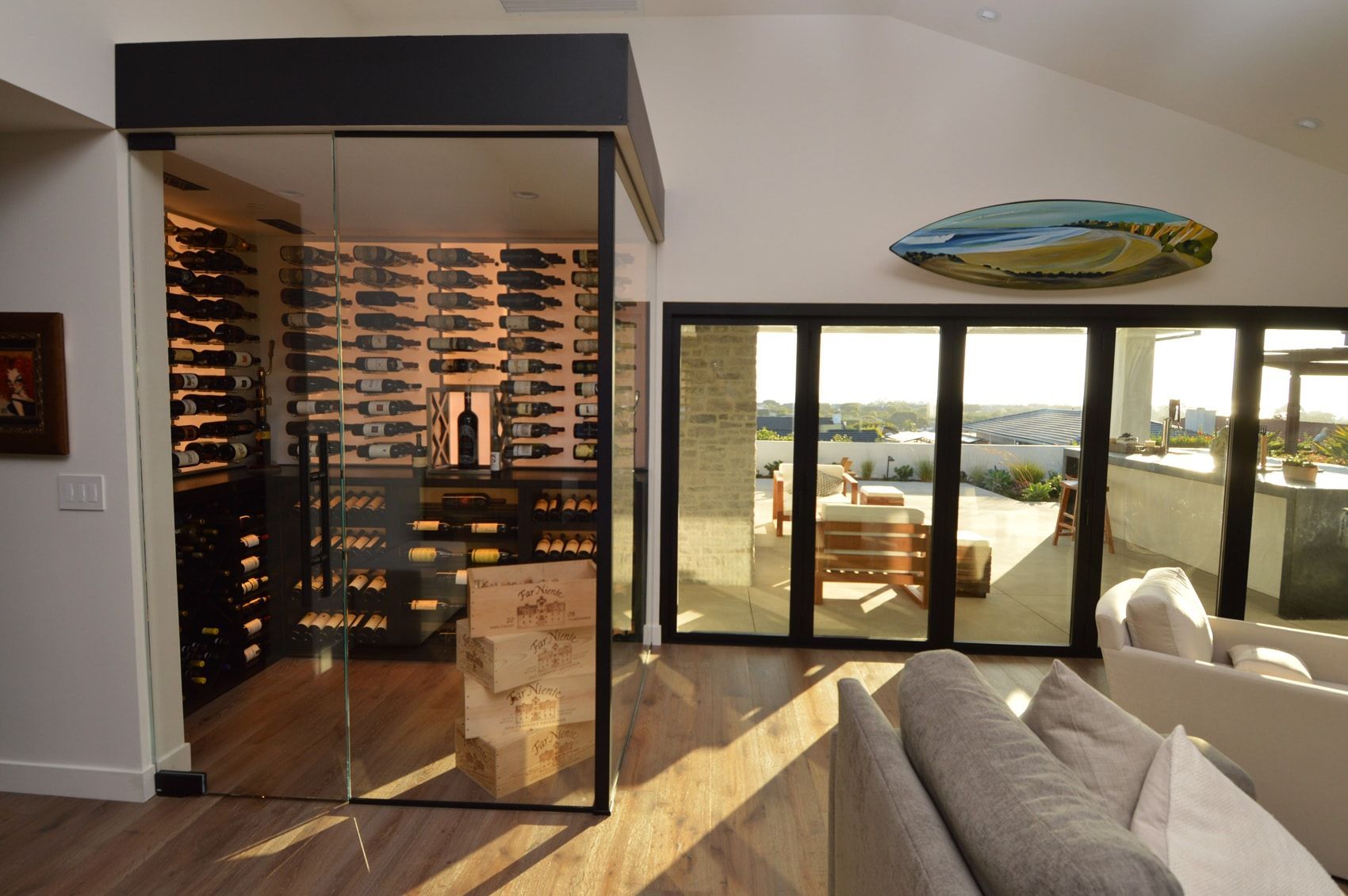
Acrylic behaves differently from every metal finish covered so far because it is not opaque. Light entering the face of a clear panel does not stop at the surface; it travels inside the material until it hits an edge, a scratch, or another discontinuity, and only then does some of it escape. A beam aimed across an acrylic panel sends part of its light traveling sideways inside the material toward the panel's cut edges, where it exits as a glowing line along the perimeter rather than as a highlight on the face.
This is why acrylic racking shows a different symptom than metal racking under the same fixture: not a hard spot where the beam lands, but a lit border around a panel that otherwise looks unlit from the front. VintageView's Evolution Series pairs clear acrylic panels with chrome-plated support rods, so a single free-standing unit can show both behaviors at once, a bright point on the rod and a glowing edge on the panel it holds..
Stainless Cable Racking: A Thin Line That Still Catches Light
Cable racking suspends bottles on tensioned stainless steel cables running singly or in double-depth pairs, and the cable itself presents very little surface area to any one fixture. A round wire returns light the same way a chrome peg does, concentrating it in one direction instead of scattering it, but because the reflecting surface is a thin line instead of a broad face, the resulting highlight is a small, quickly moving point instead of a wide glare zone.
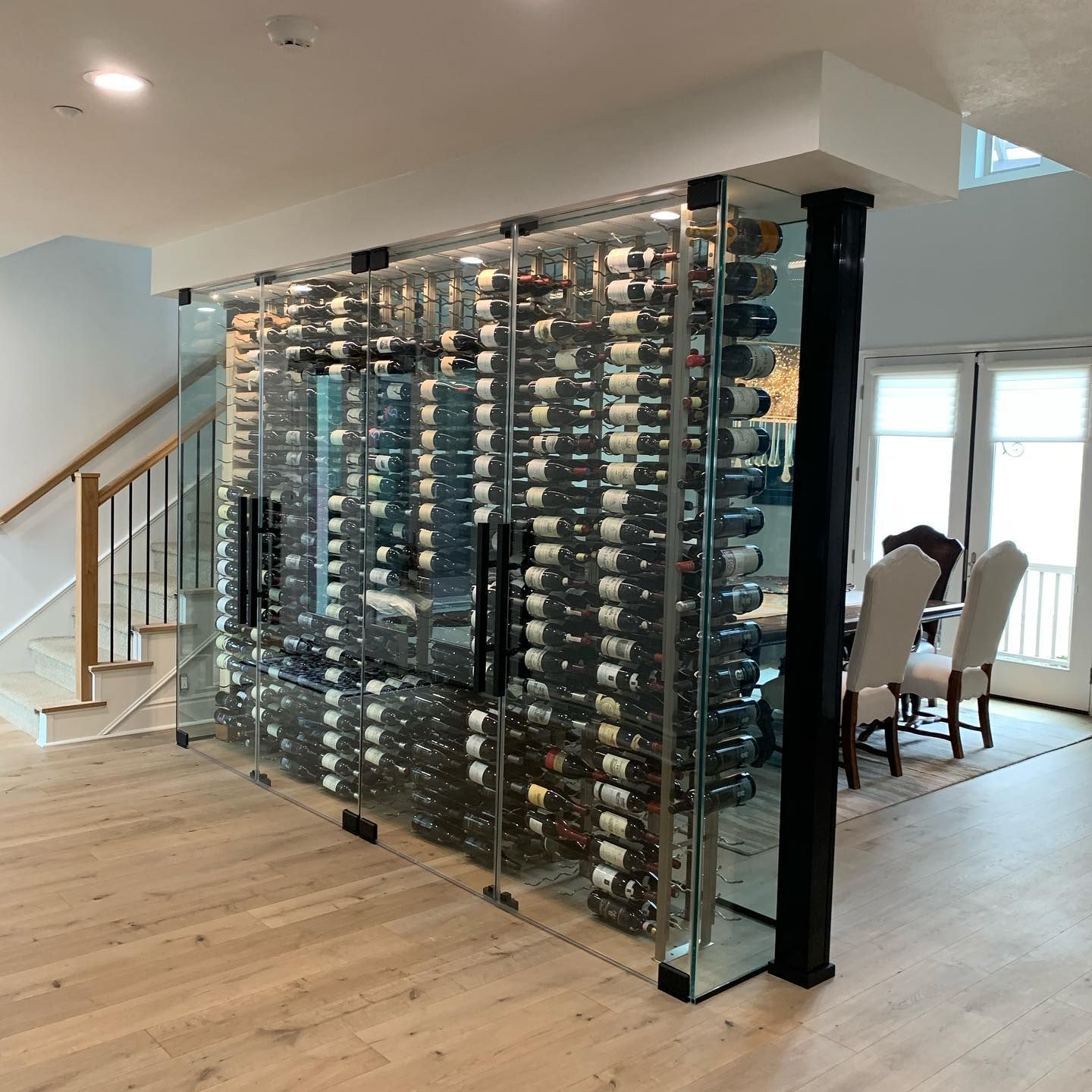
Cable racking's open structure also means fixtures usually aim through or past the cables toward the bottles behind them; the cable itself is rarely a fixture's primary target, which keeps a stray reflection from lining up with a normal viewing position most of the time. The tradeoff is that cable systems expose more of the room behind them, wall, ceiling, and other racking, to the same fixture, so a reflection problem elsewhere can become visible through a cable-racked section that would otherwise hide it.

Aiming, Shielding, and Finish Selection Working Together
None of these surfaces gets solved by adjusting brightness alone. Three variables actually change where a reflection lands, and treating them as one decision instead of three separate ones keeps a metal or acrylic rack's aim, shielding, and finish choices consistent with each other.
Fixture position: determines which direction a chrome peg, a cable fitting, or an acrylic edge throws its return, independent of whatever finish the racking was ordered in.
Shielding: positioning a fixture's lens or housing behind a peg's curvature, a ferrule face, or a panel edge so the hardware itself blocks it from normal standing height.
Finish selection: choosing chrome, brushed, powder-coated, or acrylic before the racking is ordered sets how much precision the other two decisions need. A polished chrome system requires more careful aim and shielding than a powder-coated frame does, because the powder coat is already doing part of the work optically.
Metal racking is also chosen for reasons that have nothing to do with light. A collector working with a fixed footprint often specifies it for capacity first and works the lighting plan around the finish afterward. That sequence is entirely workable; it just means aim and shielding carry more of the burden than they would if finish had been chosen with light in mind from the outset.
A mixed room, chrome pegs on one wall and powder-coated frames on another, needs its fixtures treated as two separate problems, not one uniform setting applied across the whole space. What controls the reflection on one wall does little for the wall finished a different way.
Frequently Asked Questions
Does handling the pegs while restocking bottles change how they reflect over time?
Yes. The point where a peg or bracket takes repeated contact during restocking gets burnished, and a burnished spot on chrome-plated steel reflects more sharply than the surrounding, less-handled metal around it. A rack's most-used pegs can end up with a slightly brighter, harder highlight than pegs in a section that rarely gets touched, independent of anything the fixture is doing.
Does the direction a brushed-steel panel is cut matter if a room combines several panels?
It can. When brushed sheet stock is cut from more than one coil, or a fabricator rotates panels to conserve material, adjacent panels can end up with their grain running in different directions from one another. What looks like an inconsistent reflection between two sections of the same wall is sometimes that fabrication detail rather than a lighting error, and it is worth checking panel orientation before adjusting any fixture.
Does a powder-coated finish ever still show a reflection?
Powder coat comes in gloss, semi-gloss, and matte finishes, and only a true matte or low-sheen specification fully suppresses the highlight; a gloss or semi-gloss powder coat still returns a softer, broader version of the same reflection a bare metal surface would, spread over a larger area instead of concentrated into a point.
Does a thicker acrylic panel produce a brighter edge-glow?
Generally, yes. A thicker panel, or a longer unbroken run of acrylic between where light enters and where the cut edge sits, carries more light to that edge before it escapes. A thin decorative acrylic insert shows a fainter edge line than a full-depth structural panel under the same fixture.
What part of a stainless cable rack usually produces the visible reflection?
More often the ferrules and end fittings than the cable itself. A tensioned cable is a thin line with little surface area to reflect from, but the metal ferrules, turnbuckles, or end caps that anchor it to the frame are larger, flatter, and typically polished or plated, giving a fixture aimed toward that hardware more surface to bounce off than the cable run offers.
Can existing polished metal racking be treated to reduce reflections without replacing it?
Sometimes. A bead-blasted or brushed refinish, or an aftermarket matte clear coat applied over the existing plating, can reduce a chrome peg's specular return without swapping the hardware, though both are permanent cosmetic changes best handled by a metal finishing shop or refinishing specialist working on hardware already installed inside a sealed, humidity-controlled room. Refinishing in place is worth weighing against simply adjusting fixture aim and shielding first, since that costs nothing to try before altering the racking itself.
Look at how your racking is finished, chrome, brushed, powder-coated, or acrylic, before the fixtures go in — plan the aim and shielding around that surface from the start. Cachet Wine Cellars designs and builds custom wine cellars from Irvine, California, with a lifetime warranty on every installation. Call (949) 569 7857.