
The Wine Cellar Lighting Layers Behind the 40/30/20/10 Split

September 25, 2026

Choosing Between Them for a Specific Run

A published split of 40 percent accent, 30 percent task, 20 percent ambient, and 10 percent display reads as a formula, four clean numbers that add to a hundred. A formula suggests a fixture count, a wattage table, something you could hand to an electrician and walk away from. It isn't that, and it isn't a map of which switch controls which fixture either. The ratio describes a proportion of visual output between four physically different jobs, and none of those jobs is a percentage. Each one is a specific kind of fixture, mounted a specific way, doing something the other three cannot do in its place.


Skip past the number and go straight to what it's a ratio of, and the split stops being an abstraction. Accent light is doing one thing to the rack face. Task light is doing something else at eye level. Ambient light is filling the room around both of them, and display light is doing a fourth job entirely, reserved for a handful of specific bottles. A cellar that gets the proportion between those four right looks composed without anyone being able to say exactly why. A cellar that gets it wrong usually has a specific, describable symptom, tied to whichever layer was shorted.

Accent Light Is the Layer That Makes the Racking Legible

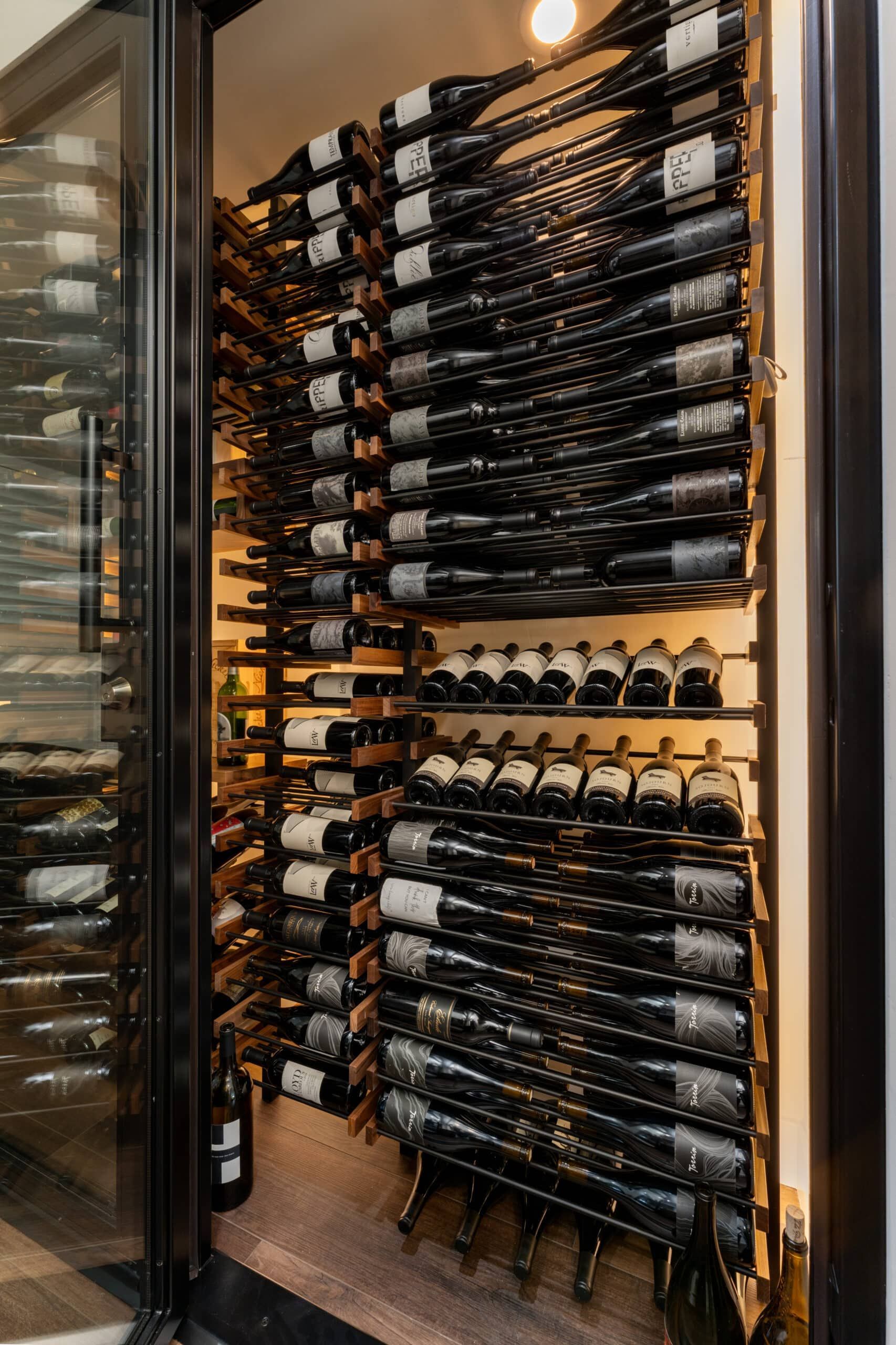
Accent lighting is focused light highlighting bottle labels and racking details, typically mounted above the racks and angled downward. It is the largest single share of the ratio for a reason: it is doing the most work per fixture, carrying the visual weight of every rack face in the room rather than one row, one counter, or one hero bottle. A cove run along the top of a rack section, aimed down across the bottles, is accent lighting. So is a narrow track head trained on a single run of shelving.

Shortchange this layer and a cellar with plenty of raw light in it can still look wrong. The racking reads as a dark mass with a general room glow around it instead of a wall of labels someone can actually study. Bottles disappear into shadow between the rows of light that do exist, and a visitor's eye has nowhere obvious to land, because nothing in the room signals where the collection actually is. Ambient light fills a room, and accent light marks what the room is for.


Over-weight this layer instead, and a cellar with accent output pushed well past its share starts to look like every bottle is on a pedestal at once. Nothing recedes, nothing sits in the room's supporting shadow, and the eye has no rest between one lit rack face and the next. A room built entirely of foreground has no foreground left; the layer that was meant to single out the racking loses its contrast against a room with nothing left to contrast against.

Task lighting is functional brightness for reading labels and accessing bottles, positioned at eye level or above islands and tasting tables. It answers a different question than accent light does. Accent light makes a rack face legible from a few steps away. Task light is what a hand actually reaches into once the eye has already found what it's after, at a counter, an island, or a run of shelving close enough to touch.


A cellar that shorts task light in favor of a heavier accent share can look striking on a walkthrough and still be frustrating to work in. Someone pulling a case at an island, decanting at a tasting counter, or comparing two labels side by side ends up squinting or reaching for a phone light, because the dramatic wash aimed at the rack face several feet away was never meant to serve close, sustained work at a work surface. Accent light is built to be looked at. Task light is built to be worked under, and a room that only has the first one shows it the moment anyone tries to actually do something at a counter.


Where the two layers hand off: accent light stops at the rack face; task light picks up wherever a hand and a bottle actually meet, usually a few feet in front of that same rack.

Ambient is general background illumination, usually on a dimmer. It is the smallest deliberate share of the four, and that smallness is the point: ambient light isn't built to match accent or task light in output. It's meant to fill the gaps between them so the room doesn't read as a set of isolated pools separated by black space.


A cellar with strong accent and task layers but no ambient fill can feel noticeably uncomfortable to stand in, for reasons that go beyond simple dimness. The eye adjusts to whichever bright pool it's looking at and then has to readjust every time it crosses a dark gap to the next one, an effect that gets more tiring the longer someone actually lingers in the room rather than passing through. A tasting group standing between a lit rack and a lit counter, in the unlit gap between the two, ends up standing in the room's least flattering light by accident, simply because nothing was assigned to hold that middle ground.


Push ambient too far past its 20 percent share, on the other hand, and it starts to wash out the very contrast the accent layer was built to create. Ambient light hitting a rack face from the front, at a level close to what the accent fixtures are putting out, flattens the shadow gradient that made the rack read as dimensional in the first place. The room gets more even and less interesting at the same time, because the layer built to be a background fill is now putting out as much light as the layer built to be a foreground.

TIP: Assign display fixtures to specific bottles or niches by name during the design phase. A layer meant to single out a handful of vintages loses its purpose the moment it gets applied to a whole run of racking instead.

When the Ratio Should Be Deliberately Broken

The published split describes a cellar built to do a bit of everything: hold a working collection, let someone read a label, feel comfortable to stand in, and single out a few bottles worth singling out. Not every room is built to do all four of those jobs in equal measure, and a room with a narrower brief has no reason to carry a proportion built for a broader one.

A storage-first room, holding case goods with no display ambition, can reasonably run heavier on accent and task and skip the display share close to zero, since no bottle in the room needs that kind of individual emphasis. A wine wall built as the visual centerpiece of a dining room, by contrast, can justifiably run its display share well past 10 percent, because in that room the spotlighted treatment isn't a rare exception; it's close to the room's entire purpose. A tasting room built around a counter and an island can push task lighting's share up and accent's down, since most of the room's actual activity happens at the counter, well away from any rack face.


The ratio is a starting proportion for a room built to balance all four jobs at once. Treating it as a compliance target, something a finished cellar either passes or fails, misreads what it was written to do. How far it's reasonable to move off that starting point depends on the room in front of you and what it's actually being asked to do.

Frequently Asked Questions

  • Does the ratio apply to fixture count or to light output?

    A single continuous cove run lighting an entire rack wall can put out more total light than a dozen small display niches combined, even though the niches outnumber it by a wide margin. The split measures output; fixture count doesn't factor into it at all.

  • Can one fixture belong to more than one layer?

    Rarely by design, though it can happen by accident. A fixture aimed to do accent work that also happens to sit close enough to a counter to serve as de facto task light wasn't planned that way, and it usually means the task layer was under-specified rather than that the room found an efficient shortcut.

  • Does a smaller cellar need the same four layers as a large one?

    Yes, but a single-wall closet conversion usually collapses two of the four into one physical run: the same cove or track head lighting the rack face for accent purposes also ends up carrying the room's ambient fill, since there's rarely space for a separate ceiling fixture. Task and display still need their own dedicated points (a light at the work surface, and, if the room has a bottle worth singling out, one display fixture), because sharing a run costs those two jobs the specificity they depend on.

  • If a design has to cut a second layer, which goes after display?

    Task, in a room where no one works at a counter or island and the racking itself is the entire point. Accent and ambient are costlier to lose: accent is what keeps the racking legible, and ambient is what keeps the room comfortable to stand in no matter what the room is used for. Task is the layer most tied to a specific activity, close-up reading or hands-on work at a surface, that a pure storage room may not actually have.

  • Does under-shelf lighting count toward display or accent?

    It depends on what the strip is doing. A continuous run washing an entire shelf functions as accent, spread evenly across a run of bottles the same way a cove or track head is. A short strip lighting one reserved position or niche functions as display, concentrated on a single bottle instead of a whole shelf. The layer follows what the light actually covers, not where the fixture happens to sit.

  • Can the four layers be installed in phases, or does the ratio require all of them at once?

    They can be phased, but the ratio only describes a finished proportion; it says nothing about the order those layers get installed in. A room built with accent and ambient first and task or display added later stays functionally unbalanced during the gap between phases, since the proportion the ratio describes doesn't exist until every layer it counts is actually installed.

Balance a lighting plan against the four-layer proportion before fixtures go on order — see which layer your room actually needs more or less of. Cachet Wine Cellars designs and builds custom wine cellars from Irvine, California, with a lifetime warranty on every installation. Call (949) 569 7857.

Recent Posts

Wooden staircase with garland, wine fridge, and glass-fronted storage in a bright home interior
September 25, 2026
Bright dots in every bottle shoulder and glass panel usually trace to the LED strip, not the racking. What causes it, and three fixes that end it.
Built-in wine wall with glass doors, warmly lit in a modern living room.
September 25, 2026
A cork-forward bottle and a label-forward bottle present two different surfaces to a light source. See which beam direction reaches each one.
Luxury living room with a glass-front wine cabinet, dark chairs, and hardwood floors
September 25, 2026
Chrome pegs, brushed steel, and acrylic panels each throw light back differently. See how finish and aim keep metal wine rack lighting glare-free.
Wine bottles stacked on wall-mounted racks in a dimly lit cellar room
September 25, 2026
A slab cellar with no ceiling cavity rules out recessed cans. See which lighting methods actually replace what an open plenum would have hidden.
Wine display in a glass-fronted cabinet with neatly arranged bottles and stemware in a modern room
September 25, 2026
Bottle glass reflects light instead of showing labels when the angle is wrong. Learn how aiming and shielding fix cellar lighting glare for good.
Glass wine cellar divider in a modern home, filled with wine bottles beside a staircase and dining area.
September 25, 2026
Wet wool or cabbage in a bottle that should have been perfect? Light strike is photochemical, and the glass color decides which wines need room.
Wine bottles stored in a tilted wooden rack behind a glass-front cabinet
September 25, 2026
Warm light reddens redwood and yellows white oak. See which way each species shifts, and the CRI floor California code sets, before fixtures are ordered.
Wall-mounted wine rack filled with bottles in a dimly lit storage room
September 25, 2026
A living-room lighting schedule under-specifies a cellar in predictable ways. The seven lines a cellar schedule needs and what happens when each one is blank.
Glass wine cellar with rows of bottles behind a clear door in a modern interior
September 25, 2026
Storage runs stay dark. Display runs stay lit. See how one cellar assigns each job to the runs that need it.
Modern living room with wine storage, ocean view through glass doors, and a beige sofa
September 25, 2026
A single fixture lights the rows nearest it and leaves the rest short. See how source position changes what a tall wine wall's upper rows show.

Show More