Wine Cellar Display Design Means Choosing One Job per Run
Choosing Between Them for a Specific Run
Once a schedule has been issued to anyone, changing a value quietly is worse than not changing it. A revised schedule carries a new revision number, a new date, and a marker against every row that moved, so a reader holding both versions can tell in seconds which lines are different. Reissuing a corrected sheet with no revision marker leaves two documents in circulation that look interchangeable and are not.
The reissue also has to reach the people working from the old one. A cellar's fixture order, the racking shop drawings, and the electrical rough-in can all be running from the same schedule at the same time, and a Kelvin value corrected on the designer's copy changes nothing until the version carrying that correction lands with whoever placed the order.
Fixture substitutions happen at bid, at order, and occasionally after delivery, and a fully populated schedule is what sets the terms of one in advance. A substitution proposed against a complete row has to hold every value on that row, including the ones a supplier would find inconvenient to match. A fixture matching wattage, beam angle, and trim size while dropping below a stated CRI floor is a different specification, and a populated row makes that visible without an argument about intent.
The burden of showing it sits with whoever proposes the swap. A substitution request arriving as a catalog number and a price, with no line-by-line comparison against the scheduled values, has not been made yet; it has been asked about. Requiring that comparison in writing is what keeps the substitution a decision the specifying professional is still making.
The Sheet Has to Say What It Is
TIP: A schedule reissued after fixtures are ordered should say so on the sheet. A revision that arrives post-order is a change order in practice, and marking it as one keeps the cost conversation attached to the line that caused it.
A wine cellar's lighting plan is answering one of two questions, and the two questions pull toward opposite answers. The first is how to keep a bottle from being seen by light any more than it has to be. The second is how to make a collection legible and worth looking at from outside the room. Most fixtures on the market can serve either question. No single setting on a single fixture serves both at once.
An aging run is built around the first question. Its job is to hold a bottle in the dark for years and give someone just enough light to find it and read the label when they're standing there, nothing more.
A display run is built around the second question. Its job is to make the collection read as intended from wherever the intended viewer stands, whether that's a few feet away in the room or across a living space through a glass wall, and it has to keep doing that job for as long as the space is meant to be seen. Those aren't the same brief calibrated to different tastes; they call for different amounts of light, on different schedules, aimed at different things.
In practice, many cellars end up carrying some version of both jobs. A room built entirely for aging, with no display ambition at all, is unusual outside a case-storage back room. A room that is entirely display, with nothing held back for long-term aging, is really a wine wall doing decor work. The room in between, holding a serious collection its owner also wants to enjoy looking at, has to decide which job belongs to which run of racking, and get that decision right before a single fixture goes in.
How Much Light Each Job Actually Needs
The aging brief and the display brief start from different baselines, and the gap between them is wide before either room reaches a design decision about fixtures.
The aging brief: the least light that still does the job. Someone standing in front of the rack has to be able to read a label and confirm a vintage, and that's the entire requirement. The bottles aren't meant to be seen when no one is standing there, and they're not meant to compete with anything else in the room for attention.
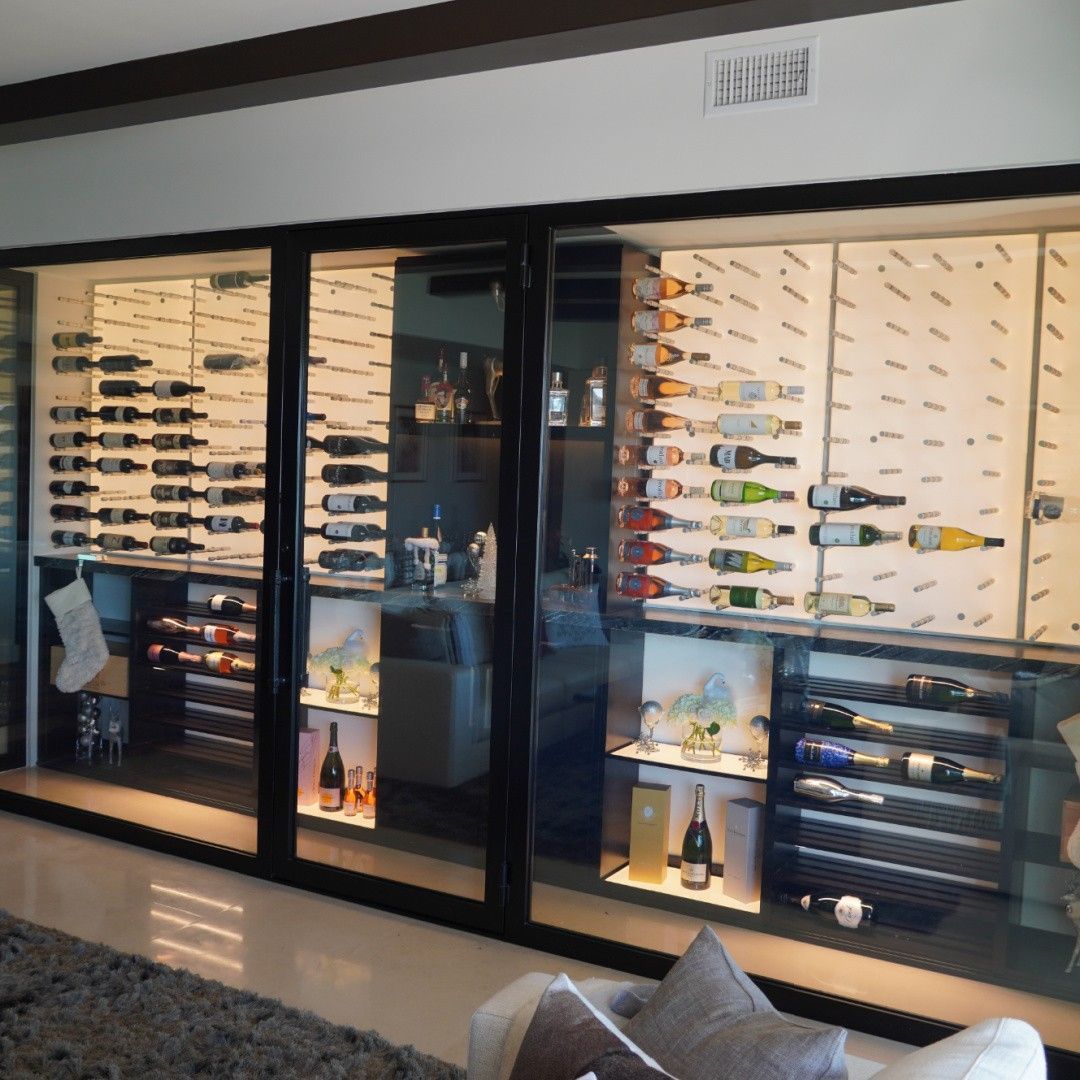
The display brief: enough light to read from where the intended viewer actually stands, and that's very often farther away than arm's length. A wine wall meant to be seen from a dining room, or a glass-fronted cellar meant to read from an adjoining living space, has to project enough light that the collection stays legible at that distance, through whatever glass or open air sits between the viewer and the rack. Getting that level of light out to a viewer several feet away, sometimes through a pane, takes more raw output than lighting a face someone is standing directly in front of.
Who the Light Is Serving, and When
Intensity is only half of what separates the two jobs. The other half is who the fixture is running for, because that decides the schedule.
Storage duty cycle: off by default, on for the person retrieving a bottle. There's no one in the room to serve most of the day, and every hour it sits dark is an hour off the electric bill. The schedule only has to answer to that one visitor, coming on and going off with them.
Display duty cycle: on for as long as the room has an audience. A wine wall built to be the focal point of a dining room, or a glass cellar visible from a kitchen or a hallway, is serving anyone in that space, so it stays lit through the hours the room itself is occupied or on view.
Reconciling those two duty cycles inside one physical space is what a zoned lighting plan exists to do, splitting the room into circuits that can each hold their own schedule instead of one switch forcing a single duty cycle on every run in the cellar.

Who the Light Has to Reach
An aging run has an audience of one: the person standing directly in front of it, usually for less than a minute at a time. Nothing about that light needs to travel any distance, work through glass, or hold its own against a room's ambient light. It just needs to be there when that one person needs it and gone the rest of the time.
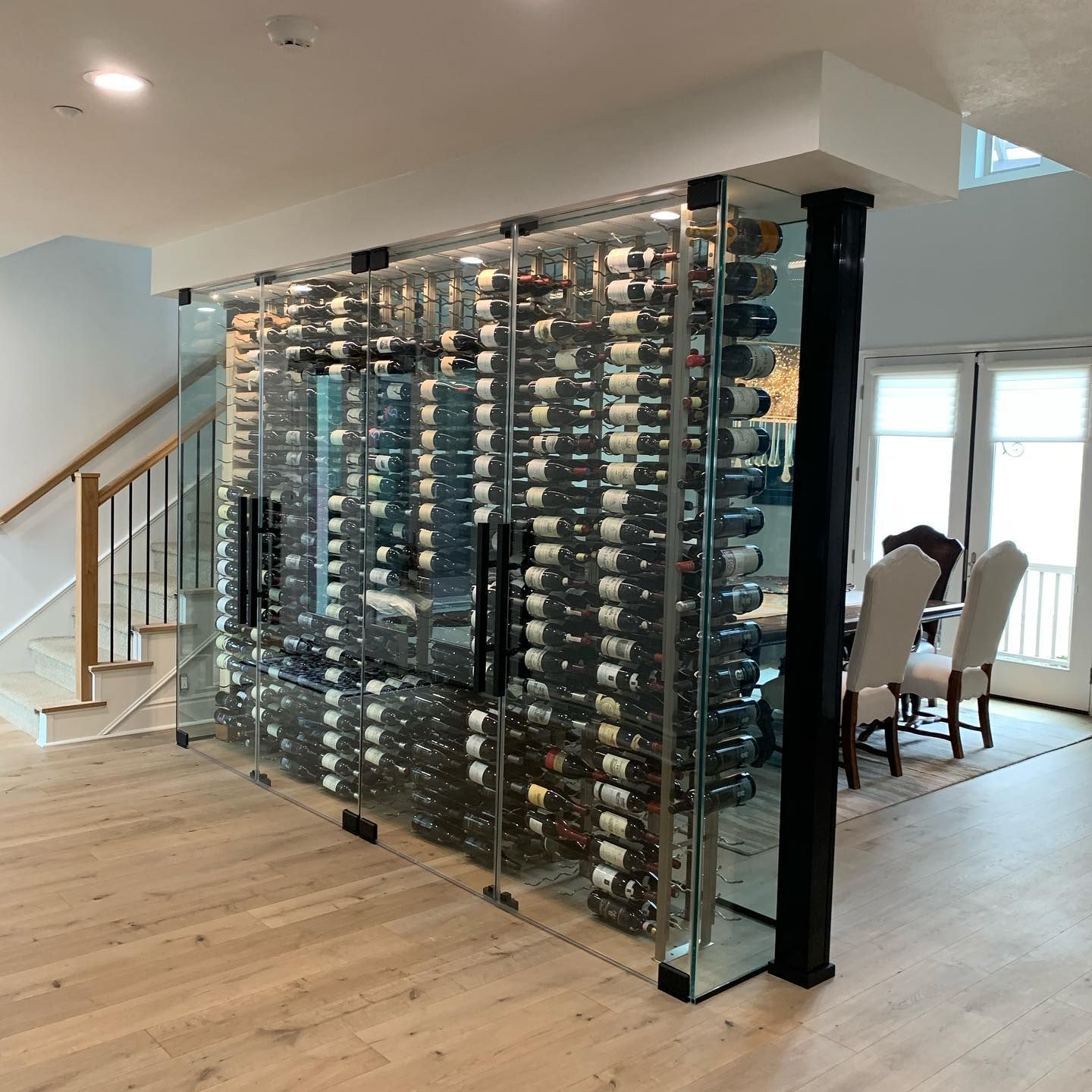
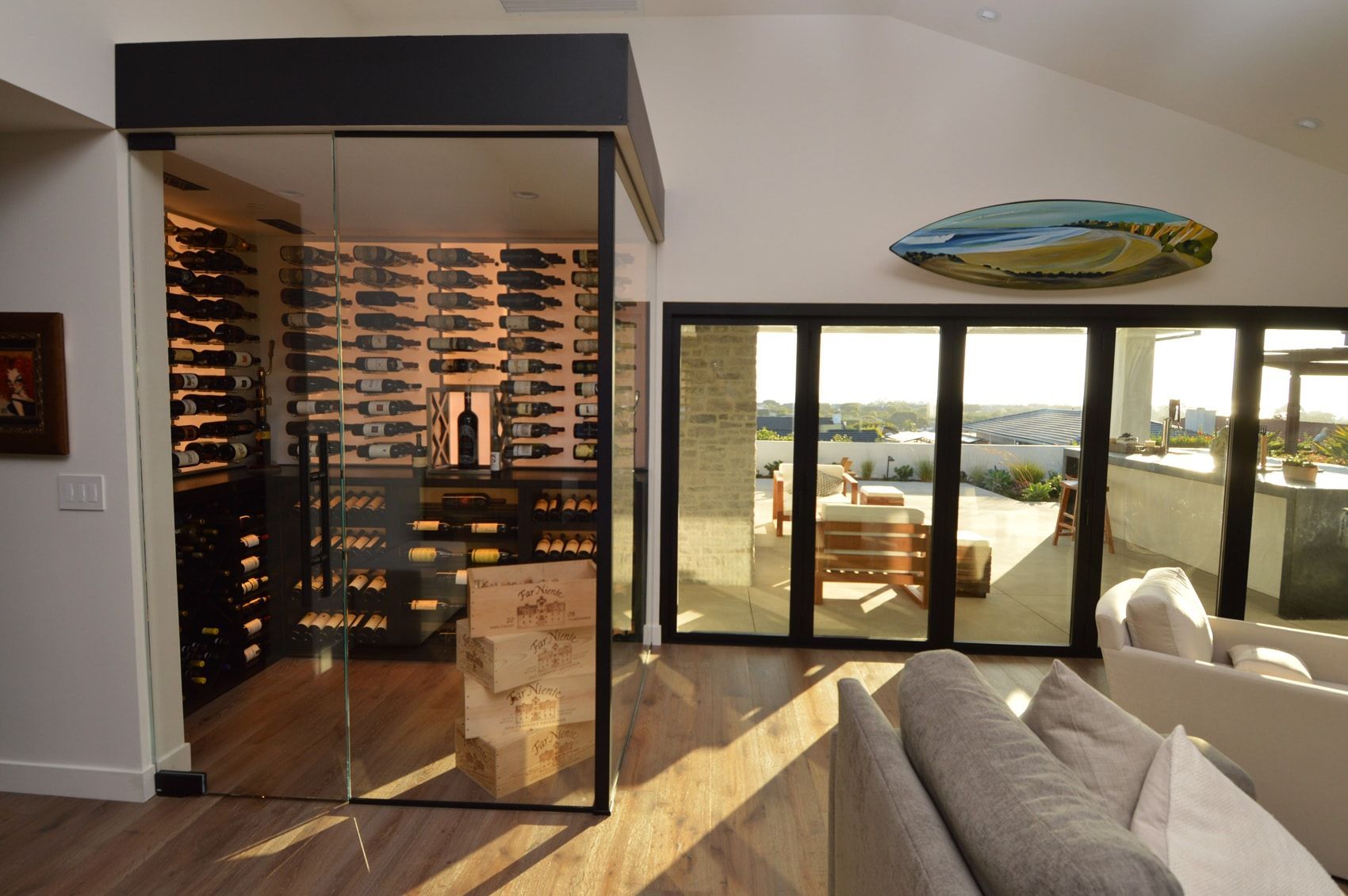
A display run has a different audience, and that audience can be standing somewhere else entirely. The intended viewer for a wine wall in a dining room might be seated at a table fifteen feet away. The intended viewer for a glass-fronted cellar off a great room might never set foot inside the cellar at all. That audience is judging the collection against everything else in the room they're actually sitting in, including that room's own lighting, so a display run has to hold its own against a competing light source it doesn't control.
That's the practical reason a display brief and a storage brief can't share a single fixture spec even when they sit a few feet apart in the same cellar. One is lighting a task for an audience of one who is already standing there. The other is lighting a room for an audience that may never come any closer than the next room over.
Evenness Versus Emphasis
The two briefs also differ on what a well-lit run should look like next to its neighbors, and this is where a cellar that hasn't decided which job each run is doing starts to look uneven for the wrong reasons.
Aging, evenness: every bin and every shelf should read at roughly the same level as the one next to it, because nothing about a storage run is supposed to draw the eye. The goal is a field of light even enough that a collector can scan the whole run quickly while looking for a specific vintage, without one section pulling their attention away from the rest.
Display, emphasis: a single run, a single wall, or a single case is usually meant to be the room's focal point, and that takes deliberate contrast between what's emphasized and what recedes around it. A landmark vintage or the run nearest the entry might carry more light than the runs around it on purpose, because a display wall with no hierarchy at all reads as flat no matter how bright it is overall.
Put an aging run's flat, even field next to a display run's deliberate hierarchy and the difference should be visible at a glance. If it isn't, one of the two runs is being lit for the wrong job.
What Counts as the Job Being Done
Because the two briefs measure success differently, a light level that would count as a failure on one run can be exactly right on the other.
A storage run that sits dark almost all day, with just enough output to check a label when someone opens the door, is doing its job well. Judged by display standards, that same run would read as underlit and neglected. A display run that stays bright for hours with nobody in the room, showing off a wall of bottles to an empty house, is also doing its job. Judged by storage standards, that same run would read as wasteful.
Neither read is wrong on its own terms. The mistake is applying one run's standard to the other, which is what happens when a cellar gets lit as a single room instead of as a set of runs, each answering to its own brief.
Deciding the Job Run by Run
None of this gets resolved by picking a single answer for the whole cellar. It gets resolved by walking the layout and assigning a job to every run before any fixture goes in.
A glass-walled display cellar is built around the display brief from the start: the whole point of putting a room behind glass is to let it be seen, so most of what's inside carries display-level light for most of the day. Even there, the bins holding a collector's longest-term holdings, bottles not meant to be touched for a decade, can sit in a shaded lower run inside that same glass room.
TIP: A cellar built entirely for aging can still carry one exception: a short run near the entry, the first thing a visitor sees, can earn display-level light on its own schedule while everything behind it stays dark on a storage schedule.
Deciding a room's category up front, glass or closed, residential or commercial, doesn't decide the job for every run inside it. Walking the layout and assigning that job run by run does.
Frequently Asked Questions
Does a wine locker program need to pick one job for the whole room?
No. In most locker programs, the individual locker and the room it sits in usually answer different briefs. A member's locker, particularly in a higher lock tier, is almost always lit to the storage brief and opened only when that member is there. The corridor or lounge the lockers open onto is a different run entirely, lit to read as a shared amenity regardless of what any locker behind it is doing.
In a restaurant or hotel cellar, does the whole room get the same treatment?
Rarely, and the split typically runs by function as much as by wall. The front-of-house wall or case that guests see from the dining room or lobby carries display-level light built to be noticed, while the back-of-house storage a sommelier or beverage team works from during service stays on the same low, on-demand storage brief as a private residential cellar, because retrieval speed, not appearance, is what that space is judged on. The same split can show up inside a single back-of-house room too: bottles on the current wine list sit in fast-retrieval storage racking, while older library bottles no longer part of that night's pours often move out to the front-of-house display wall.
Is there such a thing as a wine wall built purely for storage?
Not really, by design. A wine wall is built as a backlit, visible feature, usually facing into a living space or dining room instead of a closed utility room, so the format itself commits the run to the display brief before any fixture is chosen. A collector who also wants a pure aging run typically gets it as a separate, closed section of the cellar rather than as another wine wall.
Can a small closet-conversion cellar support a real display run?
Usually not, and that's a function of the format rather than a compromise. A closet conversion typically has no viewing distance to work with and often uses a solid door instead of glass, so there's no vantage point a display brief would pay off from. Small-space cellars default almost entirely to the storage brief for that reason, regardless of how the collection inside is priced.
Does RGB smart lighting belong on a storage run?
No, and it isn't specified there. RGB and color-changing control show up on modern cellar builds specifically as a display feature, used on wine walls and glass-fronted rooms meant to be seen. Changing color does nothing for someone trying to locate a bottle, so an aging run is specified in fixed white output instead of color-changing control.
What happens to a run's assigned job when a collection outgrows the room?
The job doesn't move with the bottles; the room gets re-zoned. A collector who adds racking as a collection grows often ends up with a run that was lit for storage getting used for occasional display when guests are around, and that run becomes a candidate for a proper display retrofit instead of staying on its original storage schedule. The alternative is adding a matching run elsewhere in the room. Either way, growth is a reason to walk the layout again instead of leaving one run to do two jobs it was never lit for.
Decide which job each run in your cellar is doing before the fixtures go in — a layout that assigns storage and display separately keeps each run built to the standard it's actually judged on. Cachet Wine Cellars designs and builds custom wine cellars from Irvine, California, with a lifetime warranty on every installation. Call (949) 569 7857.