
Tall Wine Wall Lighting That Skips Dark Upper Rows

September 25, 2026

Choosing Between Them for a Specific Run

Once a schedule has been issued to anyone, changing a value quietly is worse than not changing it. A revised schedule carries a new revision number, a new date, and a marker against every row that moved, so a reader holding both versions can tell in seconds which lines are different. Reissuing a corrected sheet with no revision marker leaves two documents in circulation that look interchangeable and are not.


The reissue also has to reach the people working from the old one. A cellar's fixture order, the racking shop drawings, and the electrical rough-in can all be running from the same schedule at the same time, and a Kelvin value corrected on the designer's copy changes nothing until the version carrying that correction lands with whoever placed the order.

Fixture substitutions happen at bid, at order, and occasionally after delivery, and a fully populated schedule is what sets the terms of one in advance. A substitution proposed against a complete row has to hold every value on that row, including the ones a supplier would find inconvenient to match. A fixture matching wattage, beam angle, and trim size while dropping below a stated CRI floor is a different specification, and a populated row makes that visible without an argument about intent.


The burden of showing it sits with whoever proposes the swap. A substitution request arriving as a catalog number and a price, with no line-by-line comparison against the scheduled values, has not been made yet; it has been asked about. Requiring that comparison in writing is what keeps the substitution a decision the specifying professional is still making.

The Sheet Has to Say What It Is

TIP: A schedule reissued after fixtures are ordered should say so on the sheet. A revision that arrives post-order is a change order in practice, and marking it as one keeps the cost conversation attached to the line that caused it.

A tall wine wall is an elevation before it is a display: one continuous vertical surface with a top course near the ceiling, a middle band at standing eye height, and a bottom course near the floor. Each of those three zones sits a different distance from wherever the light comes from, and distance is the variable that determines how bright a surface reads. Move the light and the brightest zone moves with it. The difference between the zones does not disappear.


Light intensity falls off with distance from its source, a relationship that holds whether the source is a ceiling fixture, a shelf-mounted strip, or a floor uplight, and regardless of wattage or color temperature. On a four-foot display niche that falloff barely matters, since the whole niche sits close enough to nearly any source that the difference between its top and bottom stays small. Cable wine wall systems scale from eight feet up to sixteen feet and beyond, and at that height the same falloff stretches across enough vertical distance to stop being a rounding error. It becomes visible from across the room instead.


Three single-source placements handle that elevation three different ways, and each one serves one zone at the expense of the other two. Above roughly standing eye height, whichever zone loses out shows it plainly to anyone standing in front of the wall.

QUICK ANSWER: A single source lit at one height serves the rows nearest it best and the farthest rows worst. Stack sources vertically, build light into the rack at multiple heights, or plan a deliberate gradient instead of guessing at one fixture position.

A Top-Mounted Source Over-Lights the Rows Nearest It

Mount the light at the top of the wall, whether as a continuous line source run along the head of the racking or a row of small fixtures set into the ceiling above it, and the rows closest to that mount get the largest share of the output. The top course reads brightest, sometimes bright enough to wash out label detail on the uppermost bottles when it should simply illuminate it. Every row below starts losing ground immediately, and by the time the light reaches a course six or eight feet down the wall, what arrives is a fraction of what the top course receives.


A single top-mounted source can carry a four- or five-foot niche without much complaint, because there is not enough vertical run for the falloff to separate visibly from top to bottom. On a cable wall running the fuller eight-to-sixteen-foot range, the same source turns the bottom third of the wall into the section a visitor has to lean toward to actually read. The wall was built as one continuous surface; a single top mount treats it as one bright band and a long fading tail below it.


Beam angle interacts with mounting height here — a wider beam spreads the same output over more of the wall's height, at the cost of intensity at any one point — but no beam width fixes a source that is simply too far from the rows it is meant to reach.

A Source at Eye Level Leaves the Top Rows Dark

Move the same source down to eye level, roughly the middle of the wall, and the problem does not disappear. It moves. The middle band now reads brightest, since it sits closest to the fixture, and both the top and bottom courses lose ground as the light travels away from that middle point toward the ceiling in one direction and the floor in the other.


The top rows lose the most ground under this arrangement. A source at eye level has to throw its light upward against a longer run of racking above it than a top-mounted source ever has to cover below it, on a wall of any real height. On a wall running toward the top of the eight-to-sixteen-foot cable range, the top course can end up dimmer under an eye-level source than it would under a source mounted at the ceiling and simply left to fall off toward the floor.


Eye level is where a visitor's gaze naturally lands first, and a fixture placed there does put its best output exactly where a first glance falls. What it does not solve is the wall above that glance, the top course a collector still has to reach, read, and select from.

WARNING: Reaching the top rows of a floor-to-ceiling wine wall means climbing, whether by a fixed ladder, rolling track, or step stool. Keep the top courses within a stable, rated reach, since improvised stretching from the middle of the wall risks a fall.

A source mounted at the base of the wall, whether a toe-kick strip or an uplight set into the floor, sends its light traveling upward instead of down or across. That direction change does more than shift which rows get the most output. It changes the angle at which the light meets each bottle.

TIP: Every bottle sits with its shoulder and neck above the label, and light arriving from below strikes that shoulder first, throwing the shadow upward across the label.

Where an overhead source clears the label with a downward beam, an upward one leaves it partly shadowed even at close range. The bottle rows at the base of the wall get plenty of output at close range, but the light crossing their faces comes from underneath, so shadows fall opposite of where a visitor would expect to see them. Move further up the wall and the same falloff that limits a top-mounted source applies in reverse: a floor source has the same eight-to-sixteen-foot run to cover, this time working upward, and the top courses on a tall cable wall receive even less of it than they would from a source mounted at the ceiling.

Stacking sources vertically treats a tall wall as several shorter walls layered on top of one another rather than one long run served by a single point. A line source at the top handles the top course, a second run at or near eye level handles the middle, and a third near the base covers the bottom, each one responsible only for the few feet of wall closest to it.


This is the approach behind cable walls tall enough that no single source could reasonably cover the whole run. An installation running the fuller length of the system's eight-to-sixteen-foot-and-beyond range uses this layered approach, since a wall of that height would otherwise leave its lowest third badly underserved.


Cable racking suspends each bottle on stainless steel cables, so a stacked layout doesn't have to route each tier's light around a lot of intervening shelf structure to reach the rows it's assigned to. The tradeoff is control: a single fixture becomes three or more independently aimed, and ideally independently switched, sources, each set to cover its own band without spilling enough into the next tier to recreate the same over- and under-lit pattern a single source produces.

Lighting the Rack Itself at Multiple Heights

A related approach skips ceiling- or floor-mounted fixtures altogether and builds the light into the racking, at more than one height along the run. LED strips set along the underside of a shelf break, recessed into a toe-kick, or run behind a display niche put the source close to the bottles it is meant to light, instead of throwing a beam across open space to reach them.


An Orange County dining room wall, built floor to ceiling in wood racking and holding roughly 800 bottles, uses breaks in the racking itself, points where the shelf structure steps back or changes depth, as natural mounting lines for this kind of fixture. Each break becomes its own light source at its own height, so the wall's total run gets divided into as many zones as it has structural breaks, without adding a single fixture to the ceiling or floor.


Backlighting and shelf-integrated strips both work this way. Because the source sits at the same height as the bottles it serves, distance from source to target stays roughly constant at every level of the wall, which is the one variable a single top, eye-level, or floor source cannot control on a tall run.

Designing Around a Deliberate Gradient

Not every tall wall needs three tiers of independent lighting. A gradient, brighter at one height and dimmer at another, can be a deliberate design choice, not a flaw to correct, provided it is chosen rather than discovered after installation.


A wall built with a single strong source at eye level and a soft, secondary wash above and below it reads as one continuous surface with a clear focal band, the section a visitor's eye lands on first, instead of three competing zones of equal brightness. A commercial wall holding 2,000 or more bottles, viewed mostly from a fixed dining or bar sightline rather than walked bottle by bottle, can use exactly this approach: keep the sightline band bright, let the top and bottom taper, and skip the added fixtures and switching a fully tiered system calls for.


The difference between a designed gradient and an accidental one comes down to whether the falloff lands where the wall is meant to be brightest. An eye-level focal band that fades gracefully toward the ceiling and floor reads as intentional. The same falloff landing on the section a collector actually needs to read, because the source landed wherever installation was easiest and never where the wall needed it, reads as a mistake.

Frequently Asked Questions

  • Does a rolling ladder or ladder track change where the lighting should sit?

    Yes. A rolling ladder track mounted along a tall wine wall sits directly in front of the rack face at the height where it is anchored, and the track hardware itself can throw a narrow shadow across whatever tier of lighting runs behind it. Planning the light layout around the track's mounting height from the start keeps that shadow from landing on a tier a visitor is meant to read clearly.

  • Does a mezzanine or landing partway up the wall change the lighting plan?

    It resets it. A landing or mezzanine that interrupts a tall wall partway up effectively creates two shorter elevations instead of one continuous run, each with its own top, middle, and bottom. Lighting the wall as a single sixteen-foot surface when it is actually built as two eight-foot sections stacked with a walkway between them tends to leave the break itself, and the rows just above and below it, oddly lit compared with the rest of the run.

  • Does a wine wall seen from more than one room need a different lighting plan?

    Often, yes. A twenty-foot cable wall in Newport Beach holding roughly 1,200 bottles is visible from the kitchen, dining room, and living room simultaneously, which means it gets viewed from several standing and seated eye heights instead of one fixed vantage point. No single eye-level band correctly serves every one of those positions, which is part of why a wall viewed from multiple rooms is a stronger candidate for stacked vertical lighting than a wall seen from one fixed spot.

  • Does staff needing to pull bottles change the lighting plan for a commercial wall?

    Yes, because a restaurant or hospitality wall usually serves two different viewers with two different eye heights. A seated guest reads the wall from one fixed sightline, while staff retrieving a specific bottle during service move up and down the full height of the run, often by ladder. A gradient tuned only to the seated sightline can leave the rows staff handle most, near the top or the base, too dim to read a label quickly under service pressure.

  • If two walls hold the same number of bottles, do they need the same lighting plan?

    Not necessarily. A wide, low wall carrying the same bottle count across far less vertical rise can often sit entirely within a single source's effective range, since there is no vertical distance for a falloff to develop across, while a tall, narrow wall built floor to ceiling in a single run still needs the tiered treatment described here.

  • Can nearby windows or skylights affect how a tall wall's lighting reads?

    Yes. A wall positioned near a window, glass door, or skylight picks up ambient daylight that shifts through the day and across seasons, and that daylight does not follow the fixture layout underneath it. A carefully balanced gradient can read correctly at night under the fixtures alone and look uneven at midday, when daylight adds extra brightness to whichever section of the wall happens to face the glass.

Light your tall wine wall as one complete elevation — get a height-proportioned lighting plan before installation begins. Cachet Wine Cellars designs and builds custom wine cellars from Irvine, California, with a lifetime warranty on every installation. Call (949) 569 7857.

Recent Posts

Wooden staircase with garland, wine fridge, and glass-fronted storage in a bright home interior
September 25, 2026
Bright dots in every bottle shoulder and glass panel usually trace to the LED strip, not the racking. What causes it, and three fixes that end it.
Built-in wine wall with glass doors, warmly lit in a modern living room.
September 25, 2026
A cork-forward bottle and a label-forward bottle present two different surfaces to a light source. See which beam direction reaches each one.
Wooden wine cabinet with glass doors, filled with neatly stacked wine bottles.
September 25, 2026
A published lighting ratio looks precise on a page. See what each layer is physically doing in a cellar, and when the split should bend.
Luxury living room with a glass-front wine cabinet, dark chairs, and hardwood floors
September 25, 2026
Chrome pegs, brushed steel, and acrylic panels each throw light back differently. See how finish and aim keep metal wine rack lighting glare-free.
Wine bottles stacked on wall-mounted racks in a dimly lit cellar room
September 25, 2026
A slab cellar with no ceiling cavity rules out recessed cans. See which lighting methods actually replace what an open plenum would have hidden.
Wine display in a glass-fronted cabinet with neatly arranged bottles and stemware in a modern room
September 25, 2026
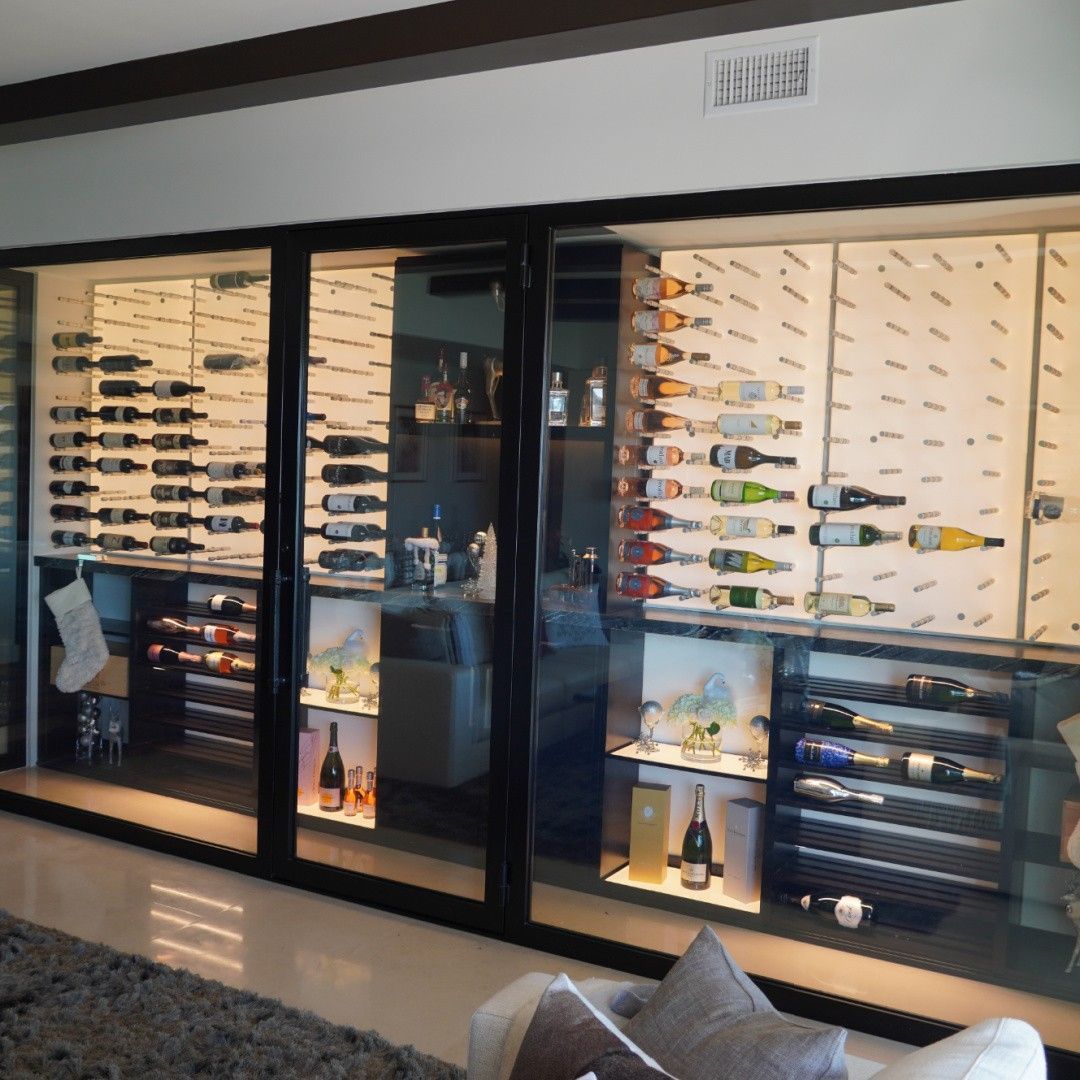
Bottle glass reflects light instead of showing labels when the angle is wrong. Learn how aiming and shielding fix cellar lighting glare for good.
Glass wine cellar divider in a modern home, filled with wine bottles beside a staircase and dining area.
September 25, 2026
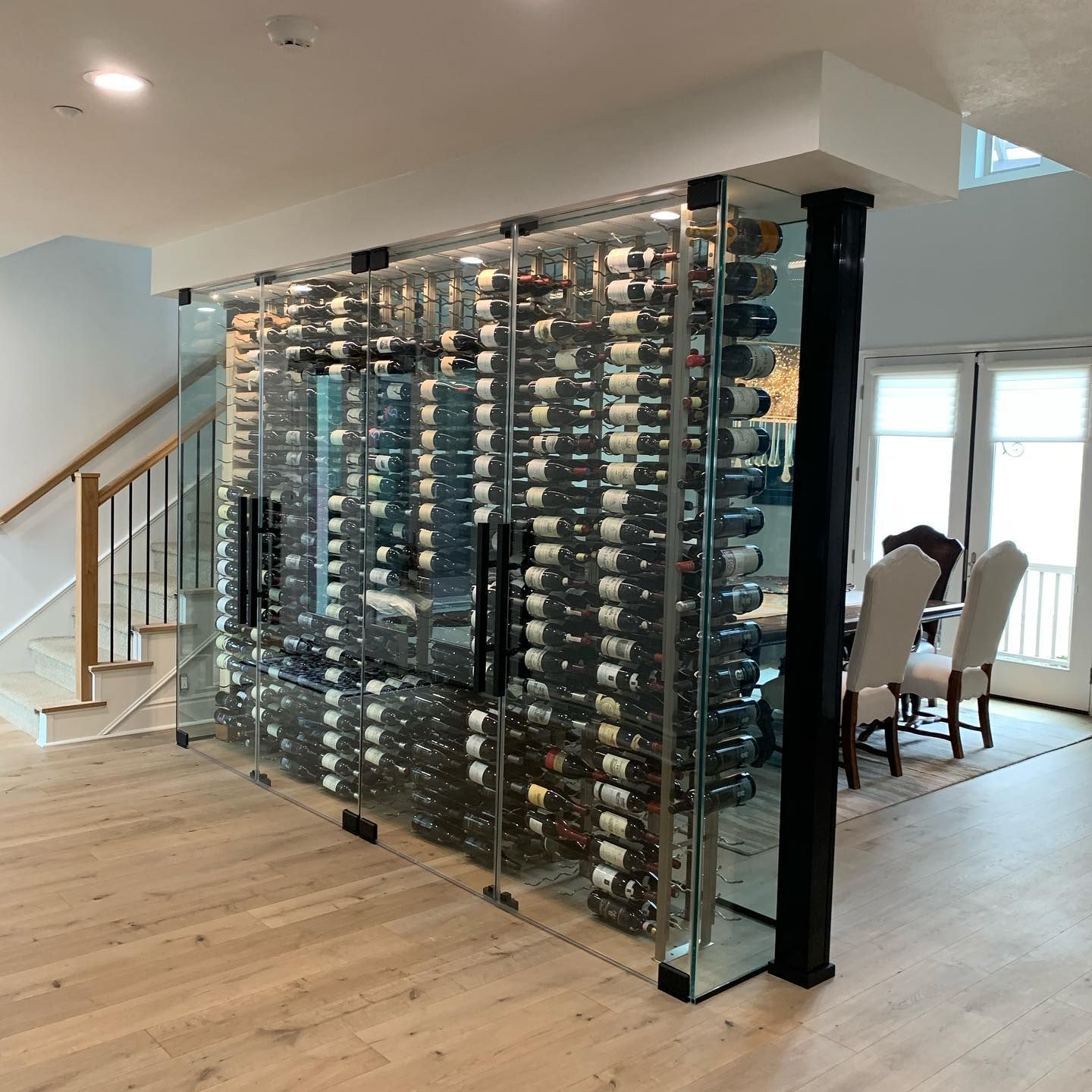
Wet wool or cabbage in a bottle that should have been perfect? Light strike is photochemical, and the glass color decides which wines need room.
Wine bottles stored in a tilted wooden rack behind a glass-front cabinet
September 25, 2026
Warm light reddens redwood and yellows white oak. See which way each species shifts, and the CRI floor California code sets, before fixtures are ordered.
Wall-mounted wine rack filled with bottles in a dimly lit storage room
September 25, 2026
A living-room lighting schedule under-specifies a cellar in predictable ways. The seven lines a cellar schedule needs and what happens when each one is blank.
Glass wine cellar with rows of bottles behind a clear door in a modern interior
September 25, 2026
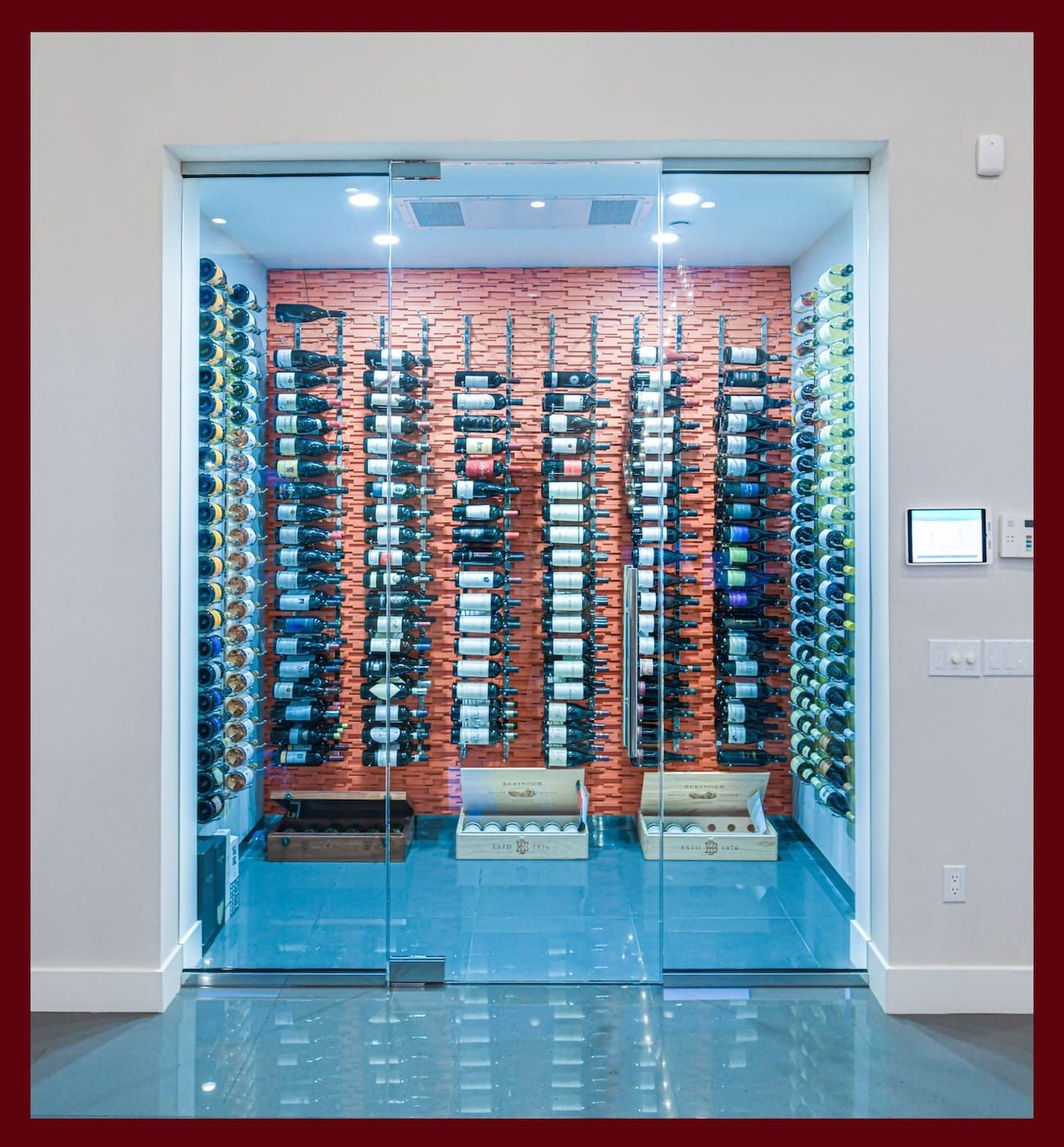
Storage runs stay dark. Display runs stay lit. See how one cellar assigns each job to the runs that need it.

Show More