
Wine Cellar Door Hardware and the Seal Line It Crosses

October 16, 2026

Choosing Between Them for a Specific Run

Once a schedule has been issued to anyone, changing a value quietly is worse than not changing it. A revised schedule carries a new revision number, a new date, and a marker against every row that moved, so a reader holding both versions can tell in seconds which lines are different. Reissuing a corrected sheet with no revision marker leaves two documents in circulation that look interchangeable and are not.


The reissue also has to reach the people working from the old one. A cellar's fixture order, the racking shop drawings, and the electrical rough-in can all be running from the same schedule at the same time, and a Kelvin value corrected on the designer's copy changes nothing until the version carrying that correction lands with whoever placed the order.

Fixture substitutions happen at bid, at order, and occasionally after delivery, and a fully populated schedule is what sets the terms of one in advance. A substitution proposed against a complete row has to hold every value on that row, including the ones a supplier would find inconvenient to match. A fixture matching wattage, beam angle, and trim size while dropping below a stated CRI floor is a different specification, and a populated row makes that visible without an argument about intent.


The burden of showing it sits with whoever proposes the swap. A substitution request arriving as a catalog number and a price, with no line-by-line comparison against the scheduled values, has not been made yet; it has been asked about. Requiring that comparison in writing is what keeps the substitution a decision the specifying professional is still making.

The Sheet Has to Say What It Is

TIP: A schedule reissued after fixtures are ordered should say so on the sheet. A revision that arrives post-order is a change order in practice, and marking it as one keeps the cost conversation attached to the line that caused it.

What you observe Points to
Present since installation, color consistent, dim points evenly spaced Spacing and mounting height
Boundary lines up with a material seam in the racking, present from day one Rack depth or finish change
Color shifts across a boundary, not just brightness Mixed LED bins from a partial replacement
Whole run dims, flickers, or fades together; appeared after a period of looking fine Driver channel losing output

New Title

Every piece of hardware on a cellar door is a hole in something that was supposed to run unbroken. A mortise lock is a pocket cut into the leaf. A lockset bore is a straight path from one face to the other. A magnetic lock needs a strike mounted at the jamb and a wire reaching it. A keypad or reader sits on a face that stays humid for the life of the door. Handles and pulls are fastened through, not applied on top. Each of those is a legitimate requirement on a serious collection, and each one lands somewhere specific relative to the seal line the door exists to hold. Hardware gets specified for how it looks and how it locks. It is rarely specified for what it does to the gasket, which is the part of the door actually doing the work.

Hardware That Cuts into the Leaf

A mortise lock body sits inside a pocket routed into the edge of the leaf, deep enough to hold the case and the latch mechanism. On a solid wood or an insulated metal leaf, that pocket removes material from the same cross-section that is supposed to run edge to edge without a gap. A bore-and-latch lockset is a different kind of cut: a hole straight through the leaf, face to face, sized for the cylinder and the spindle. Both are legitimate, and both have to be sealed and finished as carefully as the rest of the door, not treated as a fixture bolted on after the leaf is complete.


TIP: Lock body placement, bore size, and edge distance belong on the material-selection specification alongside the leaf and the finish, not a field decision made once the door has already been built.

A frameless glass leaf does not present the first problem at all. There is no pocket and no bore in the glass. Any lock function on that kind of door has to live at the frame or the strike side instead, which changes where the hardware question gets asked but does not remove it.

Where Hardware Lands on the Gasket Line

A frameless door's seal is a magnetic gasket that runs continuously along the jambs and the head, with no perimeter frame breaking that line. A strike plate for a lock has to mount somewhere on that same jamb, and if it lands inside the band the gasket needs to contact, it creates a small step where the magnetic strip cannot press flush against the frame. That step is not large, but it sits at exactly the height a walk-through rarely checks, since attention goes to the swing and the latch feel rather than the narrow band of jamb behind the strike.


On a wood or metal door with a mechanical latch, the interruption runs the other way. A strike mortise is cut into the jamb at latch height so the bolt can reach it, and that cut crosses whatever weatherstripping or compression seal was specified to run along that same jamb. The latch needs depth to engage; the gasket needs a continuous surface to compress against. Those two requirements occupy the same few inches of jamb, and one of them gives unless the hardware position and the seal detail are drawn together instead of specified separately.

Black pull handles on a tempered glass wine cellar door

A Face That Stays Humid for the Life of the Door

A keypad, a card reader, or an electronic strike mounted on the interior face of a cellar door lives at whatever humidity the room is built to hold, day after day, as a constant operating condition rather than an occasional exposure. That is a different service condition than the same hardware would see on an exterior gate or an office door. Access hardware of that kind usually reaches a cellar door through a security or low-voltage supplier working to its own specification, and the component ratings are that supplier's call. What the cellar side owns is the detail around it: where the unit lands relative to the gasket, how its back box passes through the leaf or the frame, and how that opening gets sealed and finished afterward.


The back box behind that keypad is its own penetration, separate from the lock body lower on the door. It has to pass through the leaf or the frame to reach whatever it is wired to, and that hole needs the same attention to sealing and finish as the lock bore does. Skipping that step because the keypad reads as a small, low-profile fixture is how a second, smaller leak gets added next to the one everyone already planned for.

A Conductor Has to Cross the Frame

A magnetic lock holds by continuous electrical power, not by a mechanical bolt, which means a conductor has to run from a power source to the strike mounted at the jamb. That wire crosses the frame at some point, and the hole it passes through is a penetration in the same structural member that is supposed to run continuous around the opening, no different in kind from the lock bore in the leaf.

WARNING: A magnetic lock's power path ends at a strike near the gasket, inside a room held at high humidity. Whoever supplies that lock brings the wire; the frame it crosses, and the seal around that crossing, belong to the cellar build.

Fixing that conductor path at the same stage the frame is specified, rather than routing a wire once the frame is already installed, keeps the hole where the frame's own continuity was drawn to allow for it instead of wherever a run happens to reach.

Fasteners That Bridge What the Leaf Stops

Handles and pulls are fastened through the leaf, face to face, not applied as surface decoration. On an insulated metal door with a thermal break running through its cross-section, an unplanned through-fastener can bridge that break directly, connecting the inside face to the outside face with a short length of metal that the thermal break was built to interrupt. A single fastener rarely undoes the whole assembly, but it is still a path the design did not intend, added at the point where the hardware supplier and the door fabricator hand off to each other and neither one owns the detail.


On a sealed wood leaf, the same through-bolt penetrates a finish that was specified to keep water out of the wood, and the hole needs its own seal where the fastener meets that coating, distinct from the finish itself. Left alone, that single point is where the finish fails first, well before the broad face of the door shows any wear.

WARNING: Salt-laden air along the Orange County coast attacks exposed fastener heads and hinge pins faster than the leaf around them. Brushed stainless or powder-coated hardware is the answer, and it is chosen with the hardware layout, not after a pin rusts.

Fastener count and position belong on the same drawing as the lock and the strike. A pull relocated two inches on install day is a different penetration than the one drawn, and on a leaf carrying a thermal break or a sealed finish, two inches decides whether the fastener lands somewhere the assembly was detailed to accept.

Locking a Cellar for a Real Reason

A lock on a cellar door is not a decoration or an assumption of distrust. Insurance carriers that schedule a wine collection by value routinely ask what secures the room the bottles are in, and a household with staff, guests, or teenagers has a legitimate reason to control who opens that door without supervision. None of that changes what a lock does to the leaf or the jamb; it just means the requirement is real and worth specifying against the seal rather than working around it.

TIP: Underwriting requirements arrive on their own schedule, and a carrier's answer can land well after the door drawing has closed. A requirement met at the design stage is a specification; the same requirement met later is a cut through a finished leaf.

That specification work is the same whether the lock is a single mechanical deadbolt or an electronic system with a keypad and a magnetic strike: every added component is another point where a hole gets cut through the leaf, the frame, or the band the gasket has to compress against, and the seal has to be drawn back around it deliberately.

Two Specifications on Every Hardware Item

Every hardware item on a cellar door carries two specifications at once: what it looks like and how it locks, and what it does to the seal that surrounds it. The first gets asked constantly, in finish samples and lock-style catalogs. The second rarely gets asked at all, because it requires looking at a lock, a keypad, or a handle as a hole first and a fixture second.


Where each item lands relative to the seal, and what happens to the gasket at that exact point, is a different answer for every item on the list. A mortise lock takes material out of the leaf's edge. A magnetic strike takes a mounting position off the jamb the gasket needs. A keypad adds a back box behind the face; a plain handle adds two through-bolts and nothing else. Settling that for each item during design, while the leaf is still a drawing and the frame is still a set of dimensions, costs nothing but a conversation. Settling it after the door is built costs a second visit, a second cut, and a seal that now has to work around a decision instead of alongside it.

Frequently Asked Questions

  • Can lock hardware be added to a frameless glass cellar door after installation?

    Not once the glass has been tempered. Tempered glass has to be cut, drilled, or notched before the tempering process, because it cannot be reworked afterward without the pane failing. Any hole for a lock cylinder, a strike, or a mounting plate on a glass leaf has to be decided and cut into the design before the glass goes into the tempering oven, which is why lock hardware for a glass door gets specified early rather than added on site.

  • Are wine lockers in a restaurant or club program secured individually?

    Yes. Club, restaurant, and hotel locker programs are offered with lock tiers alongside zoned climate control, so a single locker can be locked to one member or guest without changing the climate conditions shared by the rest of the room. The lock and the climate zone are specified as separate systems even though they sit in the same cabinet.

  • Does hardware choice matter differently for a restaurant cellar than a home cellar?

    It adds a second requirement. Commercial installations have to balance sommelier retrieval speed against front-of-house display, since the same door a server needs to open quickly during service is often the door guests see from the dining room. Hardware fast enough for staff still has to read correctly on a cellar built to be looked at, which a private residential cellar does not have to consider.

  • Does the wall or ceiling around the door make up for hardware penetrations in the leaf?

    No, because that insulation number belongs to a different assembly. Cellar walls are specified to a minimum of R-19 and ceilings to R-30 or higher, but that figure describes the wall and ceiling construction, not the door. A lock bore or a keypad penetration in the leaf is a separate detail that the surrounding wall's insulation value does not offset.

  • Can a door frame be custom-built to fit hardware in a non-standard position?

    Yes. Specialty doors are available through trade and wholesale supply channels that include custom frame options, which lets a frame be built with hardware positioned relative to the gasket line and the frame's own members rather than forcing a lock or a reader into a standard frame not designed for it.

  • Does a lock or keypad penetration get accounted for in the cooling load?

    Not as a line of its own. Cellar cooling is specified from a heat load calculation rather than from square footage, and that calculation takes the door assembly and how often the door opens as inputs. A bore through the leaf or a back box behind a keypad is too small to appear as a separate term in it, which is why a hardware penetration has to be resolved at the seal detail rather than absorbed later by equipment capacity.

Bring your hardware list to the design table — a habit that lets your builder position every lock, keypad, and pull against the gasket line while the design is still on paper. Cachet Wine Cellars designs and builds custom wine cellars from Irvine, California, with a lifetime warranty on every installation. Call (949) 569 7857.

Recent Posts

Tall glass wine cooler cabinet in a warm-lit restaurant hallway, with bottles visible inside.
October 16, 2026
A cellar door that worked for years can fail once work happens elsewhere in the house. Learn how to trace the real cause before blaming the door.
Open ornate glass doors into a warmly lit wooden dining room with a long table and chandelier
October 16, 2026
One face of a wooden cellar door sits at cellar humidity, the other tracks the house. That difference bows the panel; core and finish scope limit how far.
Wooden ceiling vent above a dark beam, with two bottles visible at the bottom edge.
October 16, 2026
A return grille placed near the door reads warm household air as cellar air. See where return air belongs, and the mistakes that cause the same error.
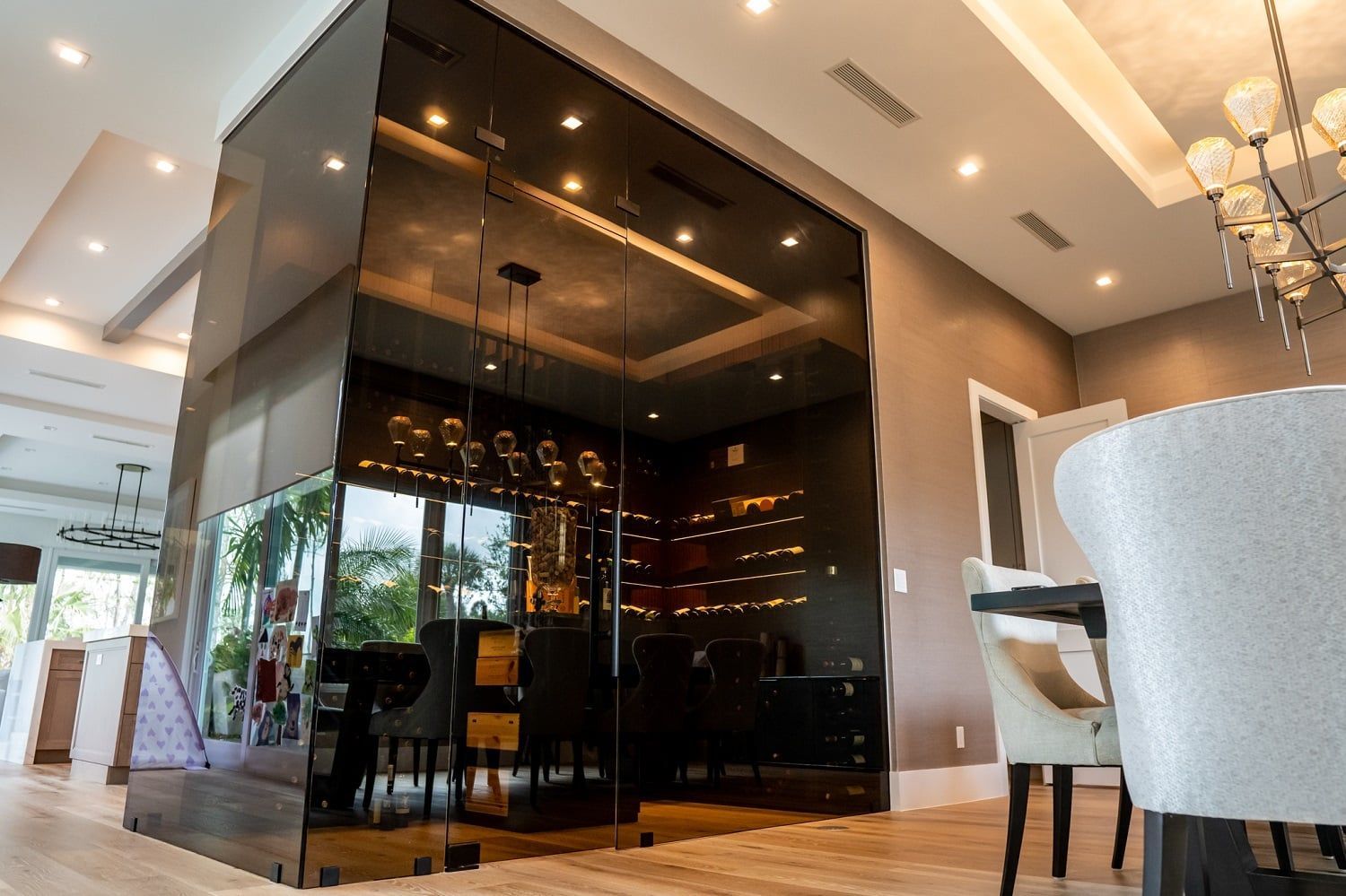
Glass wine cellar door in a dining room, the house-side pane where condensation appears
October 16, 2026
Condensation on a cellar glass door usually means humid house air met a cold house-side pane, not a cooling fault. Which side is wet is the diagnosis.
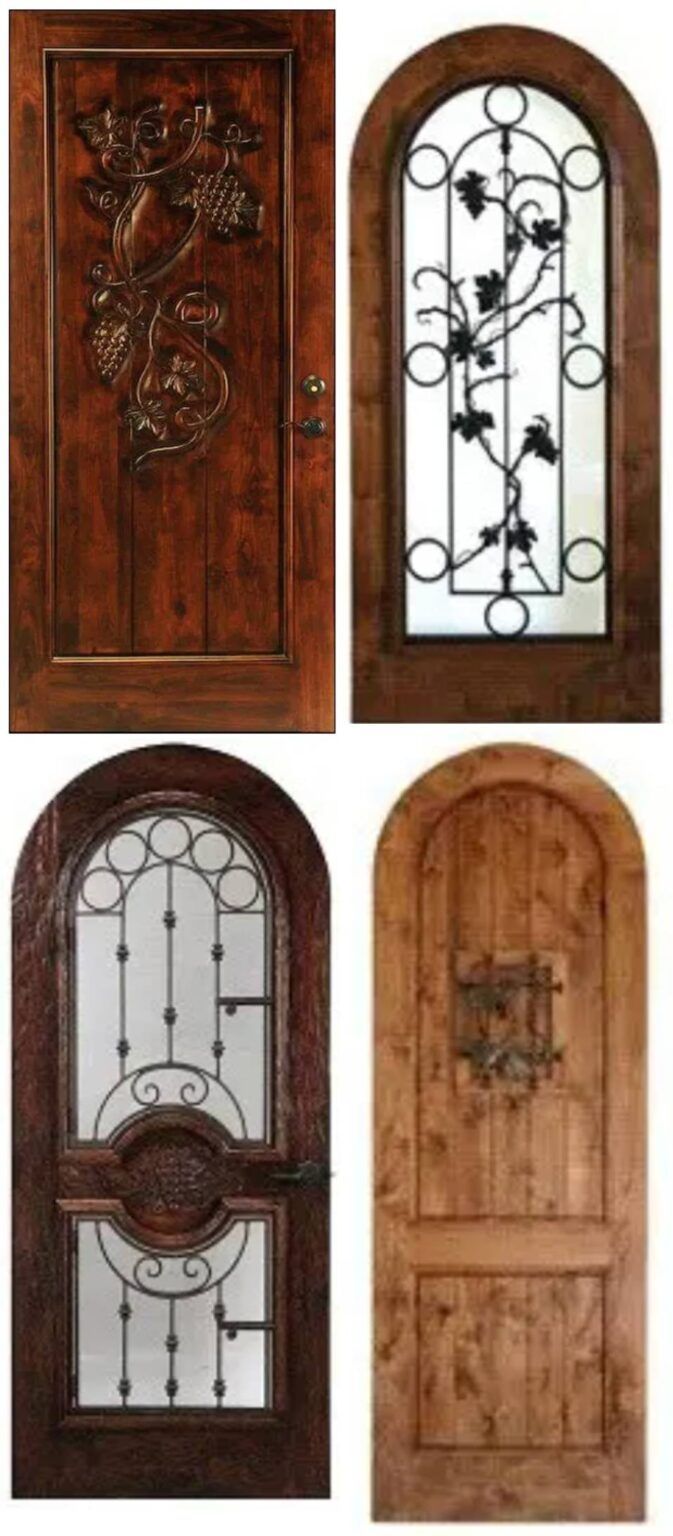
Four decorative wooden arched doors with ornate iron and carved detailing
October 16, 2026
Compare wine cellar door types by what rules each one out: the opening, the wall, traffic, and the view, not style alone.
Black metal pull handles on a glass door, viewed close up.
October 16, 2026
A cellar door can seal at the jambs and head and still fail at the floor. Why the threshold is different, and the two ways builders close it.
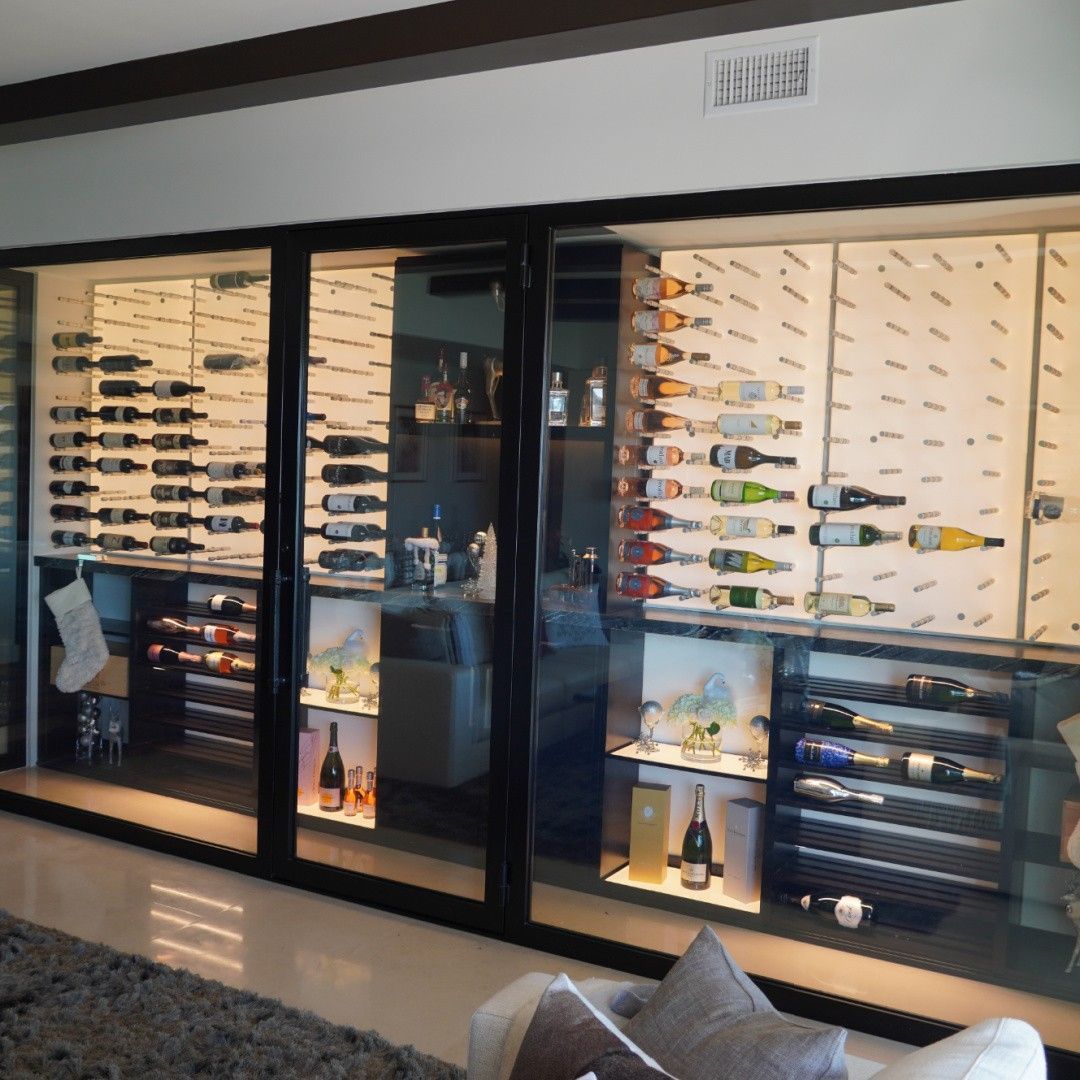
Modern wine display wall with glass-front cabinets and rows of bottles in a sleek interior.
October 16, 2026
A cellar door's swing needs clear floor inside the cellar and clear hallway outside it. See how clearance, opening width, and wall placement fit together.
Wooden double doors with glass panes in a tan hallway, flanked by framed wall art.
October 16, 2026
A custom cellar door built to the wrong opening can't be trimmed on site. What a GC and framer must confirm in writing before release to manufacture.
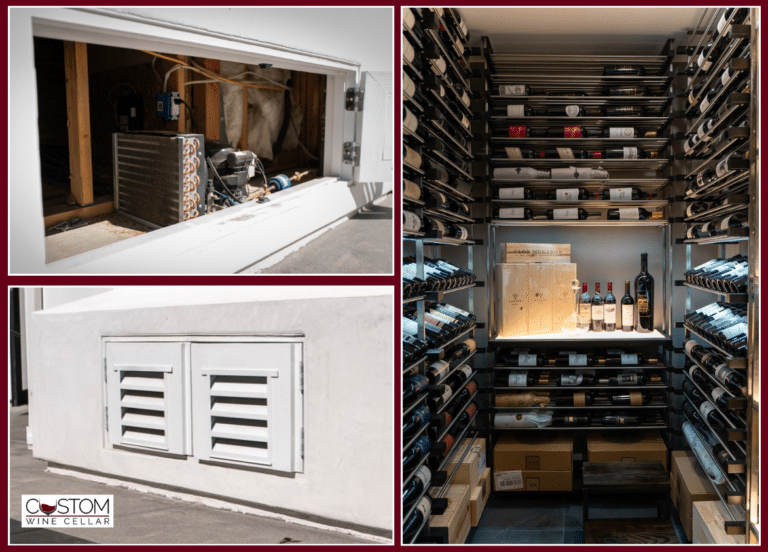
Custom home-built wall cabinet with hidden sliding shelves and a louvered wall vent in a room.
October 16, 2026
A leaking cellar door shows up first as cooling that runs longer with no setpoint change. The daily shape of that runtime is the real tell.
Built-in wine wall with glass doors and warm lighting in a modern living room
October 16, 2026
The cellar door is picked early and ordered late. See what sets wine cellar door lead time and how to build it into a remodel schedule.

Show More