Wine Cellar Return Air Door Placement: The System Reads House Air
Fogging on either face of a single pane is surface condensation, and it responds to the air conditions described above. It is a different problem entirely when moisture, or a cloudy haze that looks like moisture, sits between the two panes of a double-glazed door and never wipes away, because there is nothing on an exposed surface to wipe. That pattern means the seal on the insulated glass unit has failed, letting air and moisture into the gap between the panes. It is a manufacturing or seal defect, not a humidity condition, and it resolves with pane replacement rather than any adjustment to the cellar or the house.
Surface condensation is also not evidence that the cellar's cooling system is malfunctioning. A cooling unit correctly holding the cellar at 55°F is, in fact, the reason the glass is cold enough for condensation to form at all when the air on either side crosses its dew point. Chasing the cooling equipment as the source of a fogged pane usually leads away from the cause.
Choosing Between Them for a Specific Run
Once a schedule has been issued to anyone, changing a value quietly is worse than not changing it. A revised schedule carries a new revision number, a new date, and a marker against every row that moved, so a reader holding both versions can tell in seconds which lines are different. Reissuing a corrected sheet with no revision marker leaves two documents in circulation that look interchangeable and are not.
The reissue also has to reach the people working from the old one. A cellar's fixture order, the racking shop drawings, and the electrical rough-in can all be running from the same schedule at the same time, and a Kelvin value corrected on the designer's copy changes nothing until the version carrying that correction lands with whoever placed the order.
Fixture substitutions happen at bid, at order, and occasionally after delivery, and a fully populated schedule is what sets the terms of one in advance. A substitution proposed against a complete row has to hold every value on that row, including the ones a supplier would find inconvenient to match. A fixture matching wattage, beam angle, and trim size while dropping below a stated CRI floor is a different specification, and a populated row makes that visible without an argument about intent.
The burden of showing it sits with whoever proposes the swap. A substitution request arriving as a catalog number and a price, with no line-by-line comparison against the scheduled values, has not been made yet; it has been asked about. Requiring that comparison in writing is what keeps the substitution a decision the specifying professional is still making.
The Sheet Has to Say What It Is
TIP: A schedule reissued after fixtures are ordered should say so on the sheet. A revision that arrives post-order is a change order in practice, and marking it as one keeps the cost conversation attached to the line that caused it.
| What you observe | Points to |
|---|---|
| Present since installation, color consistent, dim points evenly spaced | Spacing and mounting height |
| Boundary lines up with a material seam in the racking, present from day one | Rack depth or finish change |
| Color shifts across a boundary, not just brightness | Mixed LED bins from a partial replacement |
| Whole run dims, flickers, or fades together; appeared after a period of looking fine | Driver channel losing output |
Return air should never pull directly from the door opening. That single line survives in Cachet's own specification because it is correct: a return grille positioned inside the door's draft path reads the warm, humid air the door has just leaked into the room, reports that reading to the controller as cellar air, and the system runs against a signal that was never accurate.
A Return Grille Only Reports the Air It Reaches
A grille positioned near the racking samples air near the racking. A grille positioned near the door samples whatever the door most recently let in, and the equipment has no way to tell those two samples apart. That gap is the whole failure, and it follows directly from what a return grille is: the intake side of the cooling loop, drawing air from the room back to the evaporator coil so the equipment can measure what the cellar is holding, then supplying cooled and dehumidified air back into the space. Whether the cooling system is self-contained, ducted, or a split configuration, the return's function does not change: sample the room accurately. What changes from job to job is where that sample comes from.
When the Return Sits in the Door's Leak Path
Every cellar door exchanges air across its threshold and perimeter each time it opens, no matter how well it is fitted, and to a lesser degree while closed under a pressure differential between the cellar and the room beyond it. That exchange runs in both directions at once: cold, dense cellar air spills out low across the threshold while warm, humid house air crosses in above it. The inbound half of that exchange carries the temperature and humidity of whatever conditioned space sits on the other side of the door, not the cellar's target range. A return grille mounted in the door's draft path, whether on the door wall itself, in the header above the door, or on an adjacent wall close enough to catch the swing, draws that leaked air toward the coil before it has a chance to mix into the rest of the room's air volume.

WARNING: A return mounted directly above or beside the door captures the leak column before it disperses, so the reading skews warm on every door cycle even when the room itself is holding at target.
The result is a return that samples the door more consistently than it samples the cellar.
What the System Does with a False Reading
The controller does not distinguish between a warm room and a warm reading. It responds to the number the return delivers, and only that number. A return skewed warm by door leakage produces calls for cooling that the cellar's air does not actually need, so the compressor and coil run against a demand signal built from house air rather than cellar air. On a system whose only room measurement is taken at the return, nothing downstream catches the error, and the same reading keeps driving compressor cycles unchanged. The consequence is not only wasted run time. Every time the return draws warm house air instead of cellar air, it draws that air's humidity into the loop along with it, adding unconditioned moisture to a system sized to manage a smaller, already-conditioned volume.
Where the Return Belongs Instead
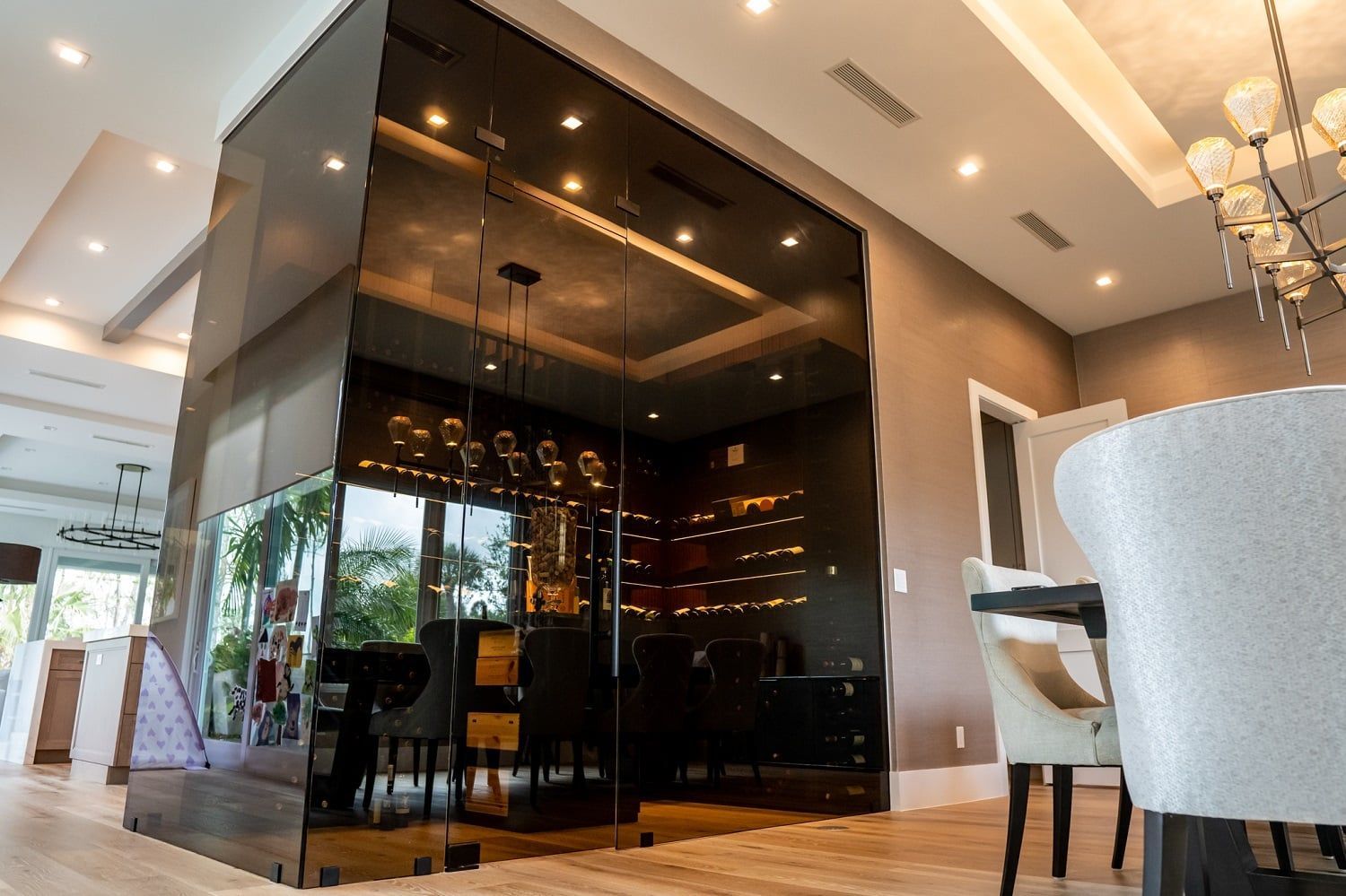
The return belongs on the wall the door's air stream does not reach directly, typically the wall opposite the door, where any leaked air has to cross and mix with the room's full volume before it can be drawn toward the coil. Cachet's Mission Viejo project uses this layout: the return draws from the wall facing the door rather than the door wall itself, so the reading reflects the cellar's conditioned air rather than the door's most recent leak.
Racking layout has to be coordinated against this decision rather than the reverse. A return position chosen after the racking is already fixed sometimes has no remaining position except back toward the door.
TIP: When racking and door placement are decided together, confirm the return location on the mechanical drawings before finalizing rack runs. Moving a grille after drywall goes up is a rough-in problem, not a design one.
The Same Error by Other Routes
The return grille is not the only component that can read the door instead of the room. A temperature sensor or thermostat mounted on or near the door wall registers the same draft a misplaced return would: a spike each time the door opens, followed by a slower decay as the room re-stabilizes. The controller responds to that transient as though it were the steady-state condition, calling for cooling the room never lost. The correction is the same principle applied to a different part: keep the sensor out of the door's draft path, on a wall the door's air stream does not cross.
The other common version of this error shows up in slab-on-grade construction. In many Southern California homes built on a slab, the cooling equipment sits above the ceiling or in an adjacent room rather than below the cellar, so the return path is routed through a soffit rather than a floor plenum. That soffit run is often the easiest place to drop a return grille near the door, because it is the shortest duct path, and the shortest path is not the same as the correct one. A grille set into a soffit that crosses close above the door captures the same leak column a wall-mounted grille would, from a different plane.
A third version does not involve the door at all. If a return sits too close to the supply grille, the system pulls back air it has just conditioned before that air travels across the room and picks up the cellar's actual heat and moisture load. The reading in that case is not warm, it is falsely stable: the return shows the supply's own output rather than the room's condition, and the compressor cycles on a signal that never reflects what the bottles, the walls, or the open door are doing to the air. The correction is positional, the same as it is for the door: enough distance, and enough of the room's volume, between the two grilles that the air has to circulate before it reaches the return.
WARNING: A return set too close to the supply reads back the system's own conditioned output, so the number holds steady while the room drifts. A falsely stable reading is harder to catch than a falsely warm one.
Frequently Asked Questions About Wine Cellar Return Air Placement
Does return placement matter as much for a self-contained unit as for a ducted system?
In a self-contained WhisperKOOL or Breezaire unit, the same faceplate handles both supply and return, so the unit's mounting location on the wall determines the return's location as well. Mounting a self-contained unit on or near the door wall to shorten the power and condensate run creates the same false-reading exposure a separately ducted return would produce, just without a separate grille to relocate later. The fix is the same: keep the unit's face off the door wall.
Can a remote sensor wired to a split system have the same problem?
Yes. Wine Guardian's Pro Series split system runs on a 24V thermostat circuit that Cachet integrates with Crestron, Nest, or Honeywell controls, and that thermostat is mounted out in the room rather than at the equipment. Mount it on the door wall instead of an interior wall away from the opening and it registers the same door-cycle spike a misplaced return grille would. The diagnostic problem is specific to split systems: the evaporator sits in a remote mechanical space, so no amount of inspecting the equipment will show that the fault is a sensor position back in the cellar.
Does a false-warm reading show up as a humidity problem before a temperature problem?
Often, yes. The evaporator coil is held below the room's dew point on purpose, which is how the system pulls moisture out of the air; that moisture then leaves through a condensate drain. A return drawing warm house air pulls that air's humidity into the loop as well, so a misrouted return frequently shows up first as humidity readings above the band, with the temperature reading lagging behind because the compressor is still cycling to chase the false number.
Where does return placement fit into Cachet's build sequence?
Cooling is installed and commissioned at stage 9 of Cachet's eleven-stage process, while the door, lighting, and finishing work happen at stage 10. That means the return's location has to be committed to, and correct, before the door is hung.
What if the cellar is too small to have a wall the door's air stream does not reach?
Closet and under-stair conversions can put the facing wall only three or four feet from the leaf, so no surface in the room sits fully clear of the swing. The workable answer there is a side wall behind the door's open position, where the leaf itself stands between the grille and the inbound stream for as long as the opening is uncovered. Height helps as well: warm air crosses in high and cold air spills out low, so a grille set at mid-height samples the layer least disturbed by either.
Can the return share the same wall as the door, just positioned farther away?
It can, if it sits far enough from the opening that it is not in the direct pressure path. What governs that distance is the grille's face velocity: an intake pulls hardest in the first few feet directly in front of its face and falls off sharply beyond that, so what has to clear the door swing is that short-circuit radius rather than the wall's full length. A same-wall return is also more sensitive to exactly where the racking or a support post ends up, since either can redirect airflow back toward the grille inside that radius.
Fix the return-air position against the door on the drawing — not at rough-in, when the easiest duct run wins by default. Cachet Wine Cellars designs and builds custom wine cellars from Irvine, California, with a lifetime warranty on every installation. Call (949) 569 7857.