
Wine Cellar Door Lead Time: Why It Runs Longer Than Planned

October 16, 2026

Choosing Between Them for a Specific Run

Once a schedule has been issued to anyone, changing a value quietly is worse than not changing it. A revised schedule carries a new revision number, a new date, and a marker against every row that moved, so a reader holding both versions can tell in seconds which lines are different. Reissuing a corrected sheet with no revision marker leaves two documents in circulation that look interchangeable and are not.


The reissue also has to reach the people working from the old one. A cellar's fixture order, the racking shop drawings, and the electrical rough-in can all be running from the same schedule at the same time, and a Kelvin value corrected on the designer's copy changes nothing until the version carrying that correction lands with whoever placed the order.

Fixture substitutions happen at bid, at order, and occasionally after delivery, and a fully populated schedule is what sets the terms of one in advance. A substitution proposed against a complete row has to hold every value on that row, including the ones a supplier would find inconvenient to match. A fixture matching wattage, beam angle, and trim size while dropping below a stated CRI floor is a different specification, and a populated row makes that visible without an argument about intent.


The burden of showing it sits with whoever proposes the swap. A substitution request arriving as a catalog number and a price, with no line-by-line comparison against the scheduled values, has not been made yet; it has been asked about. Requiring that comparison in writing is what keeps the substitution a decision the specifying professional is still making.

The Sheet Has to Say What It Is

TIP: A schedule reissued after fixtures are ordered should say so on the sheet. A revision that arrives post-order is a change order in practice, and marking it as one keeps the cost conversation attached to the line that caused it.

What you observe Points to
Present since installation, color consistent, dim points evenly spaced Spacing and mounting height
Boundary lines up with a material seam in the racking, present from day one Rack depth or finish change
Color shifts across a boundary, not just brightness Mixed LED bins from a partial replacement
Whole run dims, flickers, or fades together; appeared after a period of looking fine Driver channel losing output

A cellar door gets chosen in the design rendering, weeks into a project, and ordered several weeks after that. In between, the buyer keeps looking at the rendering, comparing wood species, and reconsidering the glass. The rest of the project does not wait for that decision to close: racking gets specified, and cooling gets sized. The door is usually the one item still open while everything around it moves, and it also carries the longest, least forgiving lead time of anything in the room.

Stock Parts, Custom Leaves, and Two Different Clocks

Two different supply chains sit behind a finished cellar door. Standard components, the parts that come off a shelf rather than a workbench, ship in about two to three weeks. Some materials run longer, six to eight weeks, because they are milled or finished to order rather than kept in stock. A custom leaf sits past both of those bands: once glass, species, hardware, and finish are locked to a nonstandard combination, the manufacturer is no longer pulling from inventory, and the lead time extends again.


Spanish cedar is the clearest example on record. At roughly six weeks to source and mill, it has already moved a construction schedule on one project, not because the wood was hard to find, but because the order went in after the framing crew had already set a completion date around it.


The distinction that matters for scheduling is not wood versus glass, or framed versus frameless. It is stock versus custom, and a custom leaf, once released to the shop, cannot be revised without going back into the queue.

TIP: Confirm species and finish at the material-selection stage, not after the quote is signed. A swap made once fabrication has started restarts the leaf's lead time from zero, even if the change looks minor on a drawing.

A Choice Revisited Longer than Anything Else in the Design

The door is usually the first item a buyer reconsiders and the last one they confirm. It appears in the 3D design and rendering that design work produces around weeks four through six, shown alongside a racking layout, a lighting plan, a cooling placement, and a finishing scheme. Racking and cooling both get approved quickly, because only a limited number of configurations fit a given room and the unit has to match its volume. The door carries no such constraint: several broad types, multiple swing and slide configurations, and a handful of workable species keep the choice open long after everything else on the rendering has closed.


A buyer satisfied with the racking and cooling by the design-approval stage in weeks eight through ten may still be weighing a glass pattern or a stain sample. Material selection, covered in weeks six through eight, is where lead-time information gets prepared for every component on the job, but it can only be prepared for what has actually been chosen. A door still under discussion at that point does not get a lead time. It gets a placeholder, and a placeholder does not hold a manufacturer's production slot.

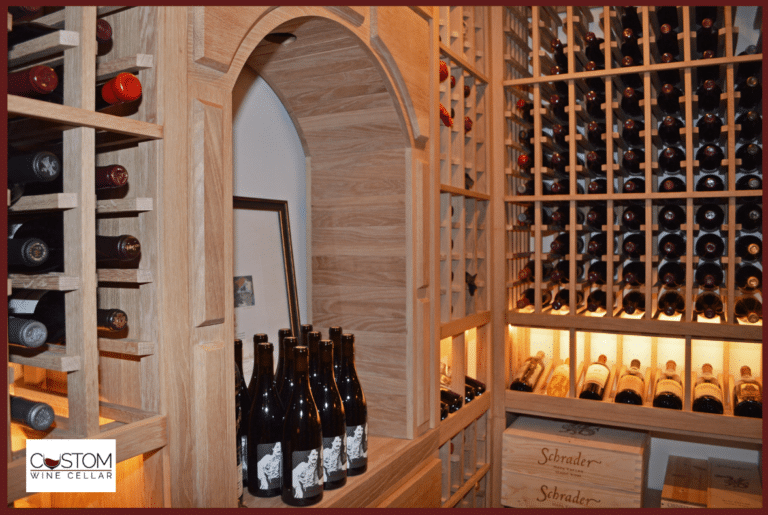
Arched wooden wine cellar doorway and custom wood racking in California

Construction and build-out run four to eight weeks. Racking installation follows at two to three weeks, and cooling installation and commissioning runs another two to three weeks. Doors, lighting, flooring, and finishing come next, and by then the room is essentially built, walls closed, racking in, cooling running. What is left is the work that makes the room usable, and most of it depends on the door being on site.

Trim gets cut to the frame the door sits in. Flooring transitions get set relative to the threshold. Final lighting adjustments account for how the door affects sightlines into the room. None of that finish work can be reordered around a door that has not arrived, because each piece depends on the opening the door occupies. A late door does not shorten the finishing stage. It holds it, and the quality inspection and walkthrough scheduled for one to two weeks after construction completion holds with it.

WARNING: The finish trades were booked against a delivery date fixed before the leaf was ever released to the shop. A reschedule does not move one calendar. It moves three, each with its own next job already committed elsewhere.

A stock component can usually be swapped for another stock component without much consequence, because both are pulled from the same kind of inventory on the same kind of schedule. A custom leaf does not work that way. Once species, glass, hardware, and finish are specified and the order is released to the shop, the leaf enters a production queue built around that exact specification. Changing any one element after that point does not adjust the order. It cancels the specification already in production and opens a new one, with the lead time starting over.


The release point is the material-selection stage, in weeks six through eight, when lead-time information gets prepared and the order can still be shaped around what the schedule needs. Design approval and quote finalization, in weeks eight through ten, close that window. After the quote is finalized, a change to the door still reaches the shop, but as a revision to an order already moving, not as an adjustment to one still being drafted. A change on a drawing costs a redraw. A change to a leaf already in fabrication reaches the specification, the tooling, and a queue position already committed.

Releasing the Order on Schedule

Releasing a custom leaf order on schedule comes down to closing three decisions before the design-approval stage ends: the species or material, the glass or panel configuration, and the hardware and finish. Each one is a separate specification the manufacturer needs, and a rendering that still shows two of the three as options is a rendering the material-selection stage cannot act on.


Pre-construction and preparation, the one to two weeks immediately ahead of the construction start date, is the last point where an unresolved door decision is not yet a hole in the schedule. Once construction begins, the four-to-eight week build-out proceeds regardless of where the door order stands, and racking and cooling installation follow on their own bands whether or not the leaf has shipped. A project with every other decision settled and only the door still open at that point is not ahead of schedule. It has a gap in its schedule, and nobody sees the gap until the finishing stage begins.

Custom alder wood and glass wine cellar door built to order

The overall project runs three to twelve months from design through final install, and where a given job lands in that range has less to do with the size of the cellar than with how early its door order released.

Decisions That Add Weeks to the Wait

Not every choice on a cellar door adds the same amount of time. A stock species finished in a standard stain moves through the two-to-three week band with the rest of the standard components. A species like Spanish cedar, chosen for its color or grain rather than what is already on the shelf, moves into the six-to-eight week band before any custom fabrication is added on top. A nonstandard glass pattern, an unusual dimension, or a special-ordered hardware finish stacks on top of whichever band the base material already sits in, because each is a separate specification the shop has to source rather than pull from stock.


None of that makes a custom door the wrong choice. It makes the timing of the choice the variable that matters. A buyer who settles on a stock configuration late still lands inside the two-to-three week band. A buyer who settles on a custom configuration late is adding six to eight weeks, or more, to whatever is left of the schedule after the decision finally closes.

Frequently Asked Questions About Wine Cellar Door Lead Time

  • Does the initial consultation set the door's lead time?

    No. The initial consultation covers collection size, aesthetic preference, budget range, timeline, and any special requirements, but it establishes direction rather than a specification. A lead time attaches to a door only once species, glass, and hardware are locked, which happens several stages later.

  • When does the actual door opening get measured?

    During the site assessment, the stage that follows the initial consultation. A physical measurement is taken then, ahead of the 3D design and rendering, so the design work that follows is built against the real opening rather than assumed dimensions.

  • Do trade and wholesale orders follow a different timeline?

    The trade and wholesale program sets no arbitrary minimums, so a designer ordering one leaf and a builder ordering a full package enter the same production queue. What differs is scope of service: a trade partner can hand the complete installation to Cachet, or take support only and run the install with their own crew, in which case the partner sets the install date and the order still has to land ahead of it.

  • Can a frameless door be built for an opening that isn't standard?

    Yes. Frameless glass doors can be custom-fabricated for irregular openings, sloped ceilings, or curved walls, but that fabrication requires custom engineering. An opening outside standard dimensions moves the door into a longer, more specification-driven order regardless of which species or glass is chosen.

  • Does racking follow the same order process as the door?

    Not exactly. Semi-custom racking kits ship factory-direct once a stain color is selected, and arrive with assembly instructions and hardware included as a set. That is a narrower set of decisions than a custom door leaf requires, which is part of why racking rarely becomes the item holding up a schedule.

  • Which wood species can a custom door leaf be built from?

    Knotty alder, Spanish cedar, mahogany, redwood, pine, and white oak are all workable species for a cellar door. Each has a different sourcing pattern behind it, which is why settling on one early, rather than comparing samples through multiple design stages, matters for the order date.

Lock in the door specification at material selection — the order releases on schedule and the finish sequence follows behind it. Cachet Wine Cellars designs and builds custom wine cellars from Irvine, California, with a lifetime warranty on every installation. Call (949) 569 7857.

Recent Posts

Open ornate glass doors into a warmly lit wooden dining room with a long table and chandelier
October 16, 2026
One face of a wooden cellar door sits at cellar humidity, the other tracks the house. That difference bows the panel; core and finish scope limit how far.
Wooden ceiling vent above a dark beam, with two bottles visible at the bottom edge.
October 16, 2026
A return grille placed near the door reads warm household air as cellar air. See where return air belongs, and the mistakes that cause the same error.
Modern restaurant interior with dark wine wall, pendant lights, and white upholstered chairs
October 16, 2026
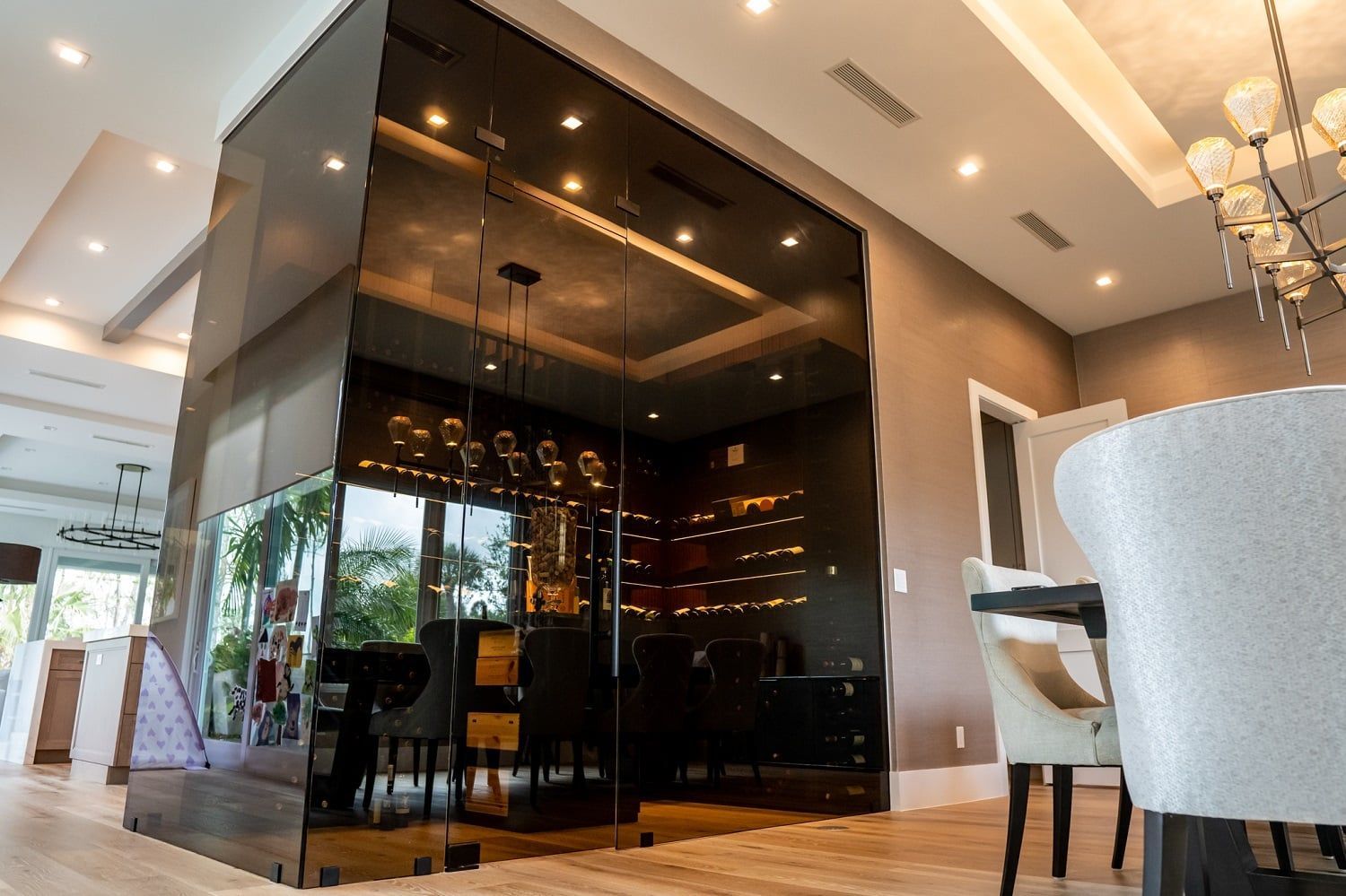
Condensation on a cellar glass door usually means humid house air met a cold house-side pane, not a cooling fault. Which side is wet is the diagnosis.
Four decorative wooden arched doors with ornate iron and carved detailing
October 16, 2026
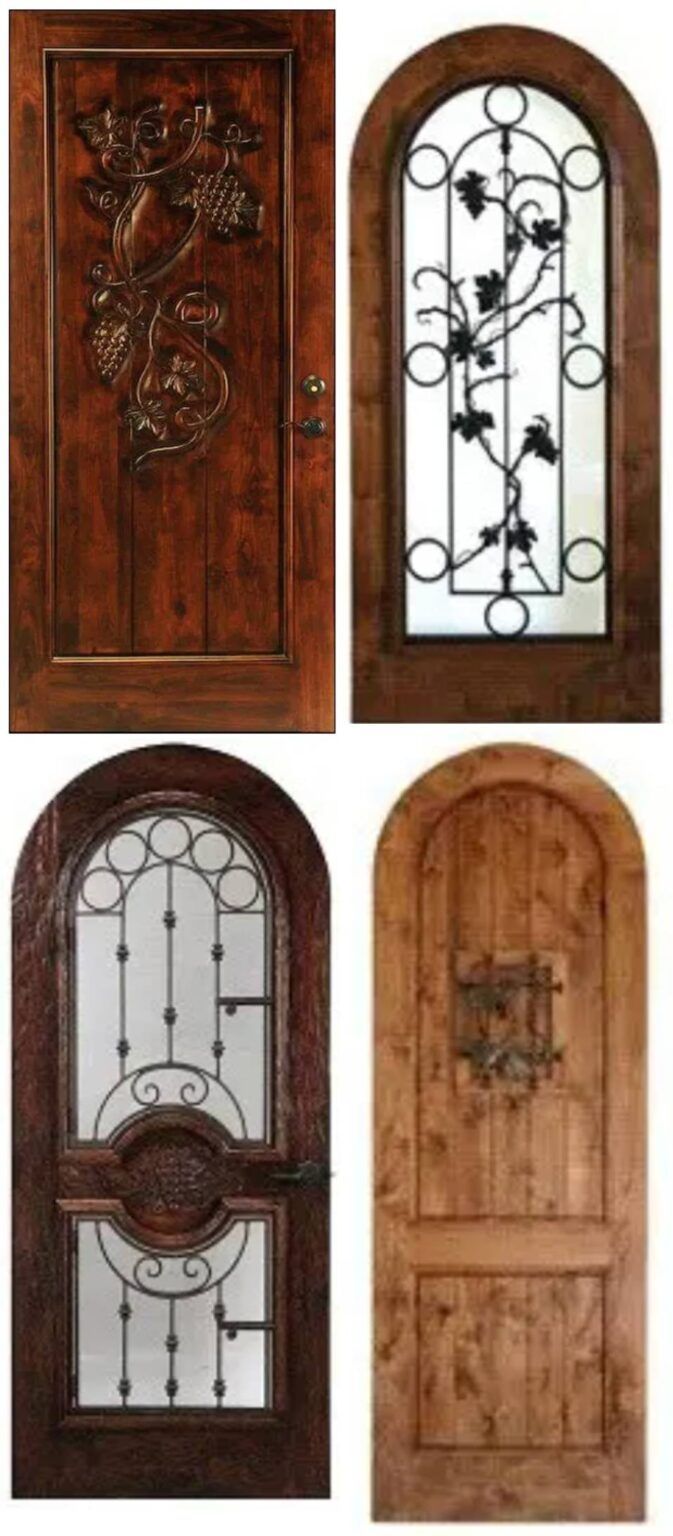
Compare wine cellar door types by what rules each one out: the opening, the wall, traffic, and the view, not style alone.
Black metal pull handles on a glass door, viewed close up.
October 16, 2026
A cellar door can seal at the jambs and head and still fail at the floor. Why the threshold is different, and the two ways builders close it.
Tall glass display cabinet with decorative metalwork in a warmly lit hallway.
October 16, 2026
A cellar door's swing needs clear floor inside the cellar and clear hallway outside it. See how clearance, opening width, and wall placement fit together.
Wooden double doors with glass panes in a tan hallway, flanked by framed wall art.
October 16, 2026
A custom cellar door built to the wrong opening can't be trimmed on site. What a GC and framer must confirm in writing before release to manufacture.
Custom home-built wall cabinet with hidden sliding shelves and a louvered wall vent in a room.
October 16, 2026
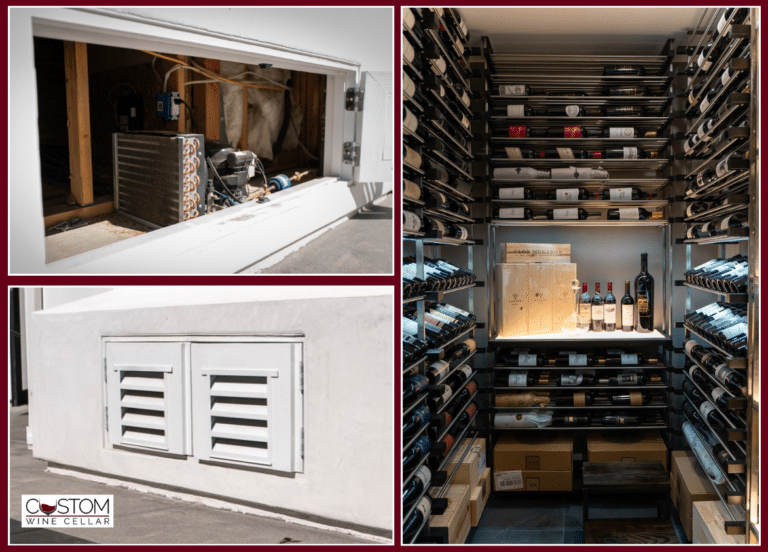
A leaking cellar door shows up first as cooling that runs longer with no setpoint change. The daily shape of that runtime is the real tell.
Wine bottles stored in a built-in under-stair wine rack with metal shelving and glass doors
October 16, 2026
A cellar door that sticks, won't stay shut, and whistles when the system cycles isn't three problems. It's one pressure difference, read three ways.
Wine rack and bottles displayed under a staircase in a dimly lit room
October 16, 2026
What gets checked on a cellar door at handover: seal compression, latch action, hardware finish, and the paperwork that should exist.

Show More