It is the question every cellar owner asks first: how many BTU of cooling do I need? There is no single number that fits a room, because two cellars of the same size can need very different capacities. This guide gives you the realistic ranges and, more importantly, what actually decides the number.
Quick answer
A wine cellar cooling unit is rated in BTU per hour, and across typical residential and commercial cellars the right unit usually falls somewhere between about 1,800 and 22,000 BTU per hour. The exact figure depends on the glass, insulation, location, lighting, target temperature, and amount of wine, not on room size alone. The only reliable way to get your number is a heat-load survey.
Why there is no simple BTU-per-square-foot answer
Comfort air conditioning is often sized by a rough BTU-per-square-foot rule, and people expect cellars to work the same way. They do not. A wine cellar has to hold a low, steady temperature against the heat that leaks in, and how much heat leaks in depends on the construction, not just the volume. A compact room with a glass wall can need more cooling than a larger, well-insulated, below-grade room. That is why a chart based on size alone is unreliable for cellars.
What changes the BTU you need
- Glass.
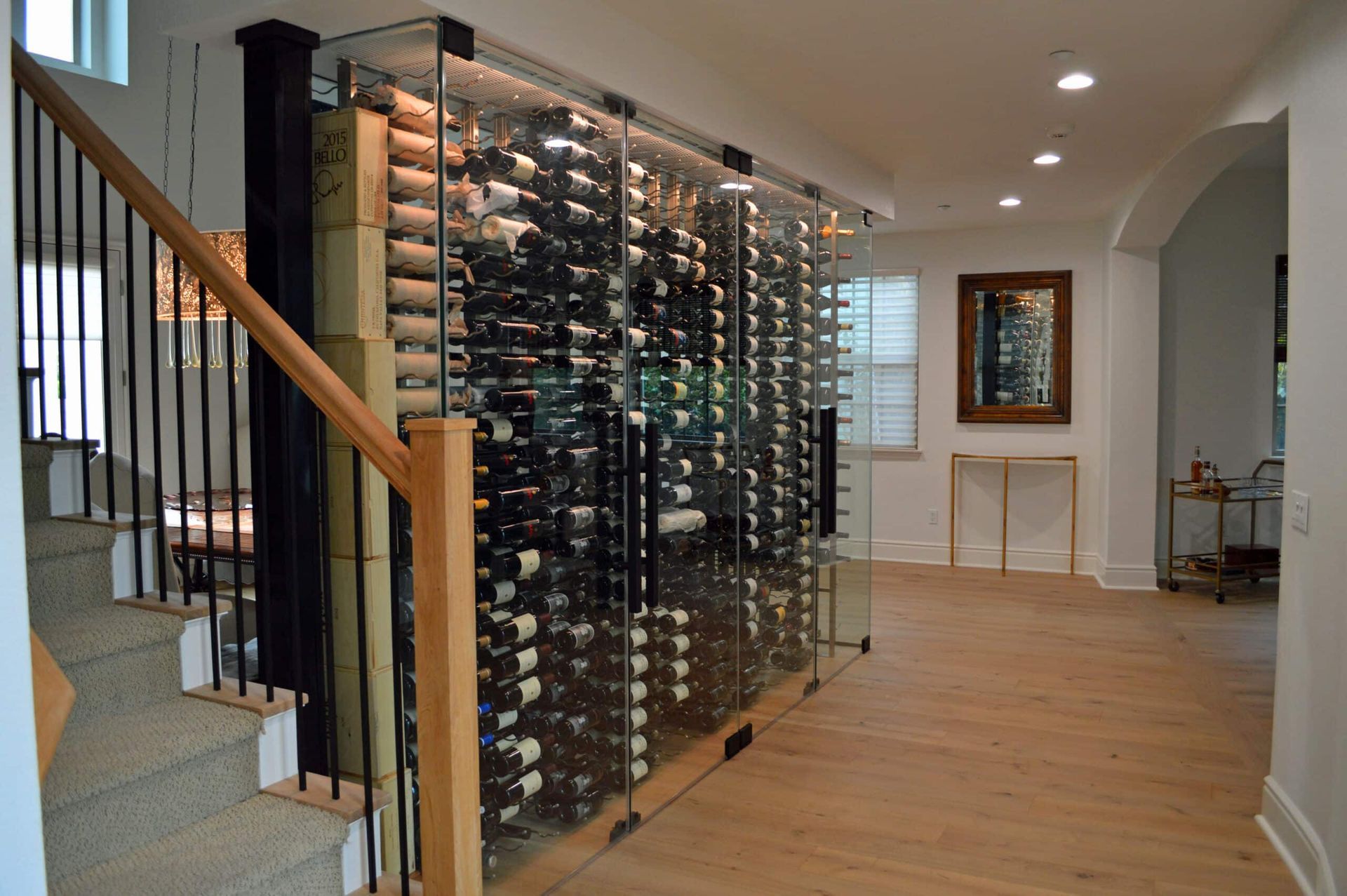
Glass walls and doors add significant heat. Even dual-pane glass insulates to only about R2, so glass raises the number quickly.
- Insulation and grade.
More insulation and a below-grade location lower the requirement. Little or no insulation raises it sharply.
- Lighting.
Hot fixtures add load; LED lighting adds almost none.
- Target temperature.
Holding a room colder than the standard 55 degrees, for serving whites, needs more capacity.
- Thermal mass and use.
A large collection, frequent door openings, or extra appliances all affect the load.
For the full picture of how these factors combine, see our guide to sizing a wine cellar cooling unit.
Typical capacity ranges by unit type
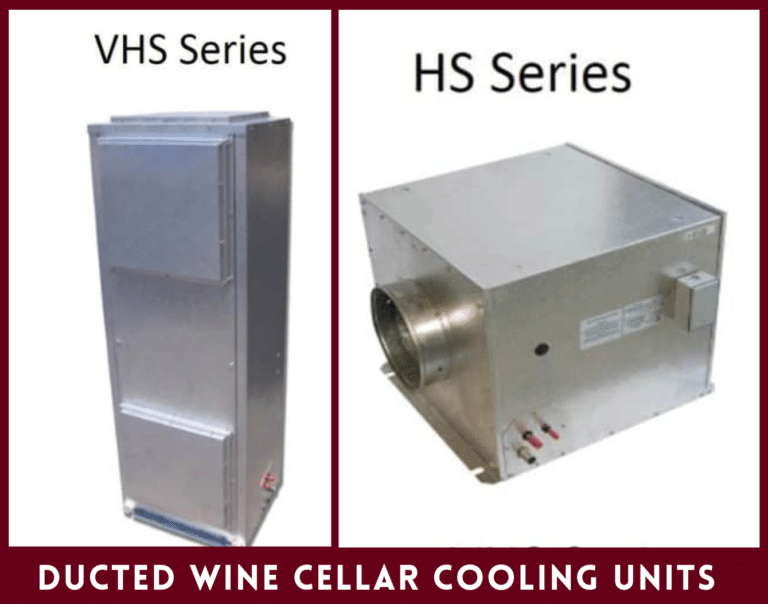
As a rough guide, here are the capacity ranges of the five cooling series we install. Where your cellar lands within these depends on the survey, not the square footage.
| Series |
Type |
Capacity (BTU/hr) |
| RM |
In-room, rack-mounted |
1,800 to 7,200 |
| RMD |
Ducted, low profile |
1,800 to 7,200 |
| LPQ |
In-room, ceiling-mounted |
1,800 to 8,600 |
| HS |
Ducted, high static |
1,800 to 22,000 |
| VHS |
Ducted, vertical high static |
1,800 to 20,000 |
What happens if the BTU is wrong
Too few BTU and the unit runs constantly, cannot hold temperature, and drives humidity down. Too many and it short-cycles, swinging humidity high and wearing out early. Matching the capacity to the real load, not padding it for safety, is what keeps a cellar stable.
A worked example
Say you are planning a 600-bottle home cellar, below grade, well insulated, with a solid insulated door and LED lighting. That room gains relatively little heat and may land toward the lower part of the range. Now add a full glass door and move it above grade against a sunny wall, and the same room gains far more heat and needs noticeably more capacity. Neither number comes from the bottle count or the square footage. Both come from the construction, which is exactly what a heat-load survey measures.
Why you should not round up for safety
It is tempting to buy a bigger unit just to be safe. With wine cellars that backfires. An oversized unit satisfies the thermostat too quickly, shuts off before it has run its humidity-balancing cycle, and then repeats, which pushes humidity up and can cause condensation. It also wears the compressor with frequent starts. The goal is a unit matched to the load so it runs in steady, measured cycles, not one with capacity to spare.
What the manufacturer rating assumes
The BTU figure on a unit is measured under set test conditions, around a 17-degree temperature difference, a 38-degree saturated suction temperature, and a 55-degree room. Your cellar may run warmer or cooler than those conditions, which shifts the real-world capacity. It is another reason the rating on the box is a reference point, not a promise for your specific room. Matching the rated capacity to the conditions your cellar actually runs at is part of what a proper sizing accounts for.
Frequently asked questions
How many BTU do I need for a small home wine cellar?
Small cellars often fall toward the lower end of the range, but a glass door or thin insulation can push the number up. A heat-load survey gives the real figure.
Can I size a cellar by BTU per square foot?
No. Unlike comfort cooling, cellar load is driven by construction, glass, and target temperature, so a per-square-foot rule misses the mark.
Is it safer to buy more BTU than I need?
No. An oversized unit short-cycles and swings the humidity, which can damage wine and the equipment. Correct sizing is what protects the cellar.
Who calculates the BTU for my cellar?
We do, with a free heat-load survey that weighs every factor, then match the result to the right unit and configuration.
Does the number of bottles decide the BTU?
Not on its own. A large collection adds some thermal mass, but the cooling load is driven mainly by glass, insulation, location, and target temperature.
How accurate is a heat-load survey?
Much more accurate than a size-based estimate, because it accounts for the specific features of your room. It is how we land on the right unit the first time.
Will a bigger BTU unit cool faster?
Only briefly, and at a cost. It cools quickly, then shuts off before balancing humidity, which swings the humidity and stresses the compressor. Steady cycling matters more than speed.
Skip the guesswork. Tell us about your space and request a quote, and we will calculate the capacity your cellar needs. Cachet Wine Cellars serves Orange County and Southern California. Call (949) 569-7857.
Call (949) 569-7857