One of the first choices in a wine cellar cooling project is where the equipment lives: inside the room or outside it. In-room units mount in the cellar, usually hidden from view, while ducted units sit outside and pipe cool air in. Both can disappear from sight, but they differ in noise, cost, and the space they need. This guide helps you choose.
Quick answer
An in-room cooling unit mounts inside the cellar, typically hidden in the racking or on the ceiling, and is simpler and lower cost to install. A ducted unit mounts outside the room and delivers air through ducts, which removes all equipment and noise from the cellar but needs somewhere to put the unit and costs a bit more. Choose in-room when you want a simple, concealed install, and ducted when you want nothing at all inside the room.
What in-room cooling means
An in-room unit sits in the cellar itself. The RM Series
mounts horizontally and hides inside the wine racking, a soffit, or a wall, while the LPQ Series
mounts on the ceiling and is engineered to run quietly. Both are concealed from view, cost less to install than a ducted system, and are the simplest way to cool a room. Because the evaporator is in the cellar, there is a little airflow sound, though a split design keeps the noisy compressor outside.
What ducted cooling means
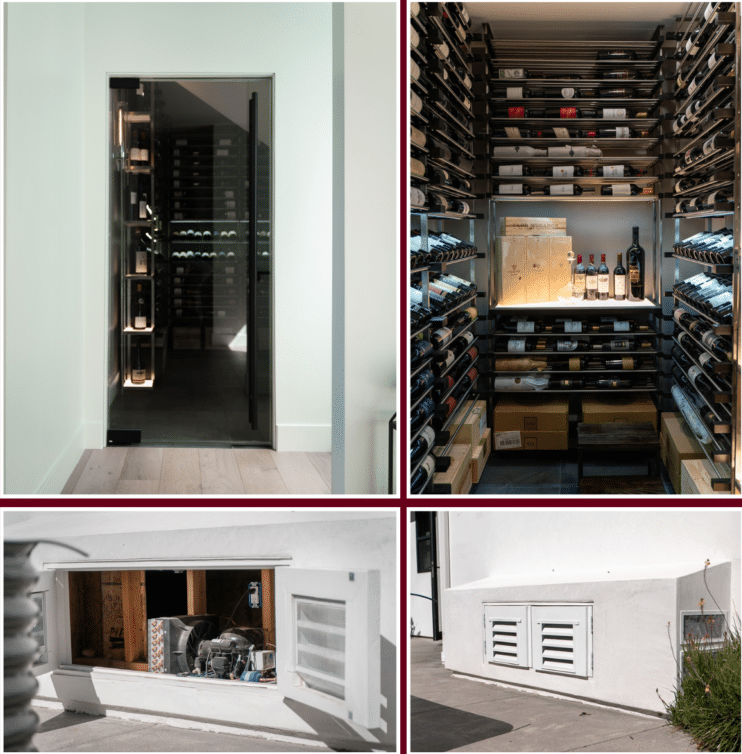
A ducted unit installs outside the cellar and connects through supply and return ducts, so no equipment sits in the room at all. The RMD Series
is an ultra-low-profile ducted unit for tight ceiling cavities, while the HS
and VHS
high-static units can be mounted up to 25 feet away in a garage or mechanical room. Ducted cooling gives you a silent cellar with no footprint inside, at the cost of needing space for the unit and ductwork and a somewhat higher install.
The trade-offs at a glance
| Factor |
In-room (RM, LPQ) |
Ducted (RMD, HS, VHS) |
| Equipment location |
Inside the cellar, hidden |
Outside the cellar |
| Noise in the room |
Slight airflow sound |
None |
| Space needed |
Fits in racking, soffit, or ceiling |
Needs an adjacent space and ducts |
| Install cost |
Lower |
Higher |
| Best for |
Simple, concealed installs |
Showpiece and larger rooms with zero in-room equipment |
How to choose
Start with how much you want the room to be free of equipment. If a cleanly hidden unit in the racking or ceiling is fine, an in-room RM or LPQ is simpler and more economical. If you want absolutely nothing inside the cellar, go ducted, then let the available space decide which: the RMD for shallow cavities, the HS for a dedicated mechanical area, or the VHS for a tall, narrow closet. Our guide to choosing a cooling unit
walks through all five side by side.
How the two types look and sound in a finished cellar
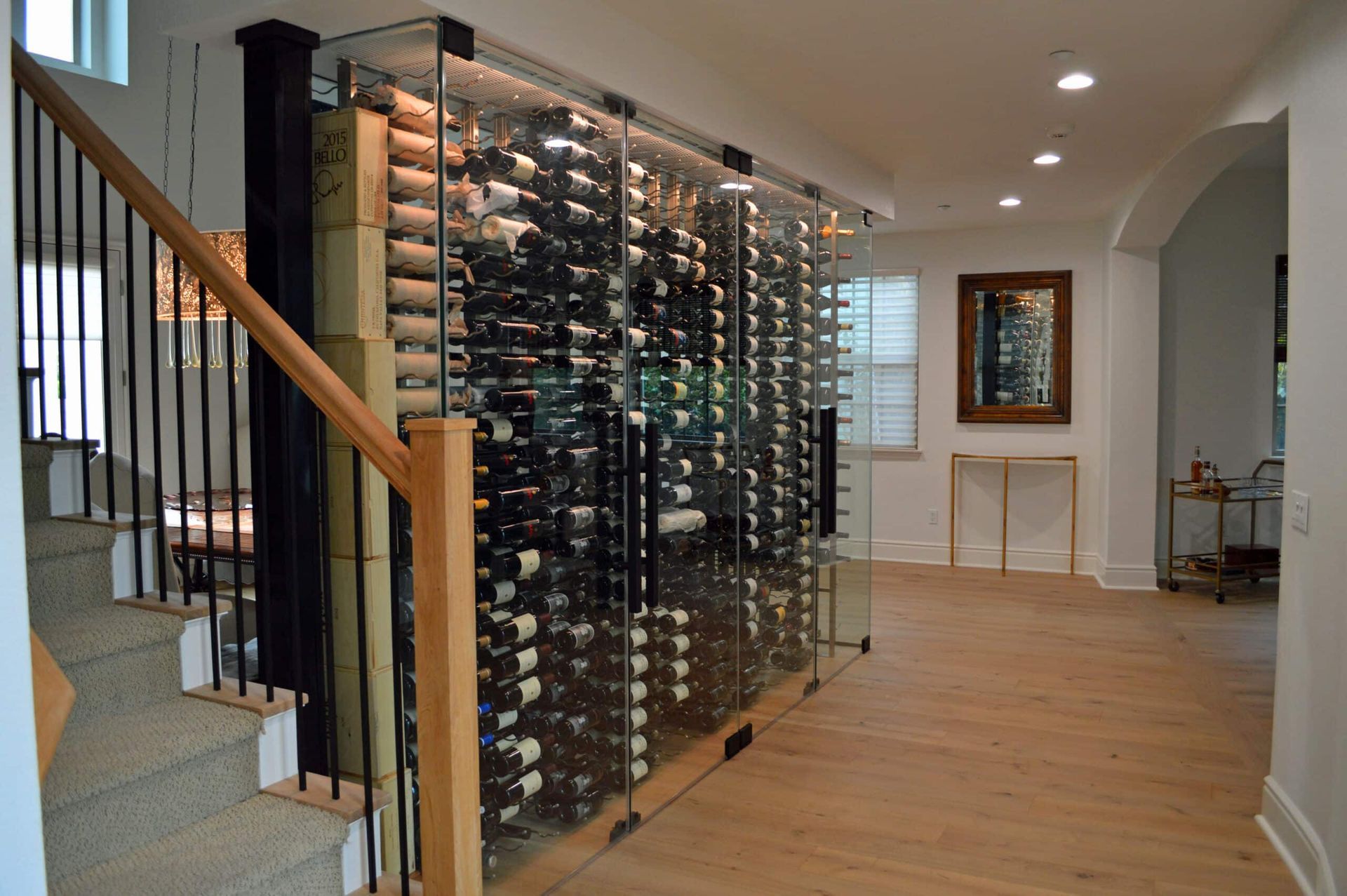
In a finished room the difference is easy to feel. With an in-room unit, the cooling lives in the cellar: with the RM it hides behind a grille in the racking, and with the LPQ it sits flat on the ceiling, both out of the way but present, with a soft airflow sound. With a ducted unit there is simply nothing there, only a supply and return grille, and the room is silent. For a showpiece cellar where the design should read as pure wine and architecture, that absence is worth a lot. For a practical storage room, a hidden in-room unit is usually all you need.
Cost and complexity
In-room units are the simpler, more economical install. The unit mounts in the room, the condenser goes remote, and that is largely it. Ducted units add ductwork, a place to house the evaporator, and a bit more labor, which raises the cost. The question is what you are buying with that extra, which is a completely equipment-free, silent room. On larger and commercial cellars, where capacity and silence both matter, the ducted premium is usually worth it. On smaller home cellars, the in-room option often makes more sense.
Can you combine both in one home?
Larger homes sometimes use more than one approach across different rooms. A main showpiece cellar might use a ducted high-static unit for total silence, while a smaller back-of-house storage room uses a simple in-room unit. There is no rule that every cellar in a home has to match. We look at each room on its own, weigh the space, the noise tolerance, and the budget, and pick the type that fits that room.
Frequently asked questions
Is ducted cooling quieter than in-room?
Inside the cellar, yes. A ducted unit places the evaporator outside the room, so there is no equipment noise in the cellar at all. In-room units are still quiet, since the compressor is remote, but the evaporator makes some airflow sound.
Does an in-room unit show in the cellar?
It does not have to. The RM hides inside the racking or a soffit behind a grille, and the LPQ mounts low and flat on the ceiling.
Is ducted cooling more expensive?
Usually a bit, because it needs ductwork and a place to mount the unit. The payoff is a cellar with no equipment or noise inside.
Which is better for a large or commercial cellar?
Ducted high-static units like the HS carry the most capacity and keep all equipment out of the room, which suits larger and commercial cellars.
Can I convert an in-room cellar to ducted later?
It is possible but means adding ductwork and relocating the evaporator outside the room, so it is far simpler to decide during the original design.
Is one type more energy efficient?
Efficiency comes mostly from correct sizing and good insulation rather than from ducted versus in-room. A right-sized unit of either type runs efficiently.
We will look at your room and recommend in-room or ducted, then size the unit to match. Cachet Wine Cellars serves Orange County and Southern California. Call (949) 569-7857.
Call (949) 569-7857