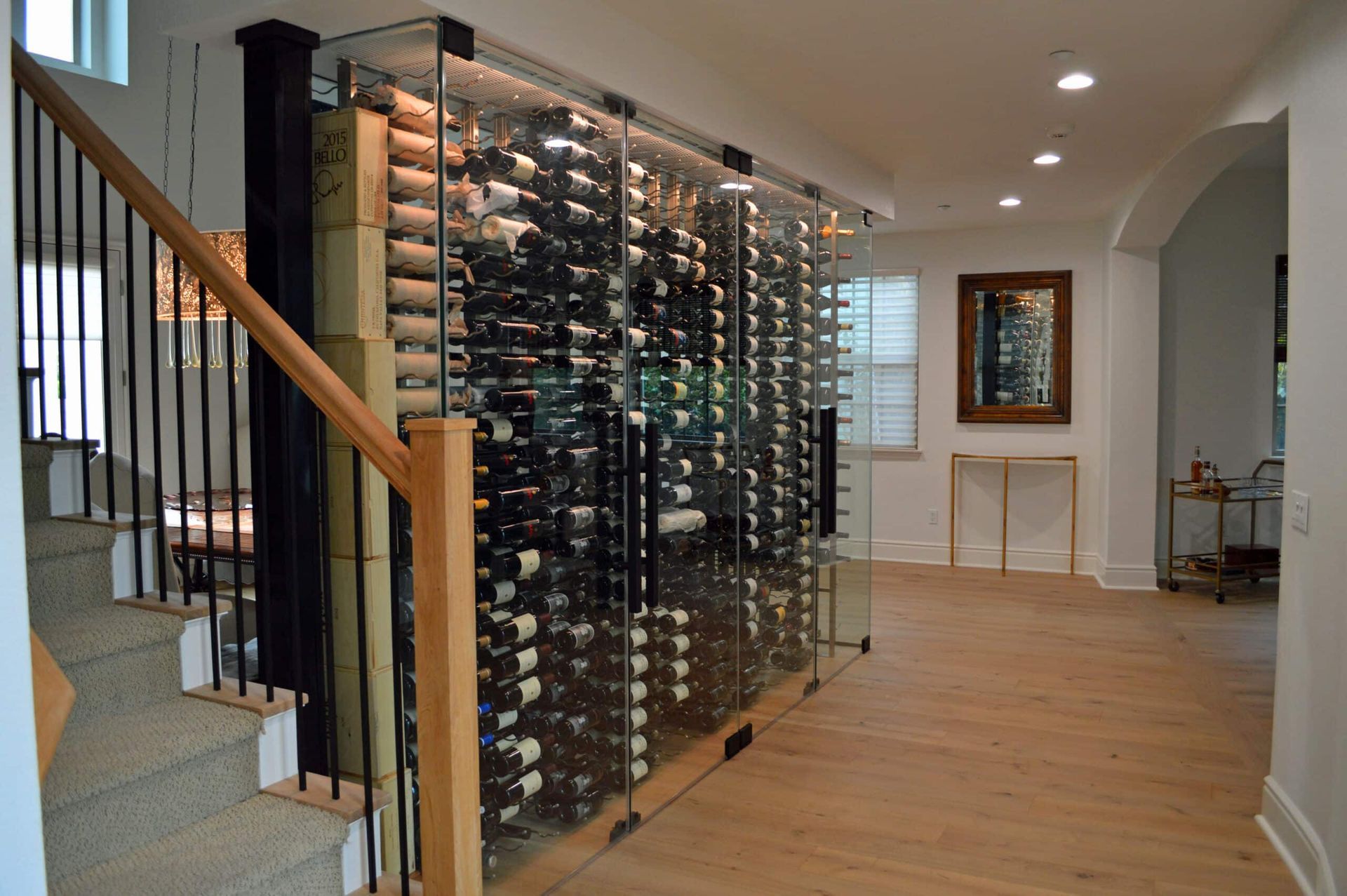
Where a cooling unit goes is as important as which unit you choose. Good placement keeps the cellar quiet, the equipment hidden, and the system running efficiently. Poor placement causes noise, uneven cooling, and service headaches. This guide covers where the two halves of a split system should sit and the rules that make placement work.
Quick answer
In a split system, the evaporator goes in or near the cellar and the condenser goes somewhere remote. In-room evaporators like the RM hide in the racking, soffit, or wall, and the LPQ mounts on the ceiling. Ducted units like the HS and VHS sit outside the room, up to 25 feet away. The condenser can be placed indoors or outdoors up to 50 feet from the evaporator. The keys are short line sets, a gravity drain, service access, and good airflow for the condenser.
Where the evaporator goes
The evaporator is the part that delivers cool air. With an in-room RM unit, it mounts horizontally and tucks into the wine racking, a soffit, between ceiling joists, or on a wall, hidden behind a grille. The ceiling-mounted LPQ
sits low and flat overhead, which suits vaulted rooms. With ducted units, the evaporator leaves the room entirely: the RMD
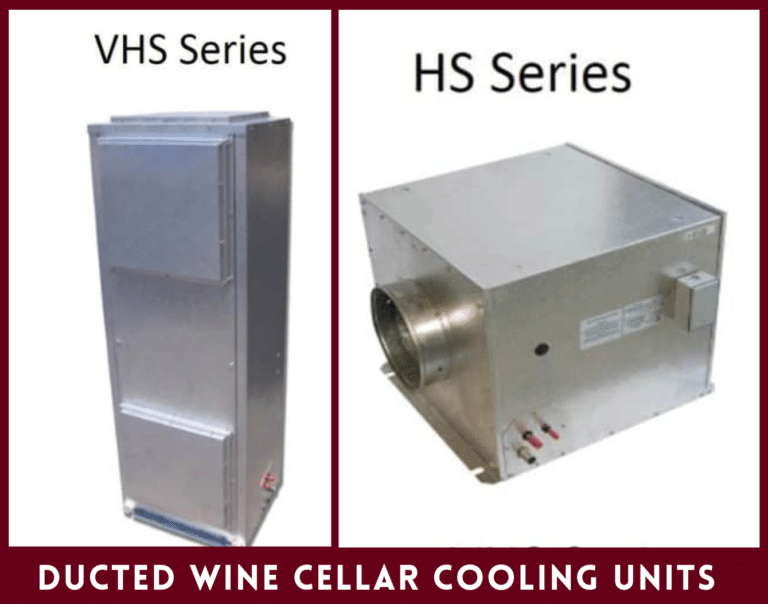
fits a shallow ceiling cavity nearby, while the HS and VHS
can live in a garage, closet, or mechanical room up to 25 feet away and connect through ducts.
Where the condenser goes
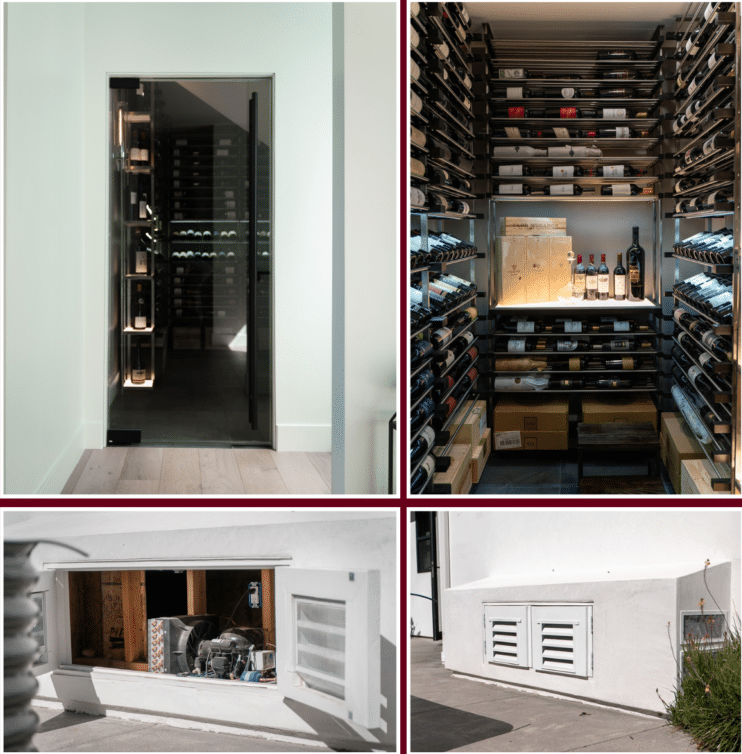
The condenser sheds the heat and can sit well away from the cellar, up to 50 feet, either indoors or outdoors, with no temperature-differential limits. Common spots are a garage, utility room, basement, or an exterior wall. It needs clear airflow to vent heat if it is air-cooled, and it should sit where its sound will not carry into living space. Keeping it remote is the whole reason a split system stays quiet in the room.
Placement rules that matter
- Keep line sets short.
Standard refrigerant line sets should run 50 feet or less, with minimal bends. Longer runs need extra steps and can hurt performance.
- Drain with gravity.
The drain line must flow downhill to a drain or pump, or condensate backs up.
- Leave service access.
Put both units where a technician can reach them. Racking and panels near the evaporator should be removable.
- Give the condenser airflow.
An air-cooled condenser needs space and ventilation to reject heat, especially indoors.
- Plan for noise and vibration.
Mount units to limit vibration and keep the condenser away from bedrooms and quiet rooms.
- Do not oversize the condenser.
An oversized condenser relative to the evaporator hurts performance, so the two are matched on purpose.
Why placement is part of the design
Because the evaporator, condenser, duct runs, line sets, and drain all have to work together, placement is settled during design, not improvised on site. We plan where each piece goes around your floor plan so the cellar stays silent and the system runs the way it should. See how the series differ in our guide to choosing a cooling unit.
Common placement mistakes to avoid
A few placement errors cause most of the trouble we are called about. Putting the condenser in a sealed closet with no airflow traps its heat and chokes performance. Running line sets far longer than needed, or with too many bends, starves the system and can shorten compressor life. Draining uphill, or into a line that can clog, leads to leaks. And mounting the condenser on a shared bedroom wall carries vibration into the quiet of the house. Each of these is easy to avoid with a little planning and hard to fix after the fact.
Placement and the look of the room
Placement is not only mechanical, it shapes how the cellar looks. An in-room evaporator can be tucked behind a grille that matches the racking so it disappears, and a ducted unit leaves only a supply and return grille in the room. Deciding early where the equipment and grilles go lets the design absorb them cleanly, rather than leaving a vent in an awkward spot. The best installs look as though there is no cooling system at all.
Plan placement before construction
The best time to settle placement is before the walls close up. Once framing, insulation, and the vapor barrier are in, moving a line-set route, a drain, or a condenser location becomes expensive. Deciding early where the evaporator, condenser, ducts, and drain will run lets the build accommodate them cleanly, with proper access panels and short, direct routes. It is far easier to design placement into a cellar than to work around it afterward.
Frequently asked questions
Can the condenser go outside?
Yes. It can be placed outdoors or indoors, up to 50 feet from the evaporator, with no temperature-differential limits. It just needs airflow and a spot where its noise will not carry.
How far can the cooling unit be from the cellar?
The condenser can sit up to 50 feet away on standard line sets. High-static ducted evaporators like the HS and VHS can be mounted up to 25 feet from the room.
Can I hide the unit completely?
Yes. In-room units hide in the racking or ceiling, and ducted units sit outside the room entirely, so only air enters the cellar.
Does placement affect how quiet the cellar is?
A great deal. Keeping the condenser remote and mounting everything to limit vibration is what keeps the room quiet.
Can the cooling unit go in the attic or a closet?
Yes, if there is airflow for an air-cooled condenser, access for service, and a proper drain route. We confirm those before choosing the spot.
Does the condenser need to be on the same floor as the cellar?
No. It can be on another floor or outside, as long as the line set stays within about 50 feet and the drain can flow properly.
We design placement around your space so the system performs and disappears. Tell us about your room and request a quote. Cachet Wine Cellars serves Orange County and Southern California. Call (949) 569-7857.
Call (949) 569-7857