Wine cellar cooling units come in two broad types: self-contained, through-the-wall units and split systems. They cool the same way in principle, but they behave very differently in a real cellar, and the right choice shapes how quiet your room is, how cold it can go, and how easy it is to service. This guide explains the difference and when each one makes sense.
Quick answer
A self-contained (through-the-wall) unit houses everything in one box that vents into an adjacent room. It is cheaper and easier to install, but noisier, limited in how cold it can go, and must be returned to the factory for repairs. A split system separates the evaporator in the cellar from a remote condenser, so it runs quieter, holds a wider temperature range, and can be serviced in place. For a custom cellar, a split system is almost always the better long-term choice.
What is a self-contained, through-the-wall unit?
A self-contained unit packs the evaporator and condenser into a single cabinet that sits in the cellar wall and vents its heat into an adjacent room. Everything is in one piece, so installation is simple and usually does not require a licensed HVAC contractor. That makes it the lower-cost option up front, which is its main appeal.
What is a split system?
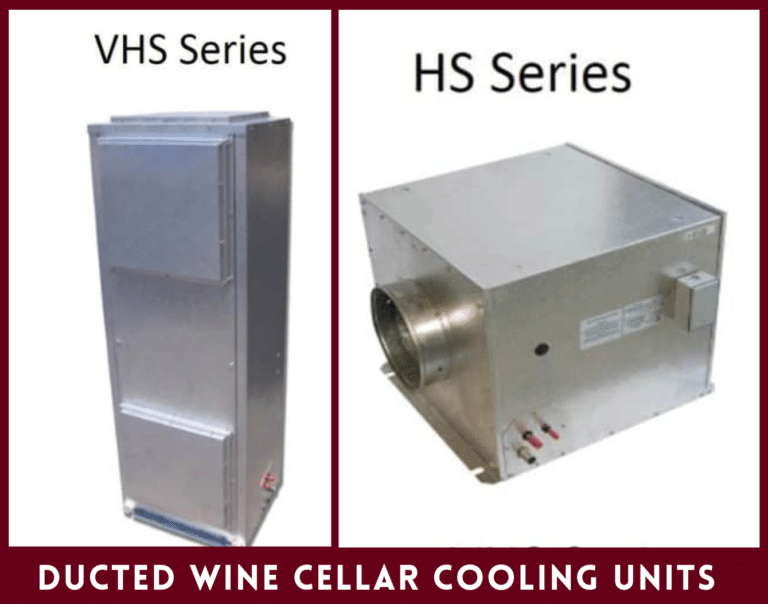
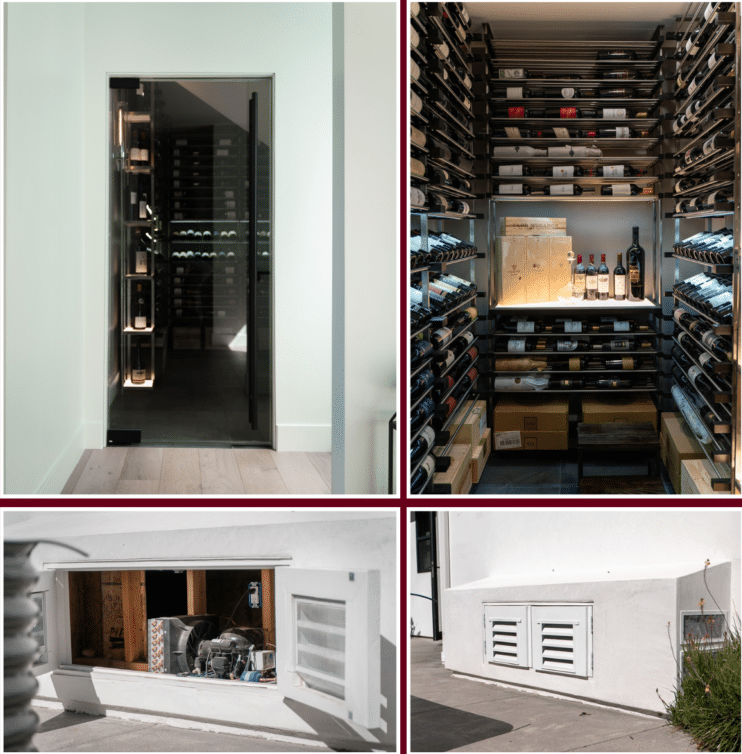
A split system separates the two halves of the refrigeration cycle. The evaporator sits in or near the cellar, and the condensing unit that sheds heat is mounted remotely, up to 50 feet away, connected by copper refrigerant lines. Because the noisy, hot component lives elsewhere, the cellar stays quiet and the system can be tuned for proper wine storage. Every US Cellar Systems
unit we install, across the RM, RMD, LPQ, HS, and VHS
series, is a split system.
The differences that matter
| Factor |
Self-contained (through-the-wall) |
Split system |
| Upfront cost |
Lower |
Higher |
| Installation |
Simple, often no licensed HVAC needed |
Needs an HVAC tech to run copper line sets |
| Noise |
Noisier, the compressor sits in the wall |
Quieter, the compressor is remote |
| Temperature range |
Limited; cannot hold serving temps for whites or champagne |
Full storage and serving range |
| Venting |
Needs a nearby room and a limited temperature differential |
Condenser goes indoors or outdoors, no differential limit |
| Repairs |
Whole unit removed and shipped to the factory |
Serviced in place by most HVAC technicians |
| Best for |
Small, budget, or simple installs |
Custom cellars built to last |
When a self-contained unit makes sense
A self-contained unit can be a reasonable fit for a small closet cellar or a tight budget, where the lower upfront cost outweighs the trade-offs and there is an adjacent room that can take the vented heat. If you only need to hold a modest collection at a steady temperature and do not plan to serve whites cold from the room, it can do the job.
Why we build split systems for custom cellars
For a cellar you have invested in, a split system is the choice that protects both the wine and the experience of the room. It keeps compressor noise and heat out of your living space, it can be set cold enough for any wine, it can be serviced without tearing the unit out, and replacement parts are available locally. Those advantages compound over the years a cellar is in use. You can see how the five split-system series compare in our guide to choosing a wine cellar cooling unit.
What the choice means for your wine
The practical difference comes down to stability. Wine is most at risk from swings in temperature and humidity, not from a cellar that sits a degree or two off but holds steady. A split system is built to hold that steady line: the remote condenser and air-temperature-probe thermostat let it run a smooth, controlled cycle, and it can reach the lower temperatures needed if you ever want to hold whites or champagne near serving temperature. A self-contained unit works harder to stay stable, relies on a slower liquid-measuring thermostat, and is limited in how cold it can go, so a demanding or valuable collection is better protected by a split system.
A quick way to decide
If your cellar is a small closet holding a modest collection on a tight budget, and there is an adjacent room that can take the vented heat, a self-contained unit can be the sensible call. If the cellar is a custom build you plan to keep, holds wine you care about, sits near living space where noise matters, or includes glass, a split system is almost always worth the extra investment. When in doubt, the split system is the safer long-term choice.
Frequently asked questions
Is a split system worth the extra cost?
For a custom cellar, usually yes. The higher upfront cost buys quieter operation, a full temperature range, and in-place servicing, which matters over the long life of a cellar.
Why are self-contained units noisier?
The compressor sits inside the single wall-mounted cabinet, close to the room. In a split system the compressor is remote, so its noise and vibration stay away from the cellar.
Can a self-contained unit keep white wine at serving temperature?
Generally no. Through-the-wall units have a limited temperature differential and cannot be set cold enough to hold whites or champagne at serving temperature. A split system can.
Do I need an HVAC contractor for a split system?
Yes, for the refrigerant line sets. We handle that as part of the install, and the payoff is a quieter, more capable, serviceable system.
Can I replace a self-contained unit with a split system later?
Often yes, though it means adding refrigerant line sets and a remote condenser, which is more involved than a like-for-like swap. Planning for a split system from the start usually costs less overall.
We size and install split systems built for the long life of a custom cellar. Tell us about your space and request a quote, and we will recommend the right approach. Cachet Wine Cellars serves Orange County and Southern California. Call (949) 569-7857.
Call (949) 569-7857