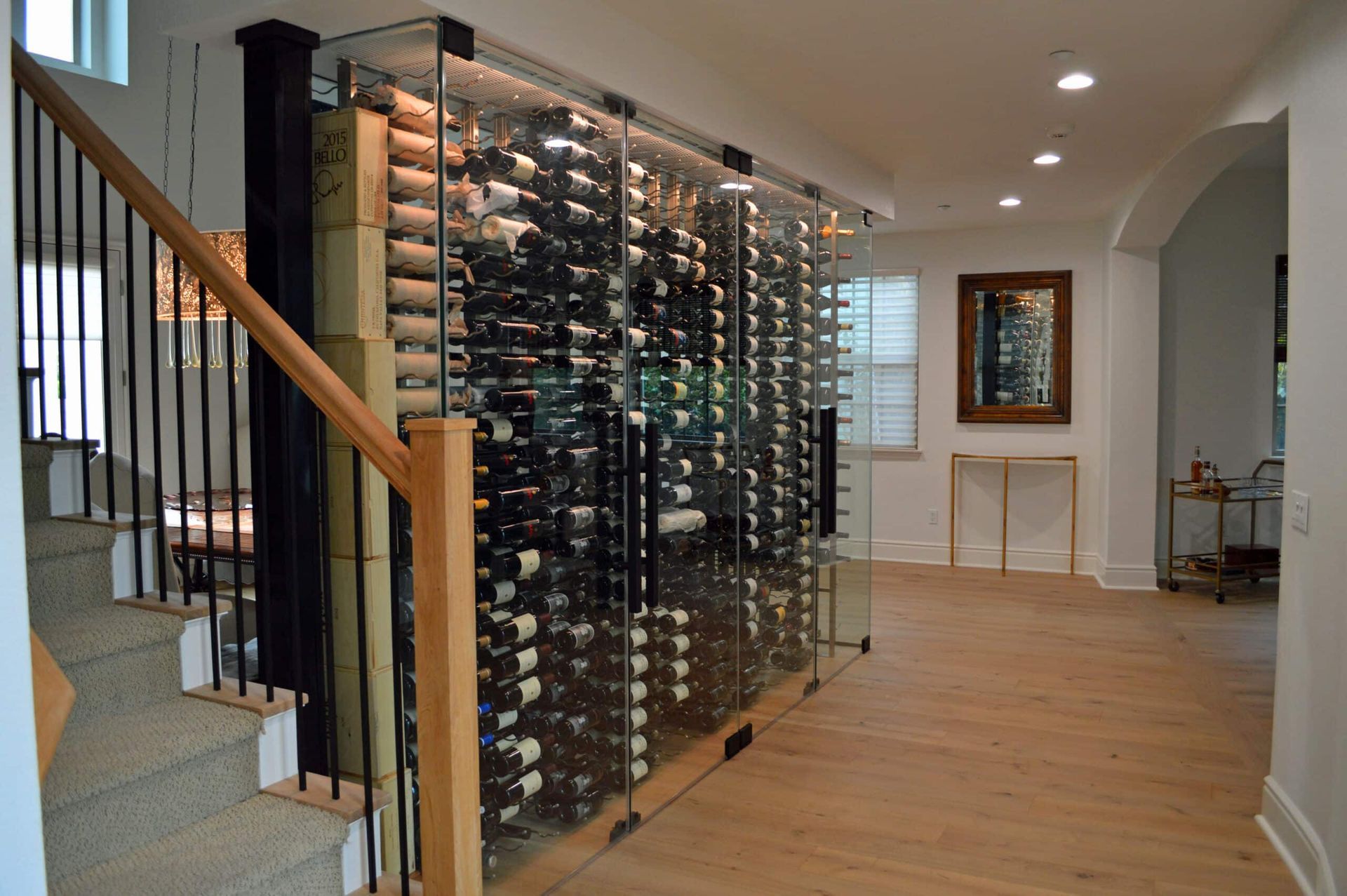
A custom wine cellar only protects your collection if it holds a steady temperature near 55 degrees Fahrenheit and keeps humidity in balance. The hard part is doing that without a bulky cooling unit interrupting a room you designed to look beautiful. The Rack-Mounted (RM) Series is built for exactly that situation, and it is US Cellar Systems’ most versatile and most popular cooling unit. It tucks into the wine racking itself, or into a soffit, ceiling cavity, or wall, so the climate control all but disappears and the cellar stays the centerpiece. Below we cover how it works, the sizes available, how to size it correctly, and where it fits best, so you can see why it is the unit we reach for most often.
Quick answer
The RM (Rack-Mounted) Series is a split-system wine cellar cooling unit that mounts horizontally inside the room and hides within your racking, soffit, ceiling, or wall. It cools custom cellars, tasting rooms, and large cabinets at roughly 1,800 to 7,200 BTU per hour, holding a steady storage temperature and balanced humidity
with no visible hardware.
The most versatile way to cool a wine cellar
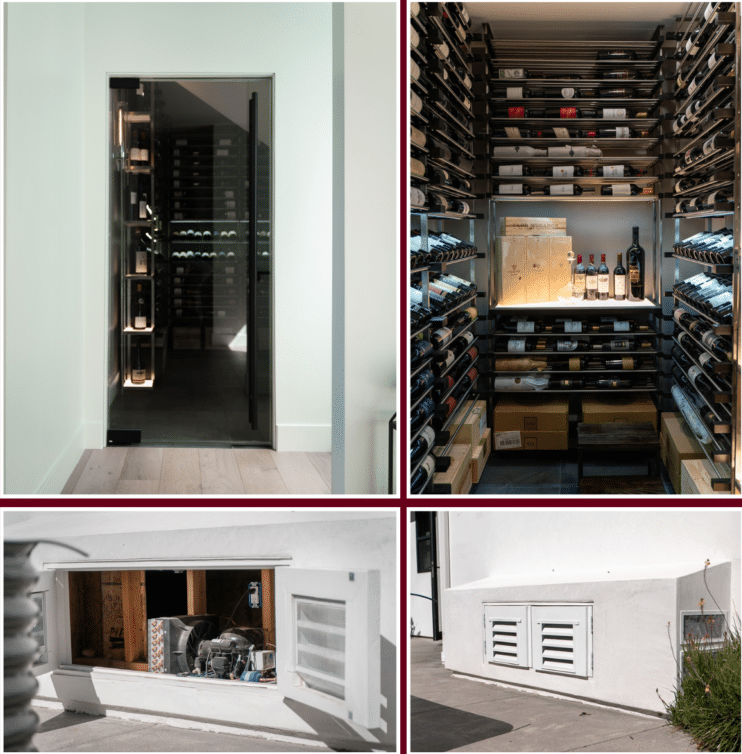
The RM is a horizontal evaporator that mounts right inside the room. Because it sits low and flat, it can be concealed within the wine racking, set into an insulated soffit, placed between ceiling joists, or fixed to a wall, then hidden behind a grille or louvered box that does not restrict airflow. Multiple access panels let the installer redirect the supply and return air wherever the room needs it, and a built-in fan-speed control fine-tunes the airflow to the space.
That adaptability is the whole point. The RM bends to the room instead of forcing the room to accommodate it, which is why it fits the widest range of cellars and is the unit we install most often. If you want the cooling to be felt but never seen, it is almost always the answer.
How the RM works as a split system
Like every US Cellar Systems unit, the RM is a split system. The evaporator inside the cellar and the condensing unit that sheds heat are separate, joined by copper refrigerant lines. That design is deliberate, and it is why we build this way:
- The compressor, its heat, and its noise stay out of the cellar and your living space.
- The condenser can sit up to 50 feet away, indoors or outdoors, with no temperature-differential limits.
- The system can be serviced in place by most HVAC technicians, and replacement parts are available locally.
- A remote air-temperature-probe thermostat reacts faster to real conditions than the liquid-measuring thermostats in self-contained units.
By contrast, self-contained, through-the-wall units cost less up front but run noisier, cannot be set cold enough to serve whites or champagne at temperature, and have to be removed and shipped back to the factory for repairs.
The RM runs on R134a, or R404a for certain applications, and is managed by a digital controller with a remote air-temperature probe. A standard automatic expansion valve holds a constant coil temperature to maintain the humidity balance wine needs, and a pump-down solenoid valve protects the compressor if a leak develops. Every unit is pressure-tested, factory-wired, and ETL certified.
Where the RM fits best
The RM is a strong fit for custom residential cellars, wine tasting rooms, and large wine cabinets, and in twin or triple-evaporator form it scales up to a high-volume commercial wine room. Typical scenarios where it is the right call include:
- A residential cellar where the owner wants the cooling hidden inside the racking rather than on display.
- A room with limited wall space, where the unit can sit in a soffit or between ceiling joists.
- A tasting room or large cabinet that needs dependable cooling in a discreet package.
- A commercial wine room that needs the higher output of twin or triple evaporators.
Capacity, configurations, and model lineup
The RM-EC line is rated from about 1,800 to 7,200 BTU per hour and is offered in single, twin, and triple-evaporator configurations, so it scales from a modest home cellar to a large commercial room. The single-evaporator models and their airflow and dimensions are below.
| Model |
Airflow (CFM) |
Dimensions (L × W × H, in.) |
Line set (liquid / suction) |
Ship wt. |
| RM 25 EC |
220 |
30 × 11 × 11⅛ |
3/8 / 3/8 |
26 lb |
| RM 35 EC |
260 |
36 × 11 × 11⅛ |
3/8 / 3/8 |
29 lb |
| RM 50 EC |
335 |
36 × 11 × 14⅛ |
3/8 / 5/8 |
35 lb |
| RM 65 EC |
420 |
36 × 11 × 14⅛ |
3/8 / 5/8 |
43 lb |
Twin and triple-evaporator systems combine these coils to serve larger rooms and improve airflow. The right model and configuration come from a heat-load survey rather than the model number alone.
Features and options
The RM is engineered for a long, low-maintenance service life:
- High-performance staggered coils with anti-corrosion coating, copper tubing mechanically expanded into aluminum fins
- Insulated, rust-proof aluminum housing
- Energy-efficient, thermally protected motors that meet or exceed California standards
- Built-in fan-speed control and multiple reconfigurable access panels for airflow
- Automatic expansion valve and pump-down solenoid valve as standard, factory-wired and ETL certified
It can also be tailored to the job with several options:
- Twin or triple evaporators
for larger and commercial rooms
- Water-cooled condensing unit
where a water source is available, for quieter, more consistent operation
- Stainless steel cabinet
for high-corrosion environments
- 230V
available on order
Getting the size right
Cooling units are often matched to a cellar by cubic feet, but that only tells part of the story. The real cooling load depends on several things a volume estimate ignores:
- Glass.
Windows and glass doors add significant heat gain. Single-pane glass should be avoided, since a small seal leak can fog the glass and stain the surrounding wood.
- Insulation.
R-value, whether the room is above or below grade, and the surrounding ambient temperature all shift the requirement. Below-grade rooms often need less equipment.
- Lighting.
Can and halogen fixtures run hot. LED lighting adds so little heat it barely enters the calculation.
- Set point.
Around 55 degrees Fahrenheit is ideal for storage. Cabinets held at serving temperature for whites or champagne need more capacity and faster recovery.
- Thermal mass.
The wine itself adjusts about 75 percent slower than the air, so a cellar loaded with room-temperature bottles takes hours to settle. Turning the thermostat colder will not speed that up, it only stresses the equipment.
- Added features.
Refrigerators, televisions, electronics, and fireplaces all give off heat and need to be accounted for.
Get the size wrong in either direction and there are consequences: an undersized unit runs constantly and drops your humidity, while an oversized one short-cycles, swings the humidity, and can fail early. We size every install from a full heat-load survey
so the system is matched to your actual room.
Air-cooled or water-cooled?
The RM is available with either an air-cooled or a water-cooled condenser. Air-cooled is the standard and most common choice for residential cellars. It is affordable and simple to install, though it makes some fan noise and its capacity varies a little with the outdoor temperature. A water-cooled condenser runs quieter and more consistently and is popular in commercial and high-rise settings, where silent operation matters and a water source is available. We recommend the right condenser for your location as part of the design.
Why we recommend the RM Series
For most custom cellars, the RM gives you the best of both worlds: serious, dependable cooling that stays completely out of sight. We handle the full job, from running the heat-load survey and specifying the right size and configuration to placing the evaporator so it hides cleanly in your racking or ceiling and installing the split system so it runs quietly for years.
If you are planning a cellar, tasting room, or large wine cabinet and want to know whether the RM Series is the right fit, request a quote
and we will size the system to your space.
Frequently asked questions
Will I be able to see the cooling unit in my cellar?
No, and that is the point of the RM. It mounts horizontally inside the racking, a soffit, the ceiling, or a wall, and can be hidden behind a grille so only cool air, not hardware, is on show.
How large a cellar can the RM Series cool?
Standard capacities run from about 1,800 to 7,200 BTU per hour, with twin and triple-evaporator options for bigger rooms. The right size depends on a heat-load survey of your specific space, not square footage alone.
Is it noisy?
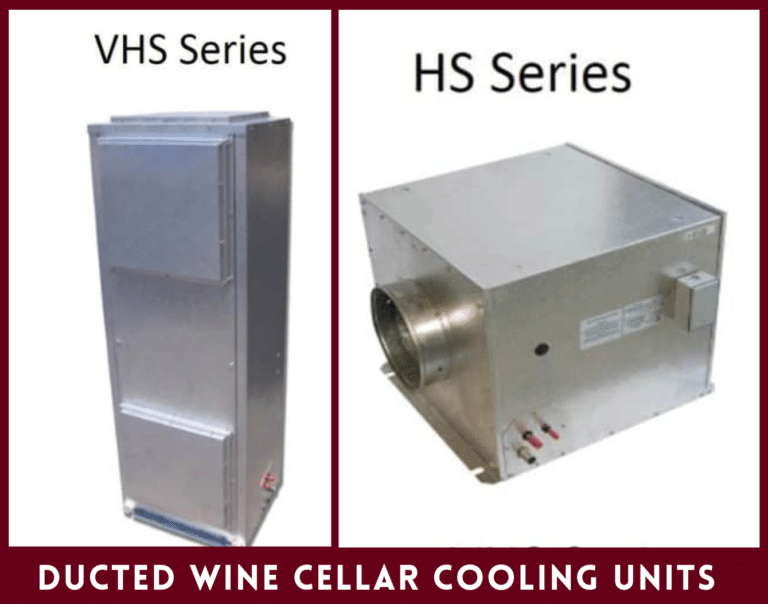
Because it is a split system, the compressor and its heat sit in a separate location, so it is far quieter than a self-contained unit. If you want absolutely no equipment noise inside the room at all, a fully ducted series such as the High Static (HS)
or Vertical High Static (VHS)
places the evaporator outside the cellar.
Can I get it air-cooled or water-cooled?
Both. Air-cooled is the standard and most common choice; a water-cooled condensing unit is available where a water source exists and is quieter and more consistent, which is common in commercial installs.
What maintenance does it need?
Routine care is light: keep the coil and drain clear and have the refrigeration side checked periodically. Because it is serviceable in place, most HVAC technicians can maintain or repair it without removing the unit.
How is the RM different from a through-the-wall cooler?
A through-the-wall unit is self-contained and vents into an adjacent room, which limits how cold it can run and makes it noisier. The RM is a split system, so it is quieter, can hold proper storage temperatures, and can be serviced in place.
Have the heat load for your room calculated before you buy any cooling unit — the number tells which wine cooling system can hold 55 degrees and safe humidity in your space. Cachet Wine Cellars serves Orange County and Southern California. Call (949) 569-7857.
Call (949) 569-7857