Uneven Wine Cellar Lighting: Four Causes, One Real Fix
Choosing Between Them for a Specific Run
Once a schedule has been issued to anyone, changing a value quietly is worse than not changing it. A revised schedule carries a new revision number, a new date, and a marker against every row that moved, so a reader holding both versions can tell in seconds which lines are different. Reissuing a corrected sheet with no revision marker leaves two documents in circulation that look interchangeable and are not.
The reissue also has to reach the people working from the old one. A cellar's fixture order, the racking shop drawings, and the electrical rough-in can all be running from the same schedule at the same time, and a Kelvin value corrected on the designer's copy changes nothing until the version carrying that correction lands with whoever placed the order.
Fixture substitutions happen at bid, at order, and occasionally after delivery, and a fully populated schedule is what sets the terms of one in advance. A substitution proposed against a complete row has to hold every value on that row, including the ones a supplier would find inconvenient to match. A fixture matching wattage, beam angle, and trim size while dropping below a stated CRI floor is a different specification, and a populated row makes that visible without an argument about intent.
The burden of showing it sits with whoever proposes the swap. A substitution request arriving as a catalog number and a price, with no line-by-line comparison against the scheduled values, has not been made yet; it has been asked about. Requiring that comparison in writing is what keeps the substitution a decision the specifying professional is still making.
The Sheet Has to Say What It Is
TIP: A schedule reissued after fixtures are ordered should say so on the sheet. A revision that arrives post-order is a change order in practice, and marking it as one keeps the cost conversation attached to the line that caused it.
QUICK ANSWER: One section reads brighter than another because of four distinct causes: fixture spacing versus mounting height, mixed LED bins from a partial replacement, a weakening driver channel, or a change in rack depth or finish mid-wall.
You walk the length of the cellar with a bottle in hand, and somewhere past the midpoint the wall changes character. The first run of racking reads crisp: label type sharp, bottle shoulders catching a clean highlight, glass reading gold instead of gray. Past that point the same bottles sit in a flatter wash, colors muted, corners of the room going dim enough that you tilt a bottle toward the nearest fixture just to read the vintage.
Uneven output across a cellar wall traces back to one of four distinct causes, and each one points to a different fix. Guessing at which one you have, and reaching for a random replacement fixture or module, treats the symptom without touching the cause. The faster route is to read what the unevenness is actually telling you, then match it to the mechanism behind it.
When the Unevenness Started Tells You the Most
Before sorting through mechanisms, place the problem in time. Has the dim section always read this way, since the week the cellar was finished? Or did it look even for months or years and only recently started to separate from the rest of the room?
A difference that has existed from day one, unchanged since installation, almost always traces back to something built into the room: how the fixtures were spaced relative to the rack, or a physical seam where one racking run meets another. A difference that showed up after a repair, an added run of bottles, or a partial swap of fixtures points somewhere else entirely, usually to a mismatch introduced by that later work. And a difference that developed gradually, or that came with a flicker or a slow fade rather than a sharp step between bright and dim, points to something failing rather than something that was ever slightly off to begin with.
Hold that timeline in mind through each of the four causes below. It narrows the list before you even look closely at the wall.

Cause One: Spacing and Mounting Height out of Ratio
A repeating scallop along the wall, evenly spaced dim bands rather than one isolated dark patch, traces back to how the fixtures are spaced relative to how far they sit from the rack face. It is a geometry issue built into the layout rather than a failing part.
This shows up most often where a lighting run was designed around one fixture spacing and later adjusted, either because the racking layout changed during design or because a run was extended without re-checking the spacing. It also turns up in rooms with a mix of mounting heights, where fixtures set at different depths from the ceiling can read slightly different from one another even when every unit is identical and working correctly.
The tell: the dim points repeat at fixed intervals tied to the mounting layout, every fixture involved is the same color and equally healthy, and moving bottles in or out of that stretch of racking changes nothing about where the pattern falls.
Cause Two: Mixed LED Bins from a Partial Replacement
LED chips are manufactured in large batches and sorted, or "binned," by output and by color temperature before they ever reach a fixture. Two chips labeled the same nominal color temperature can still land in different bins and read as subtly different shades of white side by side. Under normal conditions that variation is too small to notice. Once a later repair or an added run pulls its fixtures from a different production batch than the original installation, the difference becomes visible exactly where the two runs meet.
What sets it apart: the difference shows up in color as much as brightness, with whites reading warmer on one side of a boundary and cooler on the other, and that boundary lines up precisely with wherever a repair, an addition, or a partial fixture swap took place.
Cause Three: One Driver Channel Losing Output
A driver is the component that converts household power into the low, steady current an LED run actually uses, and one driver channel typically feeds every fixture on a given circuit. When that channel begins to fail, the fixtures wired to it dim, flicker, or fade together as a unit rather than one fixture failing on its own. The section affected tends to correspond to a wiring zone rather than a visible seam in the racking or a repair boundary.
The signature: an entire run or zone changes together, often with a mild flicker or a slow fade over weeks, or a step-change that appeared suddenly after a period of looking fine, and the boundary tracks the wiring, independent of where a racking material changes or an addition was made.

WARNING: A driver that is dimming or flickering should be evaluated by a licensed electrician arranged through your installer, not opened or tested at home. Cellar electrical work sits inside a sealed, humidity-controlled envelope built to stay that way.
Cause Four: A Change in Rack Depth or Finish Mid-Wall
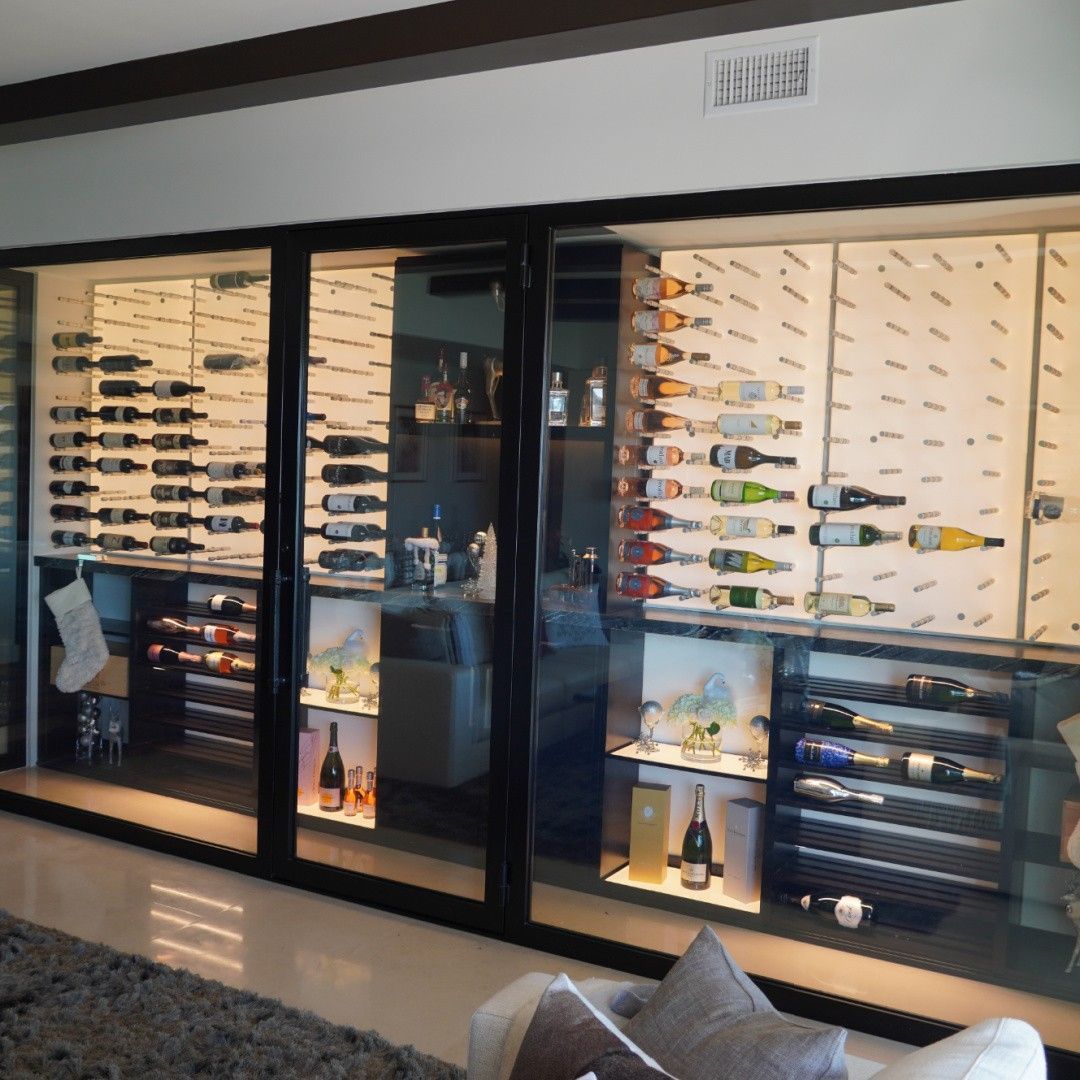
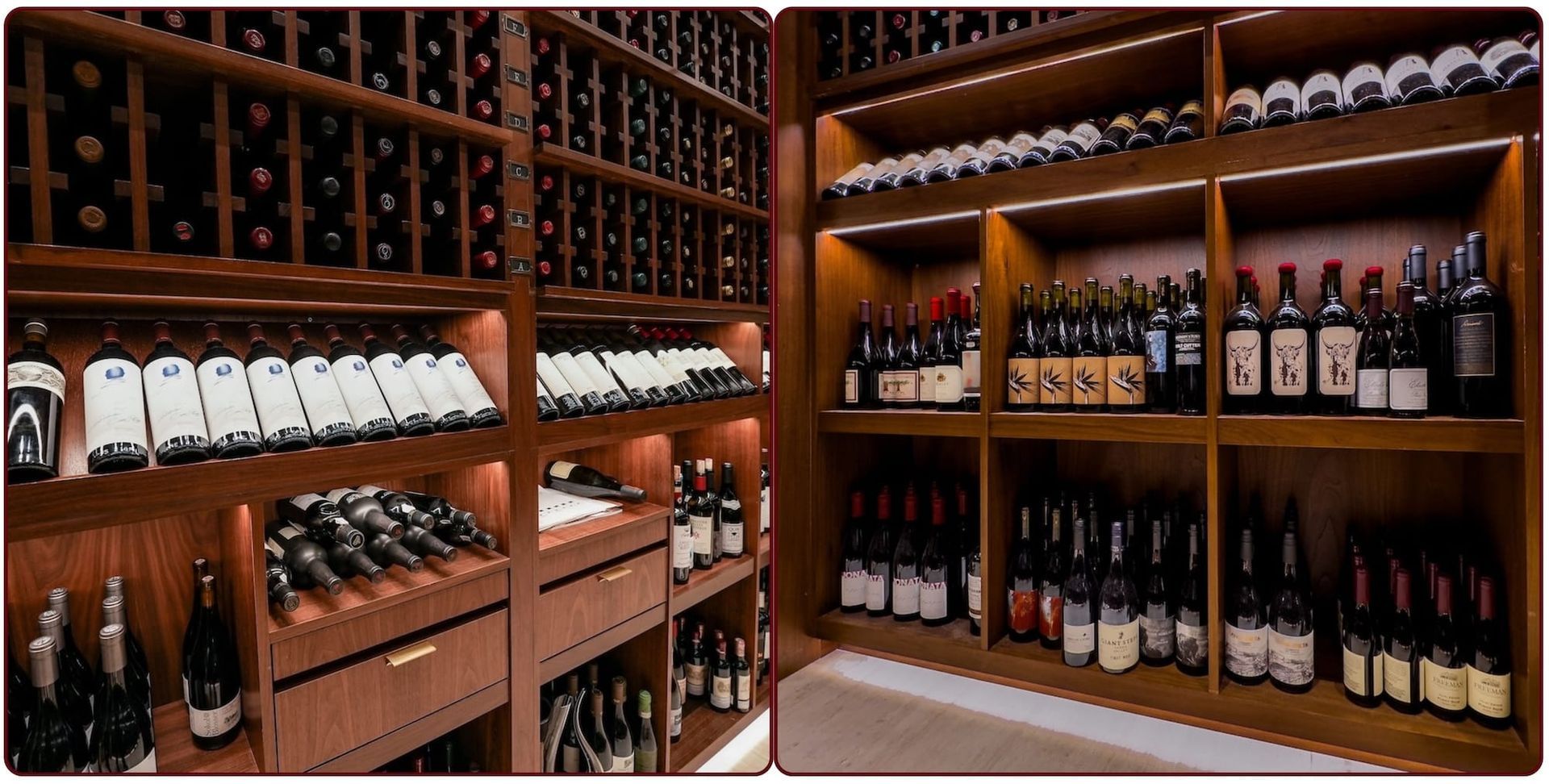
Not every uneven section starts with the fixture at all. Light reflectance depends on what the light is bouncing off, not only on what is producing it. A wall built across two racking runs, one shallower than the other, or a run where the finish shifts from a lighter tone to a darker one partway along the wall, will return a different amount of light to the eye under identical fixtures at identical spacing.
A shallower rack puts the bottle face closer to the light source and closer to the eye, so it reads brighter under the same lamp than a deeper run where the bottle sits further back in shadow. A darker finish absorbs more of the light that hits it instead of bouncing it back into the room, which reads as a dimmer section even though every fixture above it is working exactly as designed.
What confirms it: the fixtures are identical, evenly spaced, and the same color, which rules out the other three explanations, and the boundary between bright and dim lines up exactly with a physical seam in the racking, unchanged since that section of the room was built.
Matching the Symptom to the Cause
| What you observe | Points to |
|---|---|
| Present since installation, color consistent, dim points evenly spaced | Spacing and mounting height |
| Boundary lines up with a material seam in the racking, present from day one | Rack depth or finish change |
| Color shifts across a boundary, not just brightness | Mixed LED bins from a partial replacement |
| Whole run dims, flickers, or fades together; appeared after a period of looking fine | Driver channel losing output |
None of these four require guesswork to distinguish once the timeline and the boundary shape are in front of you. What they do require is someone who can look at the room, the wiring plan, and the racking layout together, because the same visible symptom, one section reading brighter than another, comes from four different systems that only the original design documentation ties back together.
What to Have Assessed Before You Replace Anything
Reaching for a replacement fixture or module assumes the fixture itself is the problem. In three of the four causes above, it is not. Swapping the fixture in the dim section of a spacing mismatch changes nothing about the throw distance. Adding a brighter fixture over a darker rack finish increases the contrast between the two sections instead of correcting the imbalance. And a failing driver channel will keep failing regardless of which fixture or module sits downstream of it.
The more useful first step is to document what you are seeing: which wall, whether the difference is in brightness or color, whether it lines up with a seam in the racking or a wiring zone, and when it started. That record is what turns a four-way guess into a fast diagnosis.
Frequently Asked Questions About Wine Cellar LED Driver Placement
Can I fix uneven lighting myself by swapping in different bulbs?
Not usually. The LED modules used in a cellar lighting run are typically spec'd for a 20,000-to-50,000-hour lifespan, roughly twenty to fifty times longer than a standard incandescent bulb's roughly 1,000 hours, which means they are built and sealed as long-life modules rather than screw-in household bulbs. A mismatch usually calls for a fixture- or module-level fix, and a simple bulb swap will not solve it.
Does uneven lighting affect the temperature or humidity inside my cellar?
Not from the brightness difference itself. The variance between a bright section and a dim one carries no storage-condition signal on its own, and the temperature and humidity setpoint is controlled independently of which fixtures are on or off. Fixtures do add a small real heat load to the space, and light exposure is a separate storage variable handled elsewhere in how the room is designed, but neither one shows up as this kind of section-to-section brightness difference.
How would a scheduled service visit catch this before I notice it?
A structured aftercare program built around a 40-day check-in, a 6-month interim service, and a 12-month full service is designed to catch a drifting driver channel or a color mismatch at one of those checkpoints, before the difference between sections becomes obvious during a normal visit to the room.
Does the type of lens on the fixture make a mismatch more or less noticeable?
Yes. A fixture with a frosted or diffused lens spreads its output across a wider arc, so small differences between neighboring units blend together before they reach the eye. A clear or narrow-spot lens throws a sharper-edged pool of light, which makes the same underlying spacing gap or bin mismatch far more visible on the wall. Two rooms with the identical underlying fixture problem can look completely different depending on which lens type was specified.
Is this more noticeable in a display-style cellar than a storage-only one?
Often, yes, though the reason has more to do with how the room gets used than with the amount of light involved. A collection built to be viewed gets walked slowly, bottle by bottle, at close range, which is exactly the viewing pattern that makes a boundary between a bright run and a dim one stand out. A storage-only room gets scanned quickly from a distance while pulling a case, so the same underlying mismatch is far less likely to register.
Does the type of wood used in the racking change how a lighting mismatch shows up?
Yes. Racking is typically built from one of five available species: alder, mahogany, redwood, pine, or white oak, and each returns a different amount of light depending on its natural tone and stain. A pale white oak run reflects noticeably more of a fixture's output than a dark-stained mahogany run under the exact same lamp.
Have your cellar's lighting professionally assessed — get a clear read on which of these four causes is actually happening in your space. Cachet Wine Cellars designs and builds custom wine cellars from Irvine, California, with a lifetime warranty on every installation. Call (949) 569 7857.