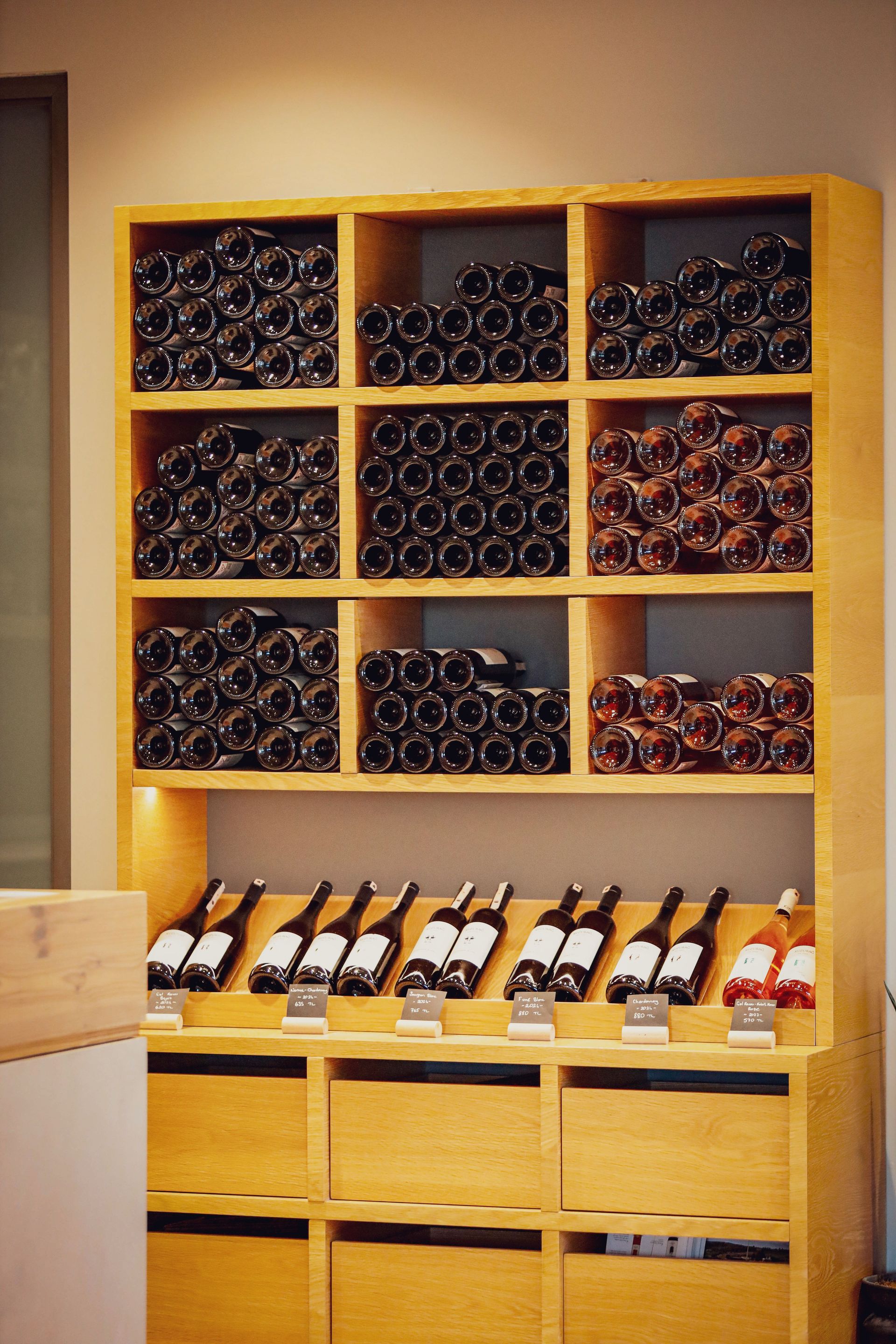
A wine cellar is the one room in the house where humidity is set on purpose, so it is easy to believe that anything hung on its walls is safe. Canvas, the surface people connect with real paintings, looks like the natural choice for a feature wall. The belief holds only until the material is looked at closely: a fiber that takes up water from the air does not care that the humidity was chosen deliberately. A cellar is held at roughly 50 to 70 percent relative humidity, and a wall covering sits inside that band every hour of every day. The surface that survives it is decided by what the material is made of and how it is attached.
How a Fiber Wall Covering Handles Damp Air
Cotton and linen are cellulose, a fiber that takes on moisture from the air fast and gives it up at a crawl. After a humid spell the room recovers first and the canvas last, so the cloth spends longer damp than the hygrometer suggests, and each swing works the fibers again.
Moisture in a fiber matters for a second reason. Mold digests whatever it grows on, and the results are staining, weakened fibers and, in the worst cases, a covering that falls apart. Spores are in the air of every room. Moisture, still air and soil on the surface decide whether they grow.
A polyester or nylon canvas holds far less water, but dirt or a sizing on its face gives mold something to eat all the same. A printed mural can be either kind of canvas, so the weave does not need to be identified: canvas is the surface to leave out of the room.
Where the Cellar's Humidity Band Meets Mold Conditions
On fabric, mold gets its chance somewhere past 65 percent relative humidity when the air is warm and stagnant, and rarely takes hold under 60 percent where air moves. Cotton and linen in dead air above about 80 percent will grow it, and a dirty or finished surface lets it start lower. A mural lies flat against the wall, so the air touching its back is as still as air gets.
Set that against the cellar's band. The top of the range overlaps the conditions where growth is possible, and the bottom of the range sits under them. Cooling air raises its relative humidity unless water is taken out with the heat, which is why a cellar cooling unit does two jobs: it lowers the temperature and it removes moisture.
The season matters in both directions. A cellar that has run through a long cooling season can read under 50 percent, and with so little moisture in the air, a canvas looks safe on paper. A cellar whose readings sit in the 60s has moisture to spare. Readings move with the season, so a mural chosen from one month's number is chosen for one month's room. A humidifier is a measured addition after readings show the room running dry, since the unit's built-in humidity control can hold some cellars in the band unaided. Holding a cellar drier than the wine wants, just to protect a canvas mural, would put the artwork ahead of the wine.
TIP
Log the hygrometer morning and evening for a couple of weeks and write down the peak, not the average. Fiber wall coverings are harmed by humidity spikes, so the highest reading tells you more than the middle of the day's range.
What Vinyl and Peel-and-Stick Do Differently
Vinyl murals go on like wallpaper, set in paste with a heavy-duty permeable adhesive. Peel-and-stick murals carry their own adhesive on a removable liner, so no paste or tools are needed, and the surface can be lifted and hung again if a section goes on crooked. The peel-and-stick surface is made to be wiped clean, resist tearing and shed wrinkles. Both are sold for high-moisture rooms, which is the reason they are the two prints that belong in a cellar.
Neither is a woven natural fiber, so the fast uptake and slow release described for cotton and linen do not apply to them in the same way. They still need a clean wall. Soil gives mold a foothold on any surface, so a vinyl or peel-and-stick mural sits on a wall that is kept clean and dry.
Tolerating humid air is a different thing from tolerating water on the wall. These murals are made for rooms built and maintained so that moisture does not get in, condense or collect in the wall cavity or on its surface. A wall that sweats or has a leak behind it is a repair for the builder before any surface goes on.
Comparing the Surfaces Side by Side
The standard designs (grapes, barrels, outdoor scenes, wine bottles and cork) are offered across all three printed surfaces, and a custom mural can be made from your own photograph. The table below sets out how the surfaces differ once the artwork is chosen.
|
Vinyl |
Peel and stick |
Canvas |
| Fit for the room |
Works in high moisture |
Works in high moisture |
Not recommended in the wine room |
| Attachment |
Pasted with a heavy-duty permeable adhesive |
Adhesive backing, no paste |
Pasted like wallpaper |
| Repositioning |
Not sold as repositionable |
Can be lifted and re-hung |
Not sold as repositionable |
| Finish |
Textured vinyl |
Lightly textured, wrinkle resistant |
Painting-style canvas |
| Smallest order |
4 by 6 feet |
4 by 6 feet |
4 by 6 feet |
Ask to see the finish of each in person before choosing, since a screen does not show texture. Because all three start at 4 by 6 feet, a print suits a whole wall or a large section of one, and it is cut down to fit after it arrives.
Preparing the Wall Before Any Mural Goes On
A mural is only as secure as the wall behind it. The surface has to be clean, smooth, dry, undamaged and free of mold, mildew and grease. Nail heads and nicks are filled, sanded and sealed, and new drywall joints are taped, mudded and sanded smooth. Glossy paint is sanded dull so the adhesive can grip, or, for the two pasted surfaces, vinyl and canvas, a latex primer that carries mold and mildew inhibitors goes on 72 hours before hanging.
Peel and stick asks for a smooth wall. Brick, rough or textured faces are poor candidates, and so are cement and concrete. A cellar finished over masonry needs a smooth painted face before a peel-and-stick mural belongs on it.
Layout is done in lead pencil, because ballpoint or marker bleeds through the covering. The first panel is lined up on a plumb line and the others follow from it.
CAUTION
Each panel is hung with up to an inch of extra material at the ceiling line, trimmed with a razor blade against a straightedge. On a tall wall that is ladder work with a blade, so hand it to a professional installer.
When a Metal Mural Fits an Arch
The three prints are for whole or partial walls. An arch, a niche or a spot-lit alcove can be smaller than the smallest print order of 4 by 6 feet. That is where a metal mural fits.
A metal mural is a one-piece panel, and each design has its own size. Designs run from about 14 to 28 inches on a side. The finish is a bronze, copper or nickel tone under a clear protective coat that needs little upkeep. Metal sits outside the canvas-versus-vinyl argument because it has no fabric to take up water, so the choice between a metal mural and a print comes down to the size of the space and the finish you want beside the racking and the door hardware.
Choosing the Surface for Your Wall
Start with the size of the space. A whole wall or a large section points to a printed surface, and a recess or arch points to metal. Within the prints, vinyl suits a wall that will stay as it is, and peel and stick suits a wall where the design may change later, since it can be lifted and re-hung. Canvas belongs outside the cellar door, in a room held at the humidity of the rest of the house, where the argument against it loses its force.
Then settle the wall itself. A smooth, dry, mold-free face and a cellar whose humidity has been read across the seasons make every choice on this list work better.
A mural goes up near the end of the build, before the cooling unit first brings the room down, but the decision belongs near the start. The wall's finish, the humidity the cooling unit holds and the size of the space all narrow the choices long before the artwork does.
Frequently Asked Questions
Can a peel-and-stick mural go over a freshly painted wall?
No. Fresh paint is one of the surfaces a peel-and-stick mural should stay off, along with dirty or damaged walls. Check the paint can for how long it needs before it is covered, and let the wall dry completely after any cleaning with a damp cloth.
Why does the room need to be warm when a mural goes up?
The room should hold a temperature above 65 degrees F for at least 48 hours before hanging, and the mural's storage area should be held at the same level. A cellar running at its storage temperature is colder than that, so the timing is worked out with the builder before the cooling unit brings the room down to storage temperature. In a cellar that already holds wine, warming the room above 65 degrees for two days warms the bottles too, so the mural is easier to plan into the build than to add later.
How are the panels of a large mural joined?
Each panel is printed with 2 extra inches at the joint so neighboring panels can overlap, and the installer double-cuts through both layers and removes the strips, which leaves the two images meeting edge to edge. On the finished wall, check that the seam lies flat along its full height and that the image lines up across it.
Can a peel-and-stick mural be hung in one motion?
No. The liner comes away a few inches at a time, starting at the top, while the upper portion is smoothed against the wall along the plumb line. A second person holding the bottom of the panel helps on a long drop. Light strokes with the smoothing tool push bubbles outward, and pressing hard or pulling the mural while positioning it stretches the print.
How long can a rolled mural wait before it is hung?
About a day. Once unrolled, a print left lying out longer can start to curl, so it goes back in its box if the wall is not ready. The panels carry small, faint numbers at the lower left, which is how their order is laid out before the first one goes up.
Can a metal mural go on a ceiling or outdoors?
No on both counts. A metal mural is an indoor piece made to hang on an upright face, so the back wall of an arch suits one, while a ceiling, any other horizontal surface or an outdoor wall does not.
Tell a wine cellar designer which wall will carry the mural â the surface can be matched to your room's humidity before anything is ordered. Cachet Wine Cellars serves Orange County and Southern California. Call (949) 569-7857.
Call (949) 569-7857