Why Exposed LED Strips Leave Dots in Wine Cellar Glass
Choosing Between Them for a Specific Run
QUICK ANSWER: Exposed LED strips dot a cellar when discrete emitters sit too close to an undiffused lens; balancing diffuser opacity, channel depth, and emitter density together closes the gap without flattening the room's accent sparkle.
A cellar's LED strip dotting problem starts at the emitter and ends at the eye, with three stops in between. Light leaves a chip as a small cone aimed straight ahead, crosses the air gap inside the channel between the strip and the lens, passes through whatever diffusion that lens provides, and lands on the first curved or glazed surface in its path, almost always a bottle shoulder or a glass rack-end panel. Whether that light lands as one smooth wash or a row of distinct points depends on what happens across all three stops together, rather than on any single one of them.
That sequence, source before subject, dots before bottles, is the tell that separates a cellar built with lighting as a designed system from one where a length of tape simply followed the shelf edge because the shelf edge was there. It is also a different defect from a single broad reflection that washes out a label: that is a matter of where the light sits relative to the viewer's eye and the bottle's curve, one bright patch rather than many. Dotting starts inside the emitter array itself, before viewing angle ever enters the discussion: a fixed row of small, separated points that reflects in every curved and glazed surface downstream no matter where you stand to look at it.
Fixing it does not mean pulling the strip and starting over. It means understanding what the strip actually is, physically, in the order the light travels through it: the emitter, the channel it sits inside, the lens or diffuser it exits through, and the position that channel occupies relative to the bottles and glass it is meant to light.
A Row of Points Becomes a Row of Reflections
Most LED tape used in cellar racking is built from surface-mount diode chips, small rectangular emitters soldered at intervals onto a flexible copper-clad strip. Each chip is its own light source with a gap of bare strip on either side of it, and each one throws light in a cone directly ahead of itself rather than sideways into that gap. Where the cone lands on a surface untouched by anything else, it lands as a distinct spot of light rather than a line.
The industry's broader answer to this has been to move away from discrete chips altogether: chip-on-board strips replace the row of individual emitters with a continuous phosphor-coated line, so there is no gap between points for a reflection to expose. That is a different product built a different way, and it is worth knowing the direction the category has moved in, but it is not the only lever available to a cellar that already has standard tape specified, or that is choosing tape for reasons other than dot suppression, such as flexibility around a curved rack or cost per linear foot. Spacing between emitters is the root of the problem; what happens to the light after it leaves each emitter, covered in the next three sections, is what decides whether that spacing ever becomes visible.

Channel Depth Decides How Much the Light Blends
The channel is the extruded aluminum housing that the strip sits inside, with a lens clipped or slid over the open face. Channel depth, the physical distance between the emitter face and the inside surface of that lens, controls how much room the light has to spread sideways and overlap with its neighbors before it ever reaches a diffusing surface.
A shallow, low-profile channel, the kind chosen because it sits nearly flush with a shelf edge or a toe-kick, puts the lens almost directly against the chips. Light exits with almost no distance to mix, so whatever pattern the emitters make on the strip is close to the pattern that leaves the fixture. A deeper channel gives that same light room to spread and blend with the cone from the chip beside it before it reaches the lens, so the points have already started to merge into a line by the time they hit the diffusing surface. This is why two cellars using an identical strip and an identical diffuser lens can look completely different: one used a channel deep enough to let the light mix, and the other did not.
Channel material matters for a second reason that has nothing to do with optics. Aluminum draws heat away from the chips, and a channel chosen purely for its shallow profile often sacrifices some of that thermal mass. That thermal mass matters more than the lens does for keeping the strip cool: heat leaves the chip through the copper-clad strip and into the aluminum at its back rather than out through the lens at its face, so a deep channel in a heavier-gauge extrusion runs the strip cooler than a shallow one regardless of which lens sits on the front.
The Lens and Diffuser: Opacity, Material, and Standoff Distance
Once light reaches the lens, opacity decides how much of the point pattern survives the trip through it. A nearly clear lens, sometimes chosen because it looks like it will pass the most light, does almost nothing to break up the points; it is glass-clear for a reason, and that reason is the same one working against you. A lightly frosted lens scatters the light across its own surface and needs some distance behind it, standoff between the emitter and the lens, to finish the job; too little standoff and the frosting only softens the dots' edges instead of merging them. A denser, more opaque diffuser blends the points at a shorter standoff, but it also cuts more of the total light that reaches the bottle, which is a trade-off a cellar's lighting plan has to account for directly.
The practical rule is to specify the least opaque lens that fully blends the points at the standoff distance the installation actually uses, rather than defaulting to the densest diffuser available. Over-diffusing costs light output that then has to be made up elsewhere, usually with more fixtures or a brighter accent layer than the room needed, which changes the balance of the whole lighting plan rather than solving the one problem it was meant to fix.
Mounting Position: Where the Strip Sits Relative to the Bottles
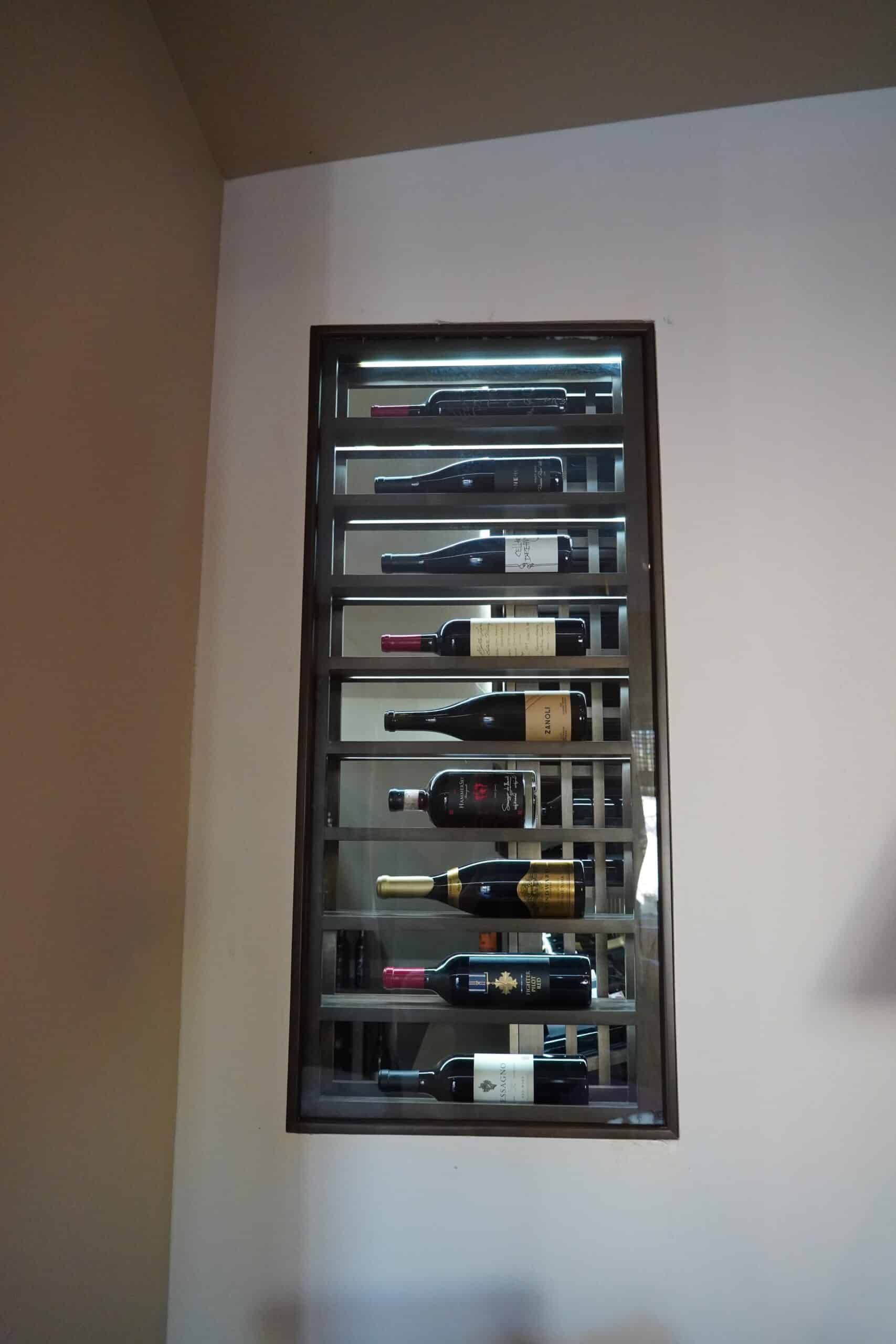
The same strip, channel, and lens can look correct in one location and dotted in another, because position changes how much distance the light has to travel, and how many surfaces it bounces off, before it reaches a bottle or a glass panel. A strip mounted at close range along a shelf edge, aimed directly at the bottle shoulders in front of it or at a glass rack-end panel, gives the light almost no distance to finish blending; whatever pattern survived the channel and the lens arrives at the glass largely intact.
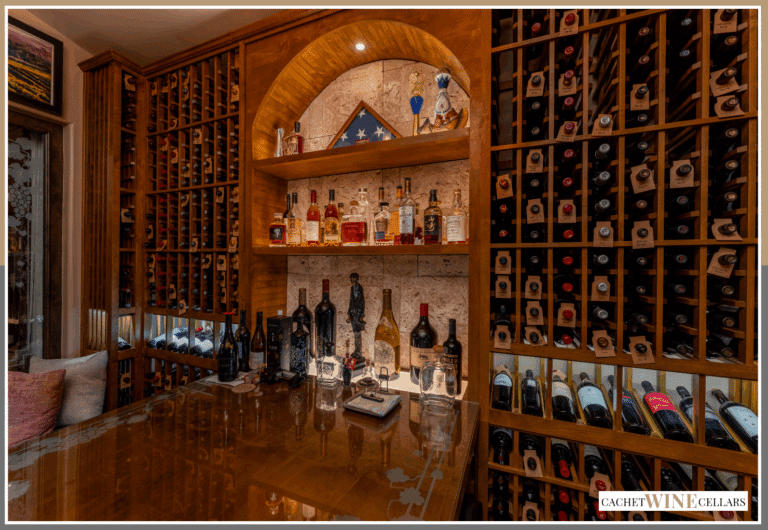
Setting the same strip back under a valance or a shelf lip so it lights a matte surface first, the underside of a shelf, a wood recess, or a stone reveal, before that light ever reaches the bottles, gives the array a second chance to mix. Indirect uplight, aimed at the ceiling and allowed to wash back down into the room, suppresses dotting more thoroughly than any other position, because by the time that light reaches a bottle it has already bounced off one broad, non-specular surface and lost most of its point structure. That gain has a cost: a ceiling-bounce loses the raking angle across the rack face that gives bottle shoulders and labels their modeling, and pushed too far it flattens the room toward the same even, source-less glow the closing section warns against overcorrecting into. A cove position, run along the top of the racking and aimed down at a shallow angle across the bottles, keeps more of that modeling and depends more heavily on getting the channel, lens, and density right to control dotting on its own.
This is a separate design decision from where overhead downlights get aimed or which fixture type handles the ceiling layer; that beam geometry question belongs to the room's general illumination. What matters here is specifically the tape that runs close enough to a rack, a shelf edge, or a glass panel to reflect its own individual emitters back at you.
Emitter Density: How Many Points per Foot Actually Matters
Density is the third lever, and it works independently of channel depth and lens opacity. A low-density strip spaces its emitters farther apart along the run, which means bigger gaps between points and more work for the channel and lens to do to blend them. A high-density strip crowds more emitters into the same length of run, shrinking the gap between points until they merge into a continuous line even behind a fairly modest diffuser.
Density is not free. A higher-density strip draws more current per foot, runs warmer, and can push a driver channel closer to its rated capacity if a run is long, which is part of why a designer weighs it against channel depth and lens choice rather than treating it as the default answer. Chip-on-board tape, mentioned earlier as the industry's structural answer to dotting, is really density taken to its limit: a continuous phosphor line has no gap left to blend at all. For a cellar working with standard discrete-emitter tape, moving to a higher density is one of three independent ways to close that gap, alongside channel depth and diffuser opacity, and the three are meant to be specified together rather than treated as separate fixes for the same symptom.
WARNING: A driver run close to its rated capacity, or any work opening the channel to inspect wiring, is electrical work. Route sizing questions and in-channel access to the installer or a licensed electrician rather than treating it as a DIY fix.
Getting the Fix Right Without Overcorrecting to a Flat Glow
It is possible to solve dotting too completely. A cellar's accent layer exists to catch facets, foil, and glass and give the room some sparkle. Push diffuser opacity, channel depth, and emitter density all to their maximum at once, and that sparkle disappears along with the dots; the room goes flat and even, generic rather than considered, and the collection stops being the thing the eye notices first.
The three levers work best evaluated together, at the actual mounting distance and angle the installed strip will use, rather than specified from a spec sheet in isolation. A diffuser rated for a given standoff on paper behaves differently mounted eight inches from a bottle than it does mounted two feet back under a shelf valance. The difference between a correctly specified array and a raw strip run along the shelf edge is rarely the strip itself; it is the channel, the lens, and the density chosen to work with the specific room the light has to travel through.

Frequently Asked Questions
Can a cellar with an already-installed exposed LED strip be fixed without replacing the racking?
Yes, in most cases. A frosted or opal lens cap made to clip or slide over the existing aluminum channel can go on without pulling the strip or disturbing the racking behind it, since the cap engages the same channel lip the original lens used. Replacing the channel itself, rather than just the lens, is the only version of this fix that requires taking the affected shelf or rack section down first.
Does the dotting problem happen with spotlights and puck lights the same way it happens with strip lighting?
No. A spotlight or a puck fixture is a single point source rather than an array of separated emitters, so it has no row of gaps to reflect. The dot pattern described here is specific to linear tape built from discrete chips, where a whole run of small, separated emitters sits along the fixture at once and can print itself onto a glass surface.
Will an etched or frosted wine bottle stop the dots from showing?
Only partly. Etched or sandblasted glass scatters some of the reflection across the bottle's body, but almost every bottle still carries a foil or wax capsule at the neck, and foil is a specular metal surface that reflects the same row of points regardless of what the glass underneath is doing. A dotted strip can still show clearly on the capsule even above a fully frosted bottle.
Does a cellar's humidity level create problems inside the LED channel itself?
Yes, but the risk is condensation, not lens yellowing. A cellar's steady 55-degree, 60-to-70-percent-humidity environment sits close enough to the dew point of an aluminum extrusion that an unsealed channel can let moisture condense inside it, around the strip and its connectors, rather than only on the outside of the lens. Specifying a gasketed or damp-rated extrusion, with the strip's own protective coating intact, keeps that moisture out of the electrical path instead of just off the glass.
Does dimming a strip through a smart control system fix the dot pattern?
Not on its own, and it can make the pattern more noticeable at low settings. Dimming lowers the current sent to every emitter equally, so it changes brightness while leaving the spacing and geometry of the array untouched. On strips run through a PWM driver, a dimming method common on smart platforms such as Crestron, turning the level down can rapid-cycle each emitter fast enough that, as the eye moves across the strip, the row reads as separated flickering points rather than one steady line, which can make the same dot pattern more obvious at a low setting than it was at full brightness.
Is there a way to tell whether an installed strip is chip-on-board or discrete-emitter without opening the channel?
The most reliable check without opening the channel is a phone camera held close to the lens with the room lights off. A camera sensor exaggerates what the eye smooths over: a chip-on-board strip's continuous phosphor line photographs as one even band, while a discrete-emitter strip photographs as a row of distinct bright squares even when it looks acceptably smooth to the naked eye from a few feet back.
Ask for a lighting plan where diffusion, channel depth, and emitter density are specified together before installation — not corrected after the racks are hung. Cachet Wine Cellars designs and builds custom wine cellars from Irvine, California, with a lifetime warranty on every installation. Call (949) 569 7857.