Wine Cellar LED Driver Placement Is Decided Before Drywall
Choosing Between Them for a Specific Run
Once a schedule has been issued to anyone, changing a value quietly is worse than not changing it. A revised schedule carries a new revision number, a new date, and a marker against every row that moved, so a reader holding both versions can tell in seconds which lines are different. Reissuing a corrected sheet with no revision marker leaves two documents in circulation that look interchangeable and are not.
The reissue also has to reach the people working from the old one. A cellar's fixture order, the racking shop drawings, and the electrical rough-in can all be running from the same schedule at the same time, and a Kelvin value corrected on the designer's copy changes nothing until the version carrying that correction lands with whoever placed the order.
Fixture substitutions happen at bid, at order, and occasionally after delivery, and a fully populated schedule is what sets the terms of one in advance. A substitution proposed against a complete row has to hold every value on that row, including the ones a supplier would find inconvenient to match. A fixture matching wattage, beam angle, and trim size while dropping below a stated CRI floor is a different specification, and a populated row makes that visible without an argument about intent.
The burden of showing it sits with whoever proposes the swap. A substitution request arriving as a catalog number and a price, with no line-by-line comparison against the scheduled values, has not been made yet; it has been asked about. Requiring that comparison in writing is what keeps the substitution a decision the specifying professional is still making.
The Sheet Has to Say What It Is
TIP: A schedule reissued after fixtures are ordered should say so on the sheet. A revision that arrives post-order is a change order in practice, and marking it as one keeps the cost conversation attached to the line that caused it.
Every LED fixture and every run of LED tape in a wine cellar is fed by a driver: a small switching power supply in a metal or plastic case that takes the building's line voltage and delivers the low-voltage, current-regulated output the diodes actually run on. It is a physical object with a location, a service life, and a heat output of its own. Most cellar owners have never seen theirs, and a fair number could not say which side of which wall it sits behind.
That anonymity is the problem. Driver manufacturers and lighting designers generally treat the driver as the shortest-lived component in a lighting system, shorter-lived than the diodes it feeds, and it is the part most likely to need replacing while the collection is still sitting in the racks. Where it lives is a maintenance decision, and it gets made once, on a drawing, before the walls close.
Left unspecified, it gets made by whoever is standing there at rough-in. Drivers end up tucked into the cellar ceiling above the racking, slipped behind a rack-end panel, dropped into a soffit inside the cooled room, or set down in the toe kick under the bottom shelf. Each of those puts a heat-producing power supply inside a sealed, cooled, humidity-controlled room and behind finished carpentry.
The Cooling System Pays for That Heat Twice
A driver converts line voltage into low-voltage output, and no conversion is free. Some fraction of the power drawn at the wall never reaches the diodes and leaves the case as heat instead. Manufacturers publish that fraction as an efficiency figure on the datasheet, and it moves with the model, the load, and how hard the unit is being run against its rating.
Inside the cellar, that heat is cooling load. The refrigeration system has to remove every watt of it to hold the room at spec, which means longer compressor run time and more of the unit's own condenser heat dumped into whatever space it exhausts to. You pay for the driver's heat when you make it and again when you take it out.
The figure that matters at design time is total connected lighting wattage, because that number feeds the cellar's heat load calculation alongside wall and ceiling R-values, door glazing, and room volume. Move the drivers outside the insulated envelope and only the diodes' own heat stays inside, which is a smaller number than the diodes plus their power supplies. A cooling unit sized on the assumption that the drivers are remote, then installed with the drivers in the ceiling, works against a load nobody accounted for as long as it runs.
Humid Air Is a Hostile Place for a Power Supply
A cellar holds a high humidity band deliberately and continuously, for the life of the room. That is correct for cork and wrong for electronics. Sustained humidity in that range works on a power supply slowly rather than dramatically: it corrodes solder joints, terminal screws, and exposed copper at the connection points, and it degrades the contact surfaces where the low-voltage output leaves the case.
Driver enclosures differ in how much of that they resist. A potted driver, filled with resin around the internal components, keeps moisture off the board far better than an open-frame or vented unit does. Potting has its own trade: the resin changes how the unit moves heat out of itself, and potted drivers are rated and specified differently from their open-frame equivalents. Whether the luminaire itself carries a damp or wet listing is a separate specification question with its own answer.
Keeping the driver out of the humidity band entirely is what stops the enclosure question from being load-bearing at all. A driver in dry, conditioned air on the other side of the cellar wall sits in the environment its rating assumes.
The First Component to Fail Should Be the Easiest to Reach
Rank a cellar's lighting components by expected service life and the driver sits at the bottom. Diodes outlast the power supplies that feed them, and a lighting run that goes dark is more often a driver at the end of its life than a failed emitter. This is the one part of the room with a replacement already built into its future.
Now put that part behind a rack-end panel scribed to the wall, finished on site, and fastened from behind. Or above a ceiling assembly insulated to a high R-value and sealed with a continuous vapor barrier. Reaching either one means opening something built to stay closed permanently, and closing it again means restoring an insulation and vapor seal that is only ever as good as the last person to touch it.
A driver mounted to a backer board in a mechanical closet on the other side of that wall is reached by opening a door. Same failure, same part number, an entirely different scope of work.
Every Conductor Crossing the Wall Is a Hole in the Vapor Barrier
A cellar's envelope is more than insulation. It is a continuous vapor barrier on the warm side of that insulation, and its performance depends on staying unbroken. Every conductor that crosses it is a penetration that has to be sealed at rough-in and stay sealed for the life of the room.
Driver placement decides how many of those penetrations exist and where they land. Drivers scattered inside the cellar still need line voltage brought to each of them, so the envelope gets punctured once per driver location, at whatever point was convenient on the day. A grouped remote bank inverts that: line voltage never crosses the envelope, and what crosses instead is the low-voltage output, planned as one bundle through one sealed penetration at a spot chosen on the drawing.
The difference is a count and a location. One planned, sealed, recorded penetration is a detail the envelope carries without trouble. Several improvised ones, made by whoever needed to get a cable through, are several places for the vapor barrier to become the weakest thing in the wall..
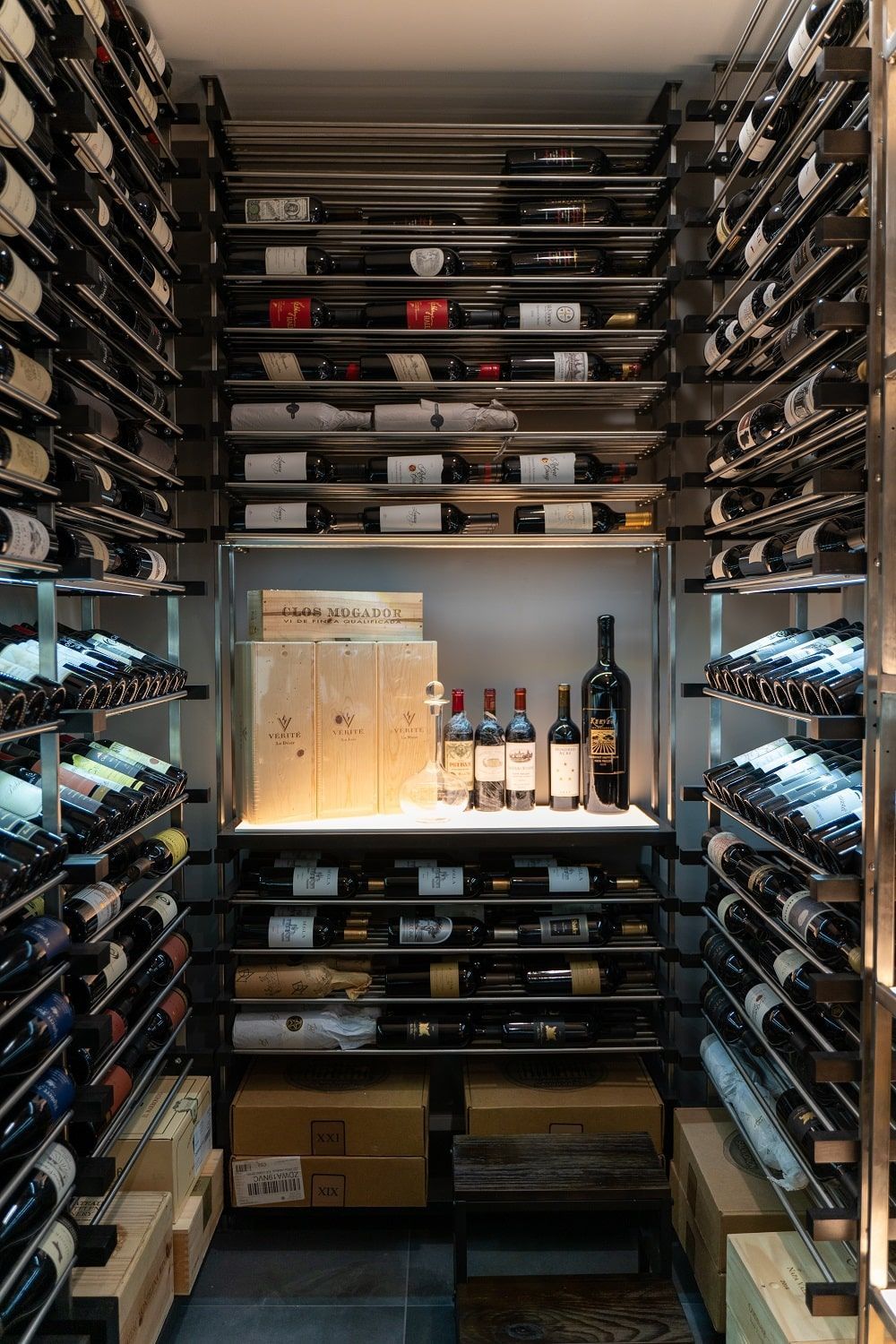
One Dark Zone and a Wall of Identical Boxes
A cellar of any size runs more than one lighting circuit. An accent layer washes the rack faces, a task layer covers the pouring surface, an ambient layer fills the room, and a display niche or a glass-front locker bank often carries its own feed. Each of those is a separate load with its own driver or drivers behind it.
Grouped drivers, mounted to one backer board in one reachable space and each labeled with the zone it serves, are easy to sort correctly at a glance. Distributed through the room's cavities, unlabeled, in whatever position the cable length allowed, the same boxes are indistinguishable from each other.
Grouping is a design decision, not a wiring detail. It gets specified on the lighting plan with a location, a backer surface, clearances, and a labeling convention, or it does not happen at all. Leave it unspecified and the default outcome is a set of boxes nobody can attribute to a zone without opening finished work.
Where the Driver Goes Instead
Three criteria decide the location, and they apply in this order.
Outside the insulated envelope: the driver belongs on the warm, dry side of the vapor barrier, in air the cellar's cooling system is not conditioning. That one rule removes the heat penalty and the humidity exposure together.
Reachable without demolition: an interior mechanical closet, a utility room, or the service side of the space housing the cooling equipment — existing spaces the electrician and general contractor identify during planning, not built specifically to house the driver. The test is whether a future replacement needs a door and a fastener or a carpenter and a finish repair.
Grouped and labeled: one location for the cellar's drivers, mounted to a backer board with the zone marked on each unit, instead of one driver per convenient cavity.
Where those criteria land depends on what sits adjacent to the cellar, and some rooms make it harder than others.
Outside the Cellar Is Not Automatically a Good Location
Moving a driver out of the cooled room solves the two problems that room creates. It does not guarantee the new address is any good.
Air around the case is the first requirement. Drivers shed heat through their housing into the air touching it, so a unit with clearance on its exposed faces runs cooler than the same unit stacked tight against three others in a small box. Manufacturers publish minimum spacing and mounting orientation for exactly this reason, and those instructions are the specification rather than a suggestion.
WARNING: Driver cases shed heat through their housing and are not rated to sit inside insulation. Batt packed around a driver in a joist bay traps that heat against the case, shortening its life and raising a fire risk.
Ambient temperature is the second. An unconditioned space that swings with the weather is a different environment from a conditioned interior closet, and a driver carries a maximum operating temperature the space has to stay under through the worst week of the year.
Position relative to the outdoors is the third, and it is regional. Along the Orange County coast, salt-laden air corrodes exposed metal faster than inland air does, which makes an exterior-wall chase or a garage location near the water a worse home for a driver than an interior closet two rooms in. In Phoenix or Scottsdale, an unconditioned space that runs above 110 degrees through the summer is ruled out on temperature before any other criterion is applied.
Frequently Asked Questions About Wine Cellar LED Driver Placement
Can a wine cellar LED driver be mounted in the attic?
It is a common suggestion and usually a poor one. An attic is the hottest and least stable space in the house, and a driver's maximum operating temperature has to hold through a July afternoon rather than an annual average. In Southern California that alone rules most attics out. That ceiling number comes from the driver's case-temperature rating, not from how hard it is working, so a vented attic can exceed it on a summer afternoon even with the driver switched off. A conditioned interior closet or a chase on the cellar's warm side keeps the case comfortably under that number year-round.
How far can an LED driver be from the fixtures it powers?
There is no single distance, because the limit is voltage drop on the low-voltage side, and that depends on system voltage, the current the run carries, and conductor size. Two things move the limit in your favor. A 24-volt system draws half the current of a 12-volt system for the same wattage, and voltage drop scales with current, so the same conductor reaches farther at 24 volts. Larger conductors also drop less over the same run. Run length gets calculated as part of the lighting design, with the driver location and the conductor size chosen together instead of one being forced by the other.
What actually fails inside an LED driver?
Most often the electrolytic capacitors on the board. They are the life-limiting component in a switching power supply, and their life is strongly temperature dependent. A long-standing rule of thumb in power-supply engineering holds that each roughly 10-degree-Celsius rise in operating temperature cuts electrolytic capacitor life about in half. This is why the temperature marking on the case matters: many drivers carry a Tc point, a marked spot on the housing where the manufacturer states the maximum case temperature the rated life assumes. That marking is what the published life is tied to, and the room's air temperature is not.
Do I need a separate driver for each lighting zone?
Effectively yes, if the zones dim independently. A driver serves one output, so two zones that need different levels at the same moment need different drivers. Drivers also multiply for a reason unrelated to zoning: LED tape usually runs on a constant-voltage driver, while many individual fixtures and downlights run on constant-current drivers rated in milliamps. Those are different device types and are not interchangeable, so a cellar mixing tape with point fixtures carries both kinds. Counting the drivers early is what tells you how much room the remote location has to hold.
Will a remote LED driver make the lighting hum or buzz?
Moving the driver out of the cellar moves any noise it makes out of the quiet room, which is usually an improvement. What to watch is where that noise lands instead. Drivers can produce a faint mains-frequency hum, and dimming can make it audible at certain levels. The sound is structure-borne as much as airborne: a driver fastened directly to a stud or to the back of a hollow wall cavity couples its vibration into the wall surface and the cavity behind it, which can carry it into an adjacent bedroom. Mounting the bank to a backer board in a closet with a solid wall between it and any quiet room is the placement answer.
What should be recorded about the drivers before the cellar is closed up?
Three things, and none of them survive on memory. A photograph of the driver location taken before the wall is closed, showing the units in place against a framing member or another fixed reference. The make, model, and output rating of each unit written into the project file, because a replacement years later has to match output type and rating, and matching the physical size alone is not enough. And a label on each driver naming the zone it feeds, applied at install instead of deduced later. The photograph is the item most often skipped and the one that saves the most time.
Map the driver locations on the lighting plan before the walls close — a component with a replacement already in its future should never end up behind finished millwork. Cachet Wine Cellars designs and builds custom wine cellars from Irvine, California, with a lifetime warranty on every installation. Call (949) 569 7857.
Recent Posts