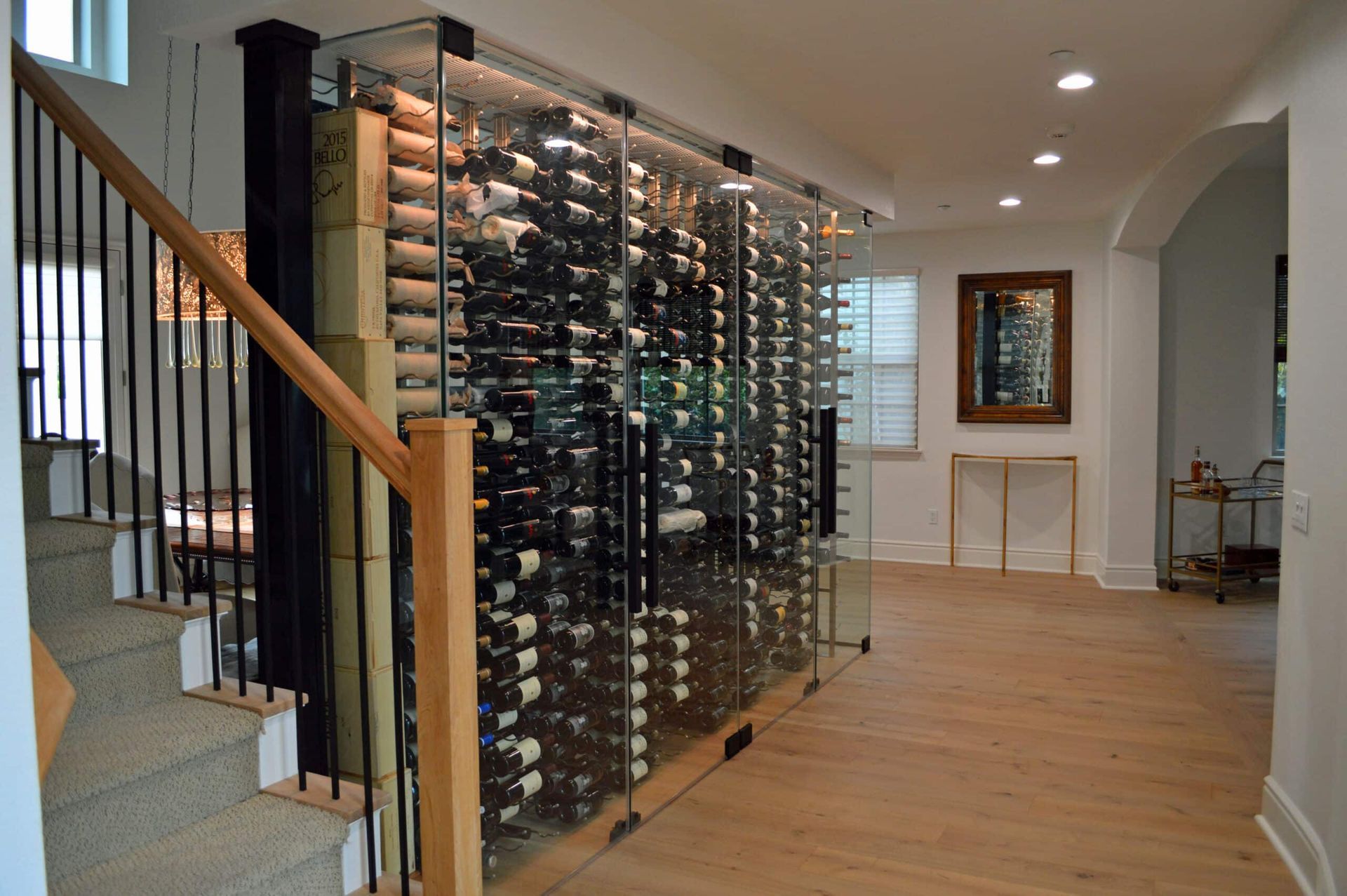
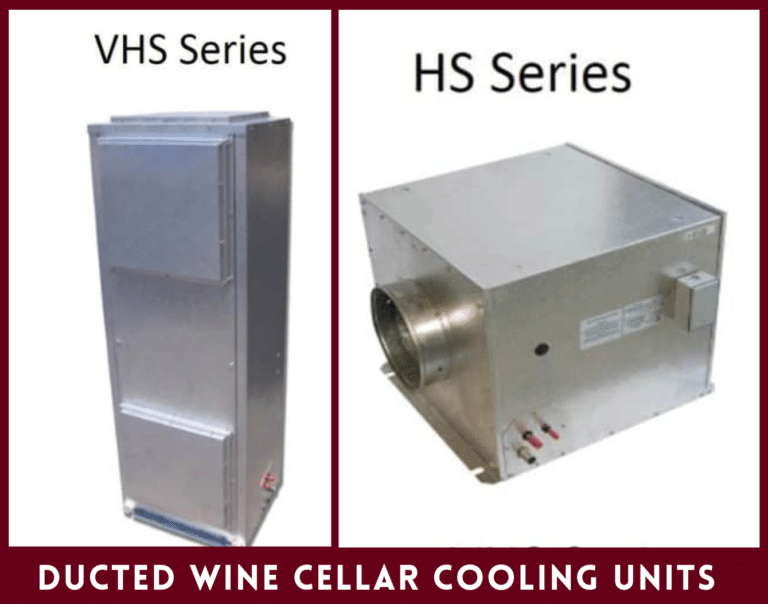
Some cellars are designed so carefully that even a hidden cooling unit is one element too many. When you want absolutely no equipment and no noise inside the room, the High Static (HS) Series is the answer. It is a powerful, fully ducted unit that installs well away from the cellar and sends chilled air in through ductwork, so the room stays silent and every inch of space goes to wine. Below we cover how far it can reach, the full model lineup, how to size it, and the projects it suits best.
Quick answer
The HS (High Static) Series is a powerful ducted split-system wine cellar cooling unit whose evaporator installs remotely, up to 25 feet from the room, with chilled air ducted in and out. It cools from about 1,800 to 22,000 BTU per hour and leaves zero noise and zero equipment footprint inside the cellar, which makes it ideal for larger and commercial rooms.
Silent cooling, completely out of the room
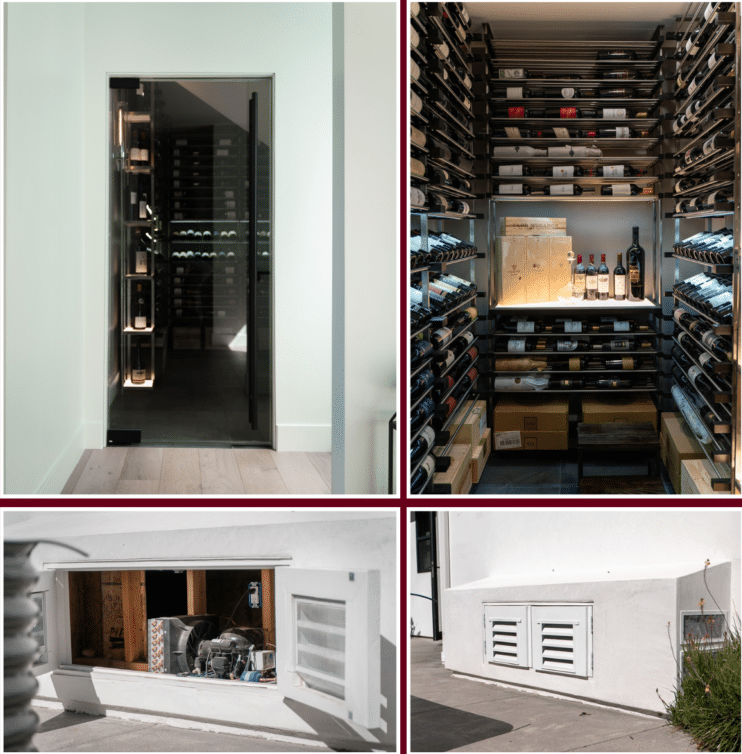
The HS evaporator is powerful enough to install as far as 25 feet from the cellar, in a garage, mechanical room, or utility space. Chilled air is then ducted to and from the room. Because the evaporator never sits inside the cellar, there is no in-room noise and no hardware taking up wall or ceiling space, which frees the entire room for storage and display. It is the most hands-off cooling experience of the lineup from inside the cellar itself.
How the HS works as a ducted split system
Like every US Cellar Systems unit, the HS is a split system, with the condensing unit separated from the evaporator and joined by copper refrigerant lines. The evaporator sits remotely and ducts conditioned air to and from the room. The split design brings real advantages:
- The compressor, its heat, and its noise stay out of the cellar and your living space.
- The condenser can sit up to 50 feet away, indoors or outdoors, with no temperature-differential limits.
- The system can be serviced in place by most HVAC technicians, and replacement parts are available locally.
- A remote air-temperature-probe thermostat reacts faster to real conditions than the liquid-measuring thermostats in self-contained units.
By contrast, self-contained, through-the-wall units cost less up front but run noisier, cannot be set cold enough to serve whites or champagne at temperature, and have to be removed and shipped back to the factory for repairs.
Energy-efficient EC motors drive the airflow and meet or exceed California standards, and the HS is field-adjustable to R134a, R404A, R410A, or R22. A standard automatic expansion valve maintains the balanced humidity
wine needs, a pump-down solenoid valve protects the compressor, and the unit is factory-wired and ETL certified.
Where the HS fits best
The HS is built for larger residential cellars, commercial wine rooms
and restaurant cellars, and for any project where a mechanical-room install and total in-room silence are priorities. Typical scenarios include:
- A showpiece cellar where the owner wants absolutely no equipment visible or audible inside the room.
- A large or commercial room whose cooling load is beyond what an in-room unit can carry.
- A build with a nearby garage, utility room, or mechanical space to house the evaporator.
- A restaurant or hospitality cellar where quiet operation during service matters.
Ductwork and reach
The HS can be mounted up to 25 feet from the cellar, and its air handlers are designed for up to 50 feet of total supply and return duct run at one inch of static pressure. Keeping duct runs and refrigerant line sets within spec is important to performance, which is part of what we plan during design.
Capacity and model lineup
The HS-EC line is the highest-capacity series in this group, rated from about 1,800 to 22,000 BTU per hour. The full model lineup, with airflow, dimensions, duct size, and shipping weight, is below.
| Model |
Airflow (CFM) |
Dimensions (L × W × H, in.) |
Duct (in.) |
Ship wt. |
| HS-EC 25 |
220 |
30 × 17¼ × 18¼ |
8 |
60 lb |
| HS-EC 31 |
380 |
30⅛ × 18¾ × 25⅜ |
10 |
105 lb |
| HS-EC 47 |
490 |
31¼ × 22¾ × 23⅜ |
10 |
120 lb |
| HS-EC 66 |
750 |
31¼ × 23 × 23½ |
10 |
125 lb |
| HS-EC 87 |
810 |
36⅛ × 25⅛ × 25⅛ |
10 |
135 lb |
| HS-EC 120 |
1,400 |
43⅝ × 30⅛ × 30⅛ |
12 |
150 lb |
| HS-EC 180 |
2,000 |
55⅝ × 31 × 32⅜ |
14 |
165 lb |
Features and options
The HS is engineered for powerful, reliable, fully remote cooling:
- Remote-mounted, so it adds no noise or footprint inside the cellar
- Easily accessible filter case for simple servicing
- Energy-efficient EC motors that meet or exceed California standards
- Automatic expansion valve and pump-down solenoid valve as standard, factory-wired and ETL certified
It can be specified for demanding installs:
- Secondary drain pan
for elevated or sensitive installations
- Stainless steel cabinet
for high-corrosion environments
- Water-cooled condensing unit
for quiet, consistent operation where a water source is available
- Industrial applications
and flat-black powder-coated finishes available
Getting the size right
Cooling units are often matched to a cellar by cubic feet, but that only tells part of the story. The real cooling load depends on several things a volume estimate ignores:
- Glass.
Windows and glass doors add significant heat gain. Single-pane glass should be avoided, since a small seal leak can fog the glass and stain the surrounding wood.
- Insulation.
R-value, whether the room is above or below grade, and the surrounding ambient temperature all shift the requirement. Below-grade rooms often need less equipment.
- Lighting.
Can and halogen fixtures run hot. LED lighting adds so little heat it barely enters the calculation.
- Set point.
Around 55 degrees Fahrenheit is ideal for storage. Cabinets held at serving temperature for whites or champagne need more capacity and faster recovery.
- Thermal mass.
The wine itself adjusts about 75 percent slower than the air, so a cellar loaded with room-temperature bottles takes hours to settle. Turning the thermostat colder will not speed that up, it only stresses the equipment.
- Added features.
Refrigerators, televisions, electronics, and fireplaces all give off heat and need to be accounted for.
Get the size wrong in either direction and there are consequences: an undersized unit runs constantly and drops your humidity, while an oversized one short-cycles, swings the humidity, and can fail early. We size every install from a full heat-load survey
so the system is matched to your actual room.
Air-cooled or water-cooled?
The HS is available with either an air-cooled or a water-cooled condenser, and water-cooled is a common choice on larger commercial installs. Air-cooled is the standard and most common choice for residential cellars. It is affordable and simple to install, though it makes some fan noise and its capacity varies a little with the outdoor temperature. A water-cooled condenser runs quieter and more consistently and is popular in commercial and high-rise settings, where silent operation matters and a water source is available. We recommend the right condenser for your location as part of the design.
Why we recommend the HS Series
For larger rooms and any cellar where silence inside the space is non-negotiable, the HS is our workhorse. We plan the remote location and duct runs, size the unit from a full heat-load survey, and install the split system so powerful, even cooling reaches the room while the equipment stays tucked away in a mechanical space.
If you are planning a large or commercial cellar, or simply want zero equipment in the room, request a quote
and we will design the system around your space.
Frequently asked questions
How far from the cellar can the HS be installed?
Up to 25 feet, with chilled air ducted to and from the room. Total ductwork is designed for up to 50 feet of combined supply and return run at one inch of static pressure.
Will I hear it inside the cellar?
No. The evaporator sits remotely, so there is no compressor or fan noise in the room at all. That total in-room silence is the main reason to choose the HS.
How large a room can it cool?
It is the highest-capacity series in this lineup, from about 1,800 up to 22,000 BTU per hour, which covers large residential and commercial wine rooms. The right size depends on a heat-load survey.
How does the HS compare to the VHS?
Both deliver the same high-static, fully ducted, remote cooling. The HS uses a horizontal cabinet, while the VHS
stands vertically to fit tall, narrow spaces and adds a coated-coil option for coastal installs.
Can I get it air-cooled or water-cooled?
Both. Air-cooled is standard; a water-cooled condensing unit is available where a water source exists and is common in larger commercial installs.
Have the heat load for your room calculated before you buy any cooling unit — the number tells which wine cooling system can hold 55 degrees and safe humidity in your space. Cachet Wine Cellars serves Orange County and Southern California. Call (949) 569-7857.
Call (949) 569-7857