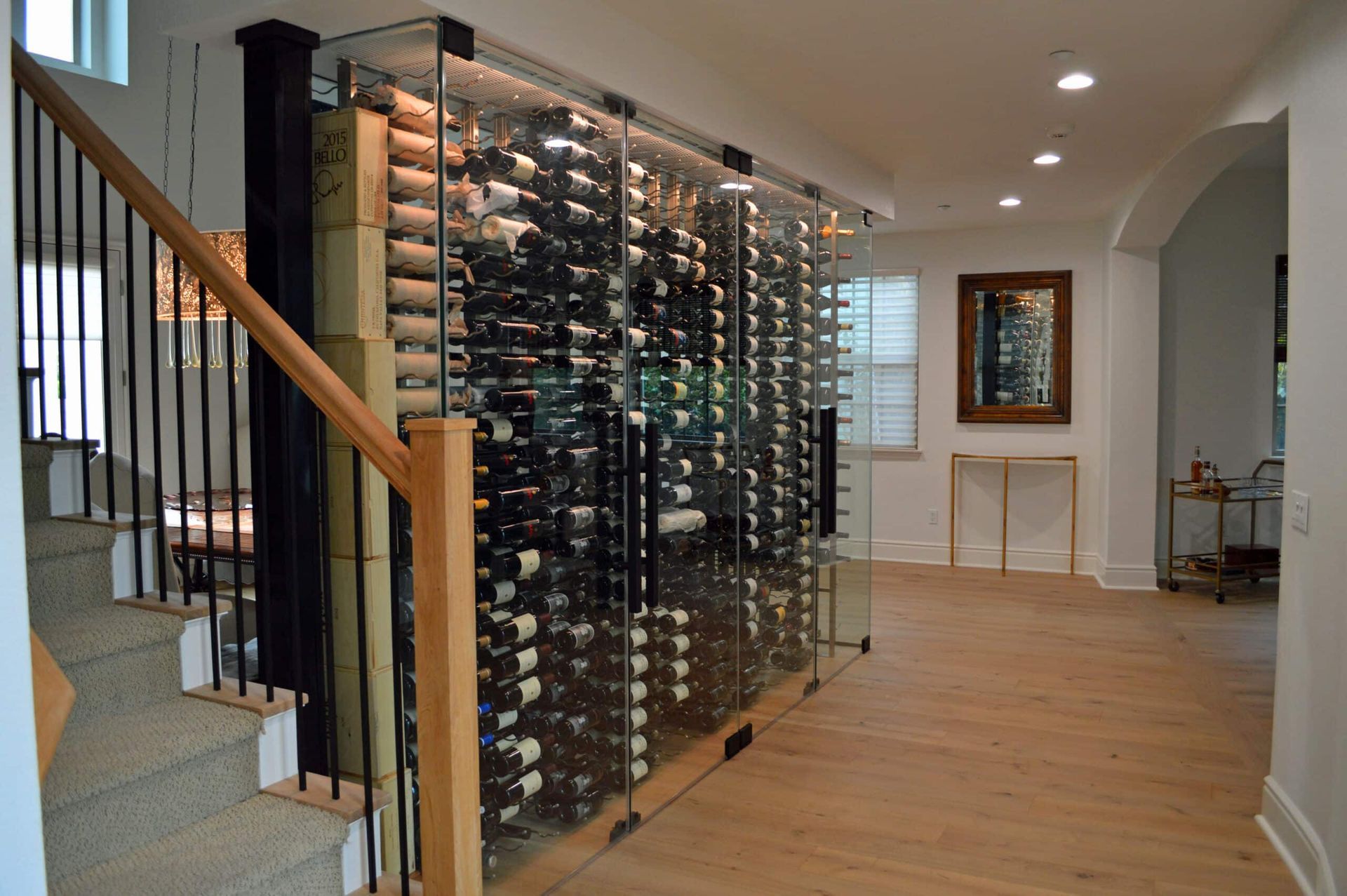
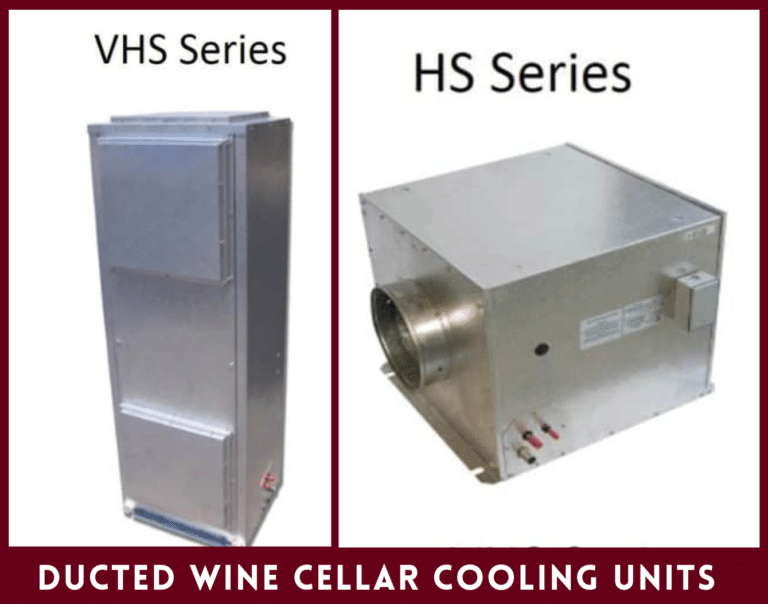
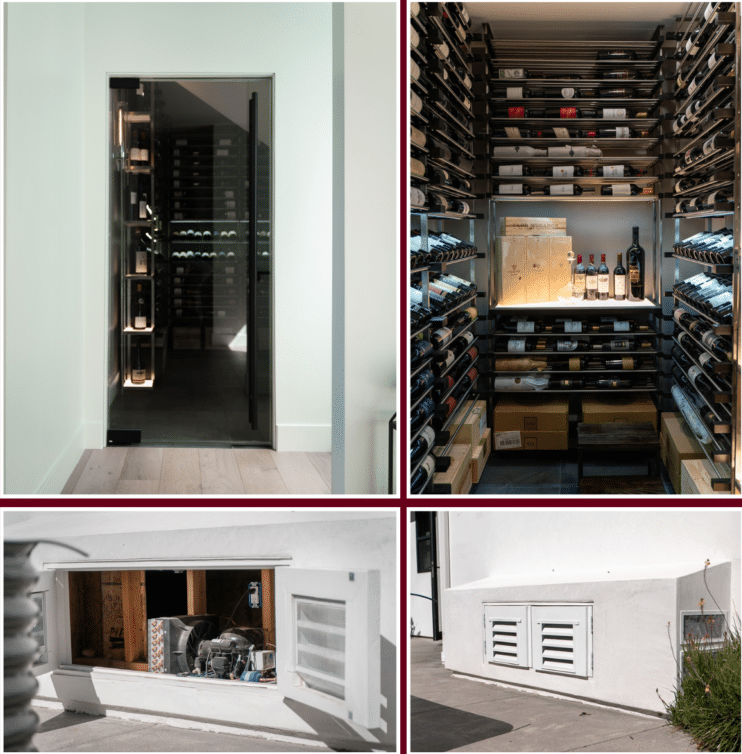
Sometimes the best place for a cooling unit is outside the wine room entirely, with only the cool air ducted in. The catch is space: a normal ducted evaporator needs more head-room than a tight soffit or ceiling cavity can give. The Rack-Mounted Ducted (RMD) Series is built for exactly that constraint. It takes the versatility of the popular RM Series
and moves the equipment out of the cellar in a cabinet slim enough to fit where other ducted units will not. This guide covers how it works, the sizes available, how to size it, and the installs it suits best.
Quick answer
The RMD (Rack-Mounted Ducted) Series is a split-system wine cellar cooling unit with an ultra-low-profile evaporator that mounts outside the room and connects to it through supply and return ducts. It cools cellars and tasting rooms at roughly 1,800 to 7,200 BTU per hour and fits tight ceiling or soffit cavities where a standard ducted unit will not.
An out-of-room unit that fits tight spaces
The RMD evaporator is internally insulated and installs outside the wine room, then connects to the cellar through a supply and return air duct. What sets it apart is its profile. It is slim enough to tuck into shallow soffits and ceiling cavities that cannot take a conventional ducted evaporator, so you keep the equipment, its heat, and any mechanical hum completely out of the room without needing a dedicated closet or a deep chase.
That makes the RMD a problem-solver. On projects where the design calls for ducted, hidden cooling but there simply is not room for a full-size ducted unit, the RMD is often what makes the install possible.
How the RMD works as a ducted split system
Like every US Cellar Systems unit, the RMD is a split system, with the evaporator and the heat-shedding condensing unit joined by copper refrigerant lines. The difference from an in-room unit is that the evaporator lives outside the cellar and moves chilled air in and out through ductwork. The split design brings the same advantages:
- The compressor, its heat, and its noise stay out of the cellar and your living space.
- The condenser can sit up to 50 feet away, indoors or outdoors, with no temperature-differential limits.
- The system can be serviced in place by most HVAC technicians, and replacement parts are available locally.
- A remote air-temperature-probe thermostat reacts faster to real conditions than the liquid-measuring thermostats in self-contained units.
By contrast, self-contained, through-the-wall units cost less up front but run noisier, cannot be set cold enough to serve whites or champagne at temperature, and have to be removed and shipped back to the factory for repairs.
The RMD uses an energy-efficient EC motor and can be field-set to R134a, R404A, R410A, or R22 by a simple valve adjustment, so it adapts to a wide range of installs. A standard automatic expansion valve maintains the balanced humidity
wine needs, a pump-down solenoid valve protects the compressor, and the unit is factory-wired and ETL certified.
Where the RMD fits best
The RMD suits custom cellars
and tasting rooms where the design calls for hidden, out-of-room cooling but space above the ceiling is limited. Typical scenarios include:
- A cellar where the owner wants no equipment inside the room, but the only space for it is a shallow soffit or ceiling cavity.
- A retrofit into an existing home where a full-size ducted unit will not fit the available chase.
- A larger room that needs added capacity, which the RMD can provide by installing multiple units in sequence.
Capacity, configurations, and model lineup
The RMD-EC line is rated from about 1,800 to 7,200 BTUH. Multiple units can be installed in sequence to increase capacity for larger rooms. The models, their airflow, dimensions, and duct sizes are below.
| Model |
Airflow (CFM) |
Dimensions (L × W × H, in.) |
Duct (in.) |
| RMD 25 EC |
220 |
30⅛ × 14 5/16 × 14 |
8 |
| RMD 35 EC |
260 |
36⅛ × 14 5/16 × 14 |
8 |
| RMD 50 EC |
335 |
37⅛ × 14 5/16 × 17 |
10 |
| RMD 65 EC |
420 |
37⅛ × 14 5/16 × 17 |
10 |
Features and options
The RMD is built for quiet, dependable, out-of-sight cooling:
- High-performance staggered coils, copper tubing mechanically expanded into aluminum fins
- Internally insulated, rust-proof aluminum housing
- Energy-efficient, thermally protected EC motor
- Automatic expansion valve and pump-down solenoid valve as standard, factory-wired and ETL certified
It can be tailored to the install with several options:
- Reversible internal assembly
to set the airflow direction the room needs
- Secondary drain pan
for elevated or sensitive installations
- 230V
power
- Sequential installation
of multiple units to increase capacity
Getting the size right
Cooling units are often matched to a cellar by cubic feet, but that only tells part of the story. The real cooling load depends on several things a volume estimate ignores:
- Glass.
Windows and glass doors add significant heat gain. Single-pane glass should be avoided, since a small seal leak can fog the glass and stain the surrounding wood.
- Insulation.
R-value, whether the room is above or below grade, and the surrounding ambient temperature all shift the requirement. Below-grade rooms often need less equipment.
- Lighting.
Can and halogen fixtures run hot. LED lighting adds so little heat it barely enters the calculation.
- Set point.
Around 55 degrees Fahrenheit is ideal for storage. Cabinets held at serving temperature for whites or champagne need more capacity and faster recovery.
- Thermal mass.
The wine itself adjusts about 75 percent slower than the air, so a cellar loaded with room-temperature bottles takes hours to settle. Turning the thermostat colder will not speed that up, it only stresses the equipment.
- Added features.
Refrigerators, televisions, electronics, and fireplaces all give off heat and need to be accounted for.
Get the size wrong in either direction and there are consequences: an undersized unit runs constantly and drops your humidity, while an oversized one short-cycles, swings the humidity, and can fail early. We size every install from a full heat-load survey
so the system is matched to your actual room.
Air-cooled or water-cooled?
The RMD is available with either an air-cooled or a water-cooled condenser. Air-cooled is the standard and most common choice for residential cellars. It is affordable and simple to install, though it makes some fan noise and its capacity varies a little with the outdoor temperature. A water-cooled condenser runs quieter and more consistently and is popular in commercial and high-rise settings, where silent operation matters and a water source is available. We recommend the right condenser for your location as part of the design.
Why we recommend the RMD Series
The RMD is our answer when you want the cooling equipment out of the wine room but the space above the ceiling is shallow. We run the heat-load survey, confirm the ductwork and refrigerant line routing, and place the low-profile evaporator so it disappears into the soffit or ceiling while delivering steady, quiet cooling to the room.
If you are planning a cellar or tasting room and want the equipment hidden outside the space, request a quote
and we will confirm whether the RMD is the right fit.
Frequently asked questions
Where does the RMD unit actually go?
Outside the wine room. The evaporator mounts in an adjacent space, such as a soffit or ceiling cavity, and ducts carry chilled air into the cellar and return air back out, so no equipment sits inside the room.
How is the RMD different from the RM Series?
The RM mounts inside the room, usually hidden in the racking. The RMD is ducted and installs outside the room, and its ultra-low profile fits shallow spaces a standard ducted unit cannot.
What if my ceiling or soffit space is tight?
That is exactly what the RMD is designed for. Its slim cabinet fits cavities that will not take a conventional ducted evaporator, which is often what makes an out-of-room install possible.
Can I add capacity later for a bigger room?
Yes. Multiple RMD units can be installed in sequence to increase capacity, which is useful for larger rooms or phased projects.
Can I get it air-cooled or water-cooled?
Both. Air-cooled is standard; a water-cooled condensing unit is available where a water source exists and runs quieter and more consistently, which is common in commercial installs.
Have the heat load for your room calculated before you buy any cooling unit — the number tells which wine cooling system can hold 55 degrees and safe humidity in your space. Cachet Wine Cellars serves Orange County and Southern California. Call (949) 569-7857.
Call (949) 569-7857