Heavy Wine Cellar Door Seal: What Mass Doesn't Fix
Choosing Between Them for a Specific Run
Once a schedule has been issued to anyone, changing a value quietly is worse than not changing it. A revised schedule carries a new revision number, a new date, and a marker against every row that moved, so a reader holding both versions can tell in seconds which lines are different. Reissuing a corrected sheet with no revision marker leaves two documents in circulation that look interchangeable and are not.
The reissue also has to reach the people working from the old one. A cellar's fixture order, the racking shop drawings, and the electrical rough-in can all be running from the same schedule at the same time, and a Kelvin value corrected on the designer's copy changes nothing until the version carrying that correction lands with whoever placed the order.
Fixture substitutions happen at bid, at order, and occasionally after delivery, and a fully populated schedule is what sets the terms of one in advance. A substitution proposed against a complete row has to hold every value on that row, including the ones a supplier would find inconvenient to match. A fixture matching wattage, beam angle, and trim size while dropping below a stated CRI floor is a different specification, and a populated row makes that visible without an argument about intent.
The burden of showing it sits with whoever proposes the swap. A substitution request arriving as a catalog number and a price, with no line-by-line comparison against the scheduled values, has not been made yet; it has been asked about. Requiring that comparison in writing is what keeps the substitution a decision the specifying professional is still making.
The Sheet Has to Say What It Is
TIP: A schedule reissued after fixtures are ordered should say so on the sheet. A revision that arrives post-order is a change order in practice, and marking it as one keeps the cost conversation attached to the line that caused it.
| What you observe | Points to |
|---|---|
| Present since installation, color consistent, dim points evenly spaced | Spacing and mounting height |
| Boundary lines up with a material seam in the racking, present from day one | Rack depth or finish change |
| Color shifts across a boundary, not just brightness | Mixed LED bins from a partial replacement |
| Whole run dims, flickers, or fades together; appeared after a period of looking fine | Driver channel losing output |
A heavy door reads as quality in a showroom. Buyers push it, feel the resistance, hear the solid clunk of the latch, and conclude the door is well made. That impression is not wrong about the hardware, but it does not describe the seal. A gasket line either closes evenly around the entire perimeter of the leaf, or it doesn't, and the weight of the material has no bearing on which one happens. What decides a seal is geometry and pressure, not mass.
Sealing Is a Perimeter Problem, Not a Mass Problem
A wine cellar door has to hold conditions inside a small, tightly built room, typically 55°F ±2°, with relative humidity between 60 and 70 percent, behind walls insulated to at least R-19 and a ceiling at R-30 or better. The door is the one moving part in that envelope, and it does the sealing work through a gasket line that has to close evenly wherever the leaf meets the frame. On a hinged wood, metal, or framed glass leaf, that line runs four-sided: up one jamb, across the head, down the far jamb, and along the threshold. A frameless glass panel is built differently. Its magnetic gaskets run at the jambs and the head only, and the floor is handled by a recessed seat cut into the slab or by an automatic door bottom carried in the bottom rail. Either way, the line has to compress evenly along its full length, with no gap where the gasket meets the frame or the floor. A gap in even one spot compromises the perimeter, regardless of how tightly the rest of the line closes.
None of that depends on how much the door weighs. A wood leaf that weighs comparatively little and a frameless glass leaf that weighs several times more can each close against their own gasket line with the same result, provided the perimeter meets evenly under similar pressure. What decides the outcome is whether the leaf sits square in its opening and whether the gasket has continuous contact, not what the leaf is made of or how much of it there is. A specification sheet can confirm hardware, finish, and glass thickness in detail and still say nothing about whether a given installation seals, because sealing is a property of fit, not of the parts list.
The Signals Buyers Mistake for a Seal
The instinct to associate weight with quality is not baseless — it is just aimed at the wrong variable. A door that closes with a firm, even resistance and locks into a positive latch position feels solid because the gasket is compressing correctly and the hardware is holding the leaf where it should sit. A door that rattles in its frame feels flimsy for the same reason in reverse: the gasket line is not meeting the frame consistently. Both impressions are real signals. Neither one is a measurement of mass.
TIP: A snug close with no play at the latch and no visible daylight along the gasket line is worth more than the felt heft of the leaf. Check those points on any door under consideration, regardless of material.
A glass or metal leaf with a compression gasket can produce that same firm, positive close at a fraction of the pull needed to swing a heavier wood door, because the mechanism holding the seal shut is doing the work, not the mass of the panel. Weight can mask a sloppy fit for a while. A leaf sitting slightly off-plane may still press hard enough into the gasket to seem tight, but that is a temporary cover that depends on hardware absorbing the difference, not a working seal.
The Hardware and Hinge Cost of a Heavy Leaf
Weight is not free. Every pound in the leaf has to be carried by something, and on a swinging door that load routes through the hinges or pivots and into the frame. A tall frameless glass panel is carried top and bottom by pivot hardware built specifically for the load that panel puts on it, and that hardware is sized for the leaf it is paired with rather than scaled up by intuition. The same principle applies down the weight range: a wood door with added mass from a thicker core or a heavier species needs hinges rated for that specific figure, not whatever hinges happen to be on hand.
WARNING: Hinges and pivots carry a rated leaf weight, and that rating is what to check rather than how the door feels. A leaf hung on hardware below its rating sits out of plane, and the gasket stops meeting the frame evenly.
That margin is thinner on a heavy door than on a light one. A leaf already carrying substantial weight leaves less room between hardware specified correctly and hardware specified approximately, and the difference shows up at a top corner or along one jamb rather than as anything audible from across the room. The check is the specification rather than the symptom: what leaf weight was this hardware rated for, and what does this leaf actually weigh once its core, its glazing, and its finish are counted.
Reading the Gasket Line and the Threshold
The gasket line deserves a closer look than a quick press test. On a hinged wood, metal, or framed glass leaf, that means all four edges with the door closed: the head, both jambs, and the bottom rail. On a frameless panel it means the two jambs, the head, and whatever detail was specified at the floor, since the magnetic strip does not run down there to be checked. A door that closes cleanly across most of its perimeter and opens at one point is not sealing; a continuous line has no partial credit.
The bottom edge is the one that gives out soonest, and mass is no help to it. Every other part of the seal line closes against a frame set and finished at the same time as the door. The bottom closes against a floor, and it absorbs the traffic of every shoe and every case that comes through the opening. Weight does nothing for that edge either, because a leaf's mass presses outward against the jambs and the head rather than downward into the floor. Heft at shoulder height reports nothing about the line at ankle height.

TIP: Which detail closes the bottom edge is worth asking about early. A recessed seat and an automatic door bottom are different specifications with different consequences for the finish floor, and only one of them survives a floor already installed.
That is also why a heavy leaf is a poor proxy for a sealed one. A door that swings with obvious mass can still have a thin or worn seal at the floor, and a lighter door can close at the floor exactly to spec. The two variables move independently of each other, and only one of them is being tested when a buyer leans on a door in a showroom.
Matching Hardware to the Specific Leaf
Hardware choice is where a heavy-feeling door and a well-sealed door diverge in practice. Wood, metal with a thermal break, framed glass, and frameless glass leaves each carry weight differently, sit in their openings differently, and need hinges, pivots, or continuous hinge systems specified for that particular leaf rather than a generic size class. A hinge rated for a mid-weight wood door and pressed into service under a heavier glass panel is under-specified from the day it goes in, and a pivot sized for a frameless leaf is overbuilt and wasted on a lighter wood door.
That leaves a specification to look for rather than a feeling to trust. The hardware schedule should name the leaf it was drawn for: its weight, its material, and whether it swings on hinges or turns on pivots. A schedule that names a size class instead of a leaf is describing a category of door, and the door going into the opening is not a category. It is one leaf, with one weight, hanging on one set of hardware, and the gasket line either meets the frame under that exact combination or it does not.
Frequently Asked Questions About Heavy Wine Cellar Doors
How many open-close cycles is pivot hardware rated for?
More than 500,000. That figure describes the pivot's own service life under repeated operation, and it is published for the hardware rather than inferred from how the door feels on a showroom floor. It is also independent of the seal: a pivot well inside its rating can sit under a door whose gasket line has drifted, and a well-sealed door can sit on pivots nearing the end of theirs.
Does the core of a wooden door change what the hardware has to carry?
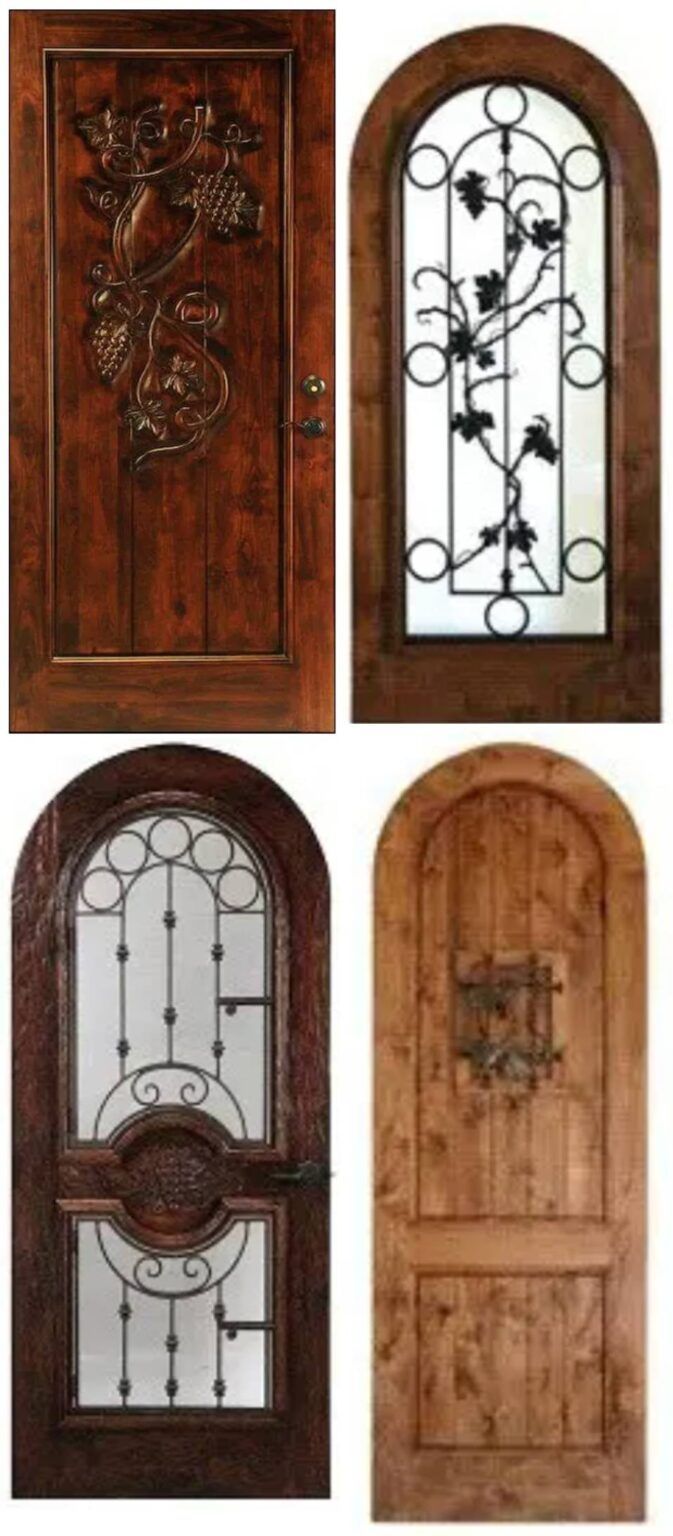
It can change it substantially. One Mission Viejo cellar used a Barolo-style arched wooden door built over an LVL core, an engineered laminated-veneer-lumber center chosen to keep a large arched leaf dimensionally stable. A core like that sets the leaf's real weight, and that figure is what the hinge schedule has to be written against rather than the species named on the finish sample.
Are metal cellar doors built heavier for commercial settings?
Metal doors with a thermal break are built with narrow sightlines for the duty cycles common in restaurants, hotels, casinos, country clubs, wine bars, and aviation clubs, where the door opens far more often than in a home. That frequency, not the door's weight, is what the hardware is specified against.
Do wood species affect how a wooden cellar door seals over time?
Wood doors are offered in species including knotty alder, Spanish cedar, mahogany, redwood, pine, and white oak, and each needs a sealed finish to prevent water absorption. An unsealed or worn finish lets the wood take on moisture at the edges, which can affect how consistently the leaf meets the gasket, regardless of the species chosen.
Does a converted opening handle a heavy leaf differently than a purpose-built one?
Most residential cellars in Southern California are conversions rather than basements: a closet, an under-stair space, a corner of a garage, or a repurposed bedroom. The opening in those rooms was framed for a passage door, so a heavier cellar leaf arrives at a header and jambs that were never sized against it. What the existing framing will carry is measured at the site assessment rather than assumed from how finished the room looks.
Does the lifetime warranty cover hinge or pivot wear on a heavy door?
The lifetime warranty applies to materials and craftsmanship on every installation, which includes the hardware supporting the leaf. That coverage is tied to the installation itself, not to how much the door happens to weigh.
Have the opening and the door assessed together — the site assessment measures the opening and the space around it, and the gasket line, the threshold detail, and the hardware rating all get specified against what it finds. Cachet Wine Cellars designs and builds custom wine cellars from Irvine, California, with a lifetime warranty on every installation. Call (949) 569 7857.