Choosing a wine cellar cooling unit comes down to a few practical questions: do you want the equipment in the room or hidden away, how much space do you have for it, how quiet does it need to be, and what environment is it installed in. We build custom cellars around five proven US Cellar Systems
series, and they are all split systems, which keeps the compressor and its heat out of your living space for quieter, longer-lasting performance. This page gives you the short version of how they compare, with links to the in-depth guide for each series.
Do you need a dedicated cooling unit?
Wine ages best at a steady temperature near 55 degrees Fahrenheit with humidity held in a stable range. A standard home air conditioner cannot do this. It cools in short bursts, dries the air, and switches off overnight, so temperature and humidity swing in exactly the ways that dry out corks, loosen labels, and age wine before its time. A dedicated wine cellar cooling unit is built to hold those steady conditions
continuously, gently, and quietly, which is what protects a collection over the long run.
Quick answer: which series fits
- RM
if you want the most versatile, in-room unit, hidden inside the racking.
- RMD
if you want the unit ducted and out of the room but your ceiling space is tight.
- LPQ
if quiet matters most, especially in a vaulted room.
- HS
if you want zero noise and zero footprint inside a larger or commercial cellar.
- VHS
if you need that same silent, remote cooling in a tall, narrow space or a coastal, corrosion-prone install.
The five series at a glance
| Series |
Placement |
In-room or remote |
Capacity |
Best for |
| RM
|
Horizontal, hidden in racking, soffit or wall |
In-room |
1,800 to 7,200 BTU/hr |
The versatile default, concealed in the racking |
| RMD
|
Ducted, mounted outside the room, ultra-low profile |
Remote (ducted) |
1,800 to 7,200 BTU/hr |
Out-of-room cooling where head-room is tight |
| LPQ
|
Ceiling-mounted, engineered quiet |
In-room |
1,800 to 8,600 BTU/hr |
Vaulted rooms and quiet, long-term storage |
| HS
|
Remote, ducted up to 25 ft away |
Remote (ducted) |
1,800 to 22,000 BTU/hr |
Larger and commercial rooms, zero in-room noise |
| VHS
|
Remote, ducted, vertical cabinet |
Remote (ducted) |
1,800 to 20,000 BTU/hr |
Tight mechanical closets and coastal installs |
A closer look at each series
- RM, Rack-Mounted:
The most versatile and popular choice. A horizontal unit that hides inside the racking, soffit, or wall and cools cellars, tasting rooms, and large cabinets from 1,800 to 7,200 BTU per hour.
- RMD, Rack-Mounted Ducted:
The out-of-room version of the RM. An ultra-low-profile ducted unit that mounts outside the room and fits shallow ceiling or soffit cavities a standard ducted unit cannot.
- LPQ, Low Profile Quiet:
The quiet specialist. A ceiling-mounted unit engineered for near-silent, low-maintenance operation, ideal for vaulted rooms.
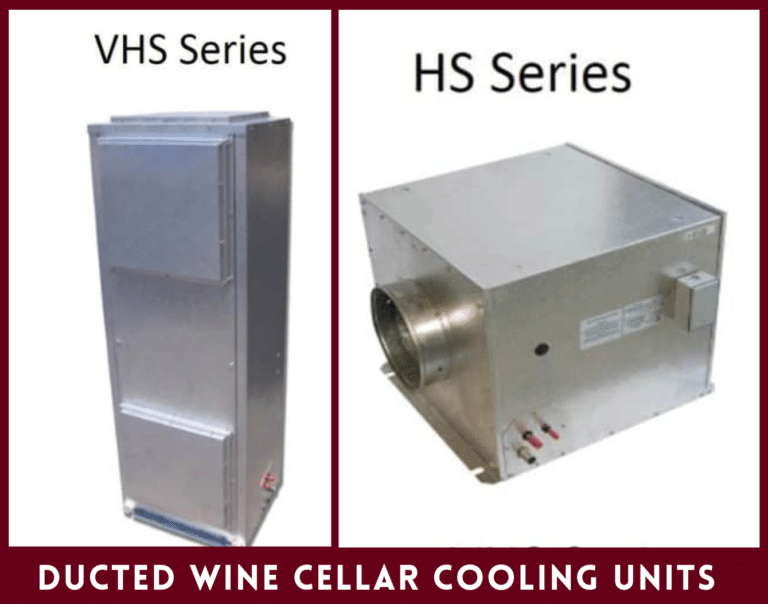
- HS, High Static:
The powerful, fully remote option. Installs up to 25 feet away and ducts air in, leaving zero noise or footprint inside larger and commercial cellars, up to 22,000 BTU per hour.
- VHS, Vertical High Static:
The same silent, remote cooling in a vertical cabinet for tight mechanical closets, with coated coils for coastal installs.
How to choose
Start with in-room or remote.
If you are happy for a cooling unit to live inside the cellar, hidden in the racking or ceiling, the RM
and LPQ
are your in-room options. If you would rather the equipment sit outside the room with only air ducted in, look at the RMD, HS, and VHS.
Then factor in space.
For out-of-room installs, the shape of the available cavity often decides it. The RMD fits shallow ceiling and soffit spaces, while the VHS fits tall, narrow mechanical closets. The HS is the choice when you have a dedicated mechanical area to work with.
Weigh noise and room size.
When quiet is the single biggest priority in an in-room unit, the LPQ is built for it. For the largest rooms, or any cellar where you want no noise and no equipment inside at all, the HS offers the most capacity and a fully silent room.
Account for the environment.
In coastal or corrosive conditions, the VHS and its coated-coil option is the safest long-term bet. Across every series, a water-cooled condenser is available where a water source exists, for quieter and more consistent operation.
Why we only install split systems
Every series here is a split system, which means the evaporator inside the cellar is separate from the condensing unit that sheds heat, joined by copper refrigerant lines. We build this way for good reasons. The compressor, its heat, and its noise stay out of your living space, the condenser can sit up to 50 feet away either indoors or outdoors, the system can be serviced in place by most HVAC technicians, and replacement parts are widely available. Self-contained, through-the-wall units cost less up front, but they run noisier, cannot be set cold enough to serve whites or champagne, and have to be removed and shipped back to the factory for repairs.
Getting the size right
Cooling units are often matched to a cellar by cubic feet, but that only tells part of the story. The real cooling load depends on several things a volume estimate ignores:
- Glass.
Windows and glass doors add significant heat gain. Single-pane glass should be avoided, since a small seal leak can fog the glass and stain the surrounding wood.
- Insulation.
R-value, whether the room is above or below grade, and the surrounding ambient temperature all shift the requirement. Below-grade rooms often need less equipment.
- Lighting.
Can and halogen fixtures run hot. LED lighting adds so little heat it barely enters the calculation.
- Set point.
Around 55 degrees Fahrenheit is ideal for storage. Cabinets held at serving temperature for whites or champagne need more capacity and faster recovery.
- Thermal mass.
The wine itself adjusts about 75 percent slower than the air, so a cellar loaded with room-temperature bottles takes hours to settle. Turning the thermostat colder will not speed that up, it only stresses the equipment.
- Added features.
Refrigerators, televisions, electronics, and fireplaces all give off heat and need to be accounted for.
Get the size wrong in either direction and there are consequences: an undersized unit runs constantly and drops your humidity, while an oversized one short-cycles, swings the humidity, and can fail early. We size every install from a full heat-load survey
so the system is matched to your actual room.
Air-cooled or water-cooled?
Every series is available with an air-cooled or a water-cooled condenser. Air-cooled is the standard and most common choice for residential cellars. It is affordable and simple to install, though it makes some fan noise and its capacity varies a little with the outdoor temperature. A water-cooled condenser runs quieter and more consistently and is popular in commercial and high-rise settings, where silent operation matters and a water source is available. We recommend the right condenser for your location as part of the design.
Frequently asked questions
Which cooling unit is best for a home wine cellar?
For most home cellars the RM is the versatile default, hidden in the racking. If quiet is the priority, the LPQ is purpose-built for it. The right pick depends on your space and a heat-load survey.
Can the unit be hidden or kept out of the room?
Yes. The RM hides inside the racking, while the RMD, HS, and VHS are ducted and install outside the room entirely, so only cool air enters the cellar.
How quiet are these units?
All are split systems, so the compressor sits away from the room. The LPQ is the quietest in-room option, and the ducted HS and VHS leave no noise inside the cellar at all.
Do I need a dedicated unit, or will my home AC work?
You need a dedicated unit. Home air conditioning cannot hold the steady temperature and humidity wine needs, and it dries the air in ways that damage corks and labels over time. You can find more in our wine cellar FAQ.
The surest way to choose is to let the room decide. We run a full heat-load survey, weigh your space, noise, and environment, and recommend the series and size that will hold a steady temperature and balanced humidity for years. Cachet Wine Cellars serves Orange County and Southern California. Call (949) 569-7857.
Call (949) 569-7857